Showing posts with label Senator Scott Brown. Show all posts

Thursday, January 28, 2010

No Exit on Exit Poll Misinformation

On the day of last week's Massachusetts special election for the U.S. Senate seat, I was disappointed to read that there would be no exit polls. The mainstream media that normally organize exit polling had decided against them for this election back when the race looked to be a cakewalk for Massachusetts Attorney General Martha Coakley. When State Senator Scott Brown surged ahead of Coakley in polls during the last one-and-a-half weeks before election day, there was simply not enough time left for the media to organize a reliable exit poll.

A week after the election, I was surprised and intrigued to read an op-ed in the Boston Globe by Democratic media consultant Dan Payne describing the results of an "exit poll" conducted by Hart Research Associates, a Washington, D.C. based survey research firm.

Did somebody actually take an exit poll despite election-day stories to the contrary?

No, as is clear from two organizations which did the polling on election day.

David Drembus, director of operations at Hart Research Associates, confirmed in an email that the firm took a telephone poll on election night of 810 Massachusetts voters. Nothing wrong with that, just that it's not an exit poll; Payne stepped in it by mischaracterizing the poll. (Payne could not be reached for comment.)
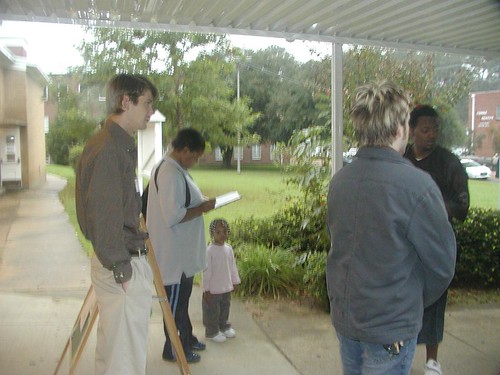
Exit polls are a gold standard for election analysis, because they track the reasons behind actual voters' decisions at the ballot box. They are also difficult to organize, since they require interviewing actual voters [image at right] as they leave representative polling places scattered across the entire election area. As Mike Allen wrote at Politico.com (and was also reported by the Wall Street Journal):
No exit polls from today’s Senate special in Massachusetts, where the polls are open from 7 a.m. to 8 p.m. The consortium scrambled to put something together — for the “why,” more than for the call — but wasn’t confident a reliable system could be built so fast.
Facts like these didn't stop WBZ's curmudgeon political analyst Jon Keller from proclaiming on his blog and Twitter about the "eye-popping exit poll numbers"*** in the election. The problem with Keller's political analysis is that no such exit polling data exists: in Keller's case, he linked to a Rasmussen summary of a telephone poll taken on election day (see bottom of this page). A curmudgeonly comment left on his blog, pointing out that there were no exit polls taken, seems to have gone missing in the message moderation queue... (Keller did not immediately respond to a request for comment.)

Last Friday on the show Beat the Press, Boston Phoenix journalist Adam Reilly and WGBH host Emily Rooney bemoaned the fact that we wouldn't really know why voters voted the way they did because there weren't any exit polls taken:
REILLY: I wish we had exit poll data so we could...

ROONEY [interrupting]: I've been lamenting that.
Sadly, the studio's cameras didn't show the look on the face of suddenly-silent Jon Keller -- seated in-between Reilly and Rooney -- who was presumably either ready to pounce with his "eye-popping exit poll numbers" or dropping his jaw that his colleagues could be so clueless as to think there weren't any exit polls. Or maybe, just maybe, he kept his mouth shut so that he would not step in it again.

That Keller so readily accepted the outcome of his Rasmussen "exit poll," in any case, is a reflection of his sagging political analysis of Massachusetts politics. He should easily have recognized that Rasmussen's polling results were not representative of Massachusetts voters:
Our polling shows that 53% of voters in Massachusetts are Democrats, 21% Republican and 26% not affiliated with either party.
These numbers agree with neither the voter registration in Massachusetts, which have 51% of the electorate unenrolled, nor the 2008 presidential election exit polling data, which have 43% of actual voters identifying as unenrolled. Those poll internals are red flags that were picked up by Nate Silver of FiveThirtyEight.com, who is currently the best independent poll analyst on the national scene; Keller should have immediately seen the poll problems, too.

Let's hope that the media don't sell short the next election and put together a set of reliable exit polls. Otherwise we are likely to see another round of misrepresentations of the nature and reliability of the polling data come November.


*** Update 1: Keller has, as of 1/29/09, now corrected the text on his blog entry to read "these election-day poll numbers."

Update 2: It looks like WGBH's Beat the Press will be tackling the issue of no exit polls in this week's broadcast -- without Keller.

Monday, January 25, 2010

Blame Game Over U.S. Senate Race -- and Flip-Flop of the Year Award

The Democratic Party and its supporters wasted no time to start passing the blame over the loss their candidate, Massachusetts Attorney General Martha Coakley, in the U.S. Senate special election last Tuesday to State Senator Scott Brown.

Political reporter Bob Katzen writes in his Beacon Hill Roll Call column about how the blame could be passed all the way back to 2004 -- when the state legislature passed a law changing the way a new senator is chosen. At the time, Senator John Kerry was the Democratic nominee for president; if he would have won that race, the law up until 2004 gave the governor the power to appoint his successor in the senate.

And the governor at that time was none other than Mitt Romney, a Republican.

If the 2004 bill had never been passed, then Senator Paul Kirk, temporary appointee of Governor Deval Patrick, would continue in his post until after the November 2012 election for the seat.

While the 2004 bill passed the legislature overwhelmingly, finger-wagger Jon Keller singles out Milton State Sen. Brian Joyce and Mattapoisett Rep. William Straus for their roles behind the bill.

Locally, we can ask: How did our Allston-Brighton representatives vote on the 2004 bill to change the way a senate vacancy is filled from an appointment to a special election? A "yes" vote was in favor of a special election instead of a gubernatorial appointment.

Rep. Kevin Honan - Yes
Rep. Michael Moran - Was not yet elected
former Sen. Anthony Galluccio - Was not yet elected
Sen. Steven Tolman - Yes

Note that Rep. Moran played a more recent role in September 2009 in chairing the legislature's committee on elections that reformed the 2004 law in order to provide for a temporary gubernatorial appointment pending the outcome of the special election.

Honan, Moran, Galluccio, and Tolman all voted for the September 2009 bill.

Reps. Honan and Moran both voted against a similar bill in 2006 that would have granted the same temporary appointment powers to the governor. They both win the "Flip-Flop of the Year" award for Allston-Brighton.

Wednesday, January 20, 2010

Brighton Resident Imagines Fallout From Senate Election


Brighton resident, businessman, Jay Severin-watcher, and sometimes playwright David Schrag decided to imagine what Adolph Hitler President Barack Obama would've thought when he realized that Republican State Senator Scott Brown defeated Massachusetts Attorney General Martha Coakley in the special election for the U.S. Senate seat.

Schrag unfortunately got scooped by Dennis DiClaudio, whose own version of the same concept made it onto Comedy Central's website.

Warning for both: put down your coffee before watching, otherwise serious spraying may result.

Tuesday, January 19, 2010

Lessons From the U.S. Senate Special Election

Now that State Senator Scott Brown has defeated Massachusetts Attorney General Martha Coakley in the special election for the U.S. Senate seat by a margin of around six percentage points, it's time for me to join the chorus of armchair politicos to draw lessons learned from the election.

Base Elections are the Exception, Not the Rule. Politicos like to point to Karl Rove's electorate base strategy in 2004 as the model for an effective presidential campaign, but that strategy worked well because so many states had anti-gay marriage constitutional amendments on their ballots that year. President George W. Bush won running towards the middle in 2000; Senator John McCain lost running towards the right in 2008; while now-President Barack Obama in 2008 had a platform full of progressive policies, in many ways he won in the middle (52-44% of moderates) using conciliatory language and vows of bipartisanship.

If you look at the mailings and phone calls in this campaign, it is plainly obvious that Coakley was contacting pretty much only Democratic voters while Brown was going for unenrolled (independent) voters. It is absolutely amazing how stark the difference was. Coakley seemed to make no attempt to contact unenrolled voters -- who make up more than 50% of registered voters -- while Brown did so repeatedly. Polls in the week before the election showed Brown winning unenrolled voters by 2:1 or 3:1 margins.

The 2004 presidential election was an outlier. Independent voters continue to be where close elections are won or lost -- even in liberal Massachusetts.

The Third Maxim of Politics.
The first maxim of politics is that All Politics Are Local. The second maxim is that You Have to Ask People For Their Vote.

Now we have learned the third maxim: You Have to Shake People's Hands. Not hide away in your campaign office or substitute meetings with members of town school committees -- even though they are elected officials. Shake people's hands; don't ever say that it isn't important to do so. And then shake some more hands.

Massachusetts Corollary #1: Sox with an "x," tot "cks". Not only shake people's hands, but don't make fun of people who shake voters' hands outside Fenway Park -- or mock Red Sox legends like Curt Schilling. That'll kill you with the crowd that is looking for any reason to say that you're Out Of Touch.

Establishment Candidacies Are Bad News In This Political Climate. Coakley ran a campaign that was amazingly similar to then-Senator Hillary Clinton's presidential campaign in 2007-8: the establishment candidate whose election is inevitable. Until that inevitability hits a big pothole, that is. Even though Clinton wrapped up lots of Democratic superdelegates early in the primary and caucus season, then-Senator Barack Obama eventually caught up with her on that score; meanwhile, Obama had churned out substantially more elected delegates.

You don't need to lock up the support of every single member of a school committee, board of selectmen, water district board, union organizing committee, or ward committee. There are far more voters out there than there are selectmen. Meet some ordinary voters, shake their hands, and ask them for their vote.

Don't Make Easy Assumptions: They Can Be Wrong. People assumed Coakley, as the woman in the race, had the women's vote wrapped up. But at least one poll in the past week broke down the numbers and showed she was surprisingly weak among women voters. I wouldn't be surprised if that were true back in the December 2009 primary, too. Do the Capuano, Khazei, or Pagliuca campaigns have polling to share on this point?

Coakley's Future In Doubt. Coakley's amateurish campaign immediately makes her appear vulnerable this fall -- from either a Republican or a Democratic challenger. Coakley is now perceived as such a weakened candidate for state-wide office that a challenger is inevitable.

I will venture a bit close to the precipice and make a bolder prediction: Democratic Party leaders in Massachusetts will quietly pull Coakley aside and suggest that she not run again for attorney general. Those leaders talking to Coakley will not be the leadership in the state legislature, however, since they are all scared to death that Secretary of the Commonwealth William Galvin will run for Attorney General -- and get subpoena power. They would rather see a no-name Republican as attorney general than Galvin.

I predict that Galvin moves forward with a run for the seat and scares Coakley into not running for re-election -- just like 2002 when Mitt Romney drove then-Acting Governor Jane Swift out of the race for governor.