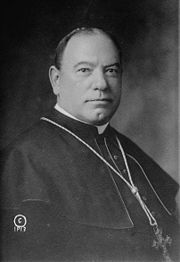
 The latest issue of Boston Magazine carries a story ("Over His Dead Body") about Boston College's recent institutional expansion -- and the bodies that might be buried underneath. Reading the story is worth it just for the amusing artwork showing a cutaway of William Cardinal O'Connell's grave with his skeletal hand reaching up out of the ground. Melrose Place, anyone?
The hook for the story is the supposed problems that BC might have with Cardinal O'Connell's buried remains in their massive expansion plan into 65 acres of former St. John's Seminary land that they purchased in 2004-7, which was previously reported in the Boston Globe.
Yet in neither BC's 10-year proposed institutional master plan nor their 20-50 year long-range plan do they show any plans for construction at the site of Cardinal O'Connell's mausoleum; moving his remains is not really necessary for the other plans to go forward. Why BC officials insist on moving the remains is another issue, and is bound to stir up animosity from its Catholic constituency who look fondly upon the Cardinal.
Other graves on the site, however, may pose a more immediate problem, as was first reported here at Brighton Centered based on a letter written by the Massachusetts Historical Commission to the Boston Redevelopment Authority. A number of Sulpician priests were buried on the site and subsequently disinterred for reburial in Maryland, but the records of the disinterment are apparently either too vague or missing altogether.
Result: there might be unmarked graves somewhere on the site, but you don't know exactly where, so the Massachusetts Unmarked Burial Law may apply and therefore require an intensive search for the remains. That's a far worse problem than the remains of Cardinal O'Connell's at a location not currently slated for development.
Writer Paul McMorrow spells out the steps from graveyard to courthouse:
The college will likely try to tap some form of public funds in its quest to build out the chancery grounds, and if it does, that will give the historical commission a) statutory oversight, and b) standing in court. This means [Secretary of the Commonwealth William] Galvin can reserve the right to sue BC.I'm not sure if there is a legal distinction between using public funds for purchasing the property and developing it, but BC has already tapped state support in the form of tax-exempt bonds issued last year by MassDevelopment, the state's finance and development authority, to the tune of $177 million for the express purpose of purchasing 18 acres of the former St. John's Seminary land. And I would also be surprised if there would be any problem getting standing when the Massachusetts Unmarked Burial Law applies to possible graves of the Sulpician priests. But those are questions for the lawyers and the courts, which just supports McMorrow's thesis that the graves constitute one way that opponents of BC's expansion could tie up their plans in court for quite some time.
The Boston Magazine story spins a good yarn, although the references to graves, and most of the other content, is not new. BC officials wouldn't speak to McMorrow on the record, and "one prominent alum" would only talk anonymously and on the condition that he be considered not to speak on behalf of the university. (I'd place a bet at Deval Patrick's Suffolk Downs Casino that he's talking about a well-to-do member of BC's Board of Trustees, but I could be wrong.)
Trying to Convert Beer Can Hill Into BC Flatland
There is some new content, however, in the continuation of the story about BC's longstanding attempts to purchase "Beer Can Hill," a four acre plot of state-owned land adjacent to Edmonds Hall:
According to a source close to the talks between Boston College and the MWRA, the school has said it wants to level the hill and use it for nothing more than soccer fields. A bit cavalier, considering that if Beer Can Hill collapsed, some 2 million people would lose water for days, if not weeks, says one MWRA [Massachusetts Water Resources Authority] source.I would be surprised if anyone in the neighborhood believes that BC only wants to build soccer fields there; one BC student even reported after a 2006 planning session with Sasaki that BC wanted to build dorms on the site. In 2005 BC was unsuccessful in their attempts to gain ownership of the parcel in exchange for a promise to maintain the Chestnut Hill Reservoir. McMorrow continues:
McMorrow seems to have missed the point about why Brennan filled out paperwork registering as a lobbyist for BC. The answer would've helped tie together his story... but, alas, that tale is best left for another day. McMorrow continues:BC knew that it would face opposition to its plans, so it hired an engineering team that told the MWRA's engineers, "We could do it safely." When the agency's board disagreed, the college brought in some political muscle: Jack Brennan, a lobbyist, former state senator, and close ally of ex–Senate President (and BC alum) William Bulger. Brennan's 2007 filings with the state show him performing work on BC's master plan and other unspecified "property issues."
But those efforts notwithstanding, his firm's lobbying of the MWRA board on BC's behalf—"It was some heavy stuff," the MWRA source says—didn't work. Last November, the board passed a resolution condemning the proposed plans, citing the potentially dire consequences of any damage to the water lines.The MWRA's Advisory Board's minutes for the November 2007 meeting spell out concerns not narrowly concerned with Beer Can Hill, but with their general development plans in and around "Shaft 7", which supplies 2/3 of the drinking water for 2.1 million people in the Boston area:Still, no one thinks that setback will really stop BC. Asked whether the college is still interested in buying Beer Can Hill, Moran replies, "I haven't asked, but I don't have to ask that question to get an answer. They were interested in it 30 years ago, and they'll still want it 30 years in the future."
Whereas, there is currently inadequate redundancy for Shaft 7; andBowles is not just the chairman of the MWRA's Advisory Board; he's also Governor Deval Patrick's Secretary of the Executive Office Of Energy and Environmental Affairs.
Whereas, any failure of Shaft 7 would have catastrophic consequences;
Therefore, be it resolved that on this 14th day of November, 2007, the MWRA Board of Directors, reaffirms its prior opposition to proposals by Boston College to develop a portion of MWRA-controlled property in and around the vicinity of Shaft 7 at Chestnut Hill unless and until redundancy is first constructed and fully operable...
Chairman [Ian] Bowles stated that he visited the site of Shaft 7. He noted that he felt less comfortable with Boston College’s proposal after the visit.
That is a damning development: that the state Secretary of Energy and Environmental Affairs is increasingly concerned the more he learns about BC's development proposals near that water main.



