Showing posts with label state legislature. Show all posts

Thursday, April 22, 2010

Do Library Supporters Have the Right Target in Their Sights?

The Trustees of the Boston Public Library voted earlier this month to close four of the 26 branch public libraries in the city, including the Faneuil Branch Library in Brighton's Oak Square.

Library supporters are outraged and looking to reverse that decision -- whether through additional state funding, with an attached rider that would require all the branches to remain open, or additional city funding.

Those who want the branches to remain open have top two targets for their criticism: BPL President Amy Ryan, who drew up the closing plan, and Boston Mayor Thomas Menino, who voiced his strong support for it.

Are they targeting the right people?

The answer to this question lies first in figuring out why BPL is in a funding crunch.

Menino spokesperson Dot Joyce noted that the city this year "level-funded libraries."

Budget documents on the BPL website show that the City of Boston has decreased its payments much less: from $31.2 million in FY09 to $29.7 million in FY10 and $29.4 million in FY11. That's a decrease of $1.8 million over two years, or a cut of 6%. (Note that Joyce is not quite correct in saying that the city has "level-funded libraries.")

Now let's look at the state funding side of the BPL budget.

Brighton state Representative Michael Moran is especially outraged at Menino and has co-sponsored a bill in the state House of Representatives that would restore some state funding.

Note that verb: "restore."

In the same time period that the city has cut its funding to BPL by a little bit, the state has cut heavily its own contribution to BPL: from $8.9 million in FY09 to $4.0 million in FY10 and $2.4 million in FY11. That's a decrease of $6.5 million over two years, or a cut of 73% in state funding for BPL.

The funding shortfall in BPL's budget can nearly all be traced to a decline in state funding, not a decline in city funding.

Should Brighton protesters target Mayor Menino to tell him to restore funding for the libraries to keep the Faneuil Branch Library open? That strategy appears misguided, since it is not the city that has drastically cut their funding for the libraries.

Instead, Brighton residents might find their outrage better directed at members of the state legislature who voted to decrease state spending on BPL by 73% over the past two years.

Since state representatives Moran and Kevin Honan both voted for the budget bill that included decreased funding for BPL in the FY10, shouldn't the outraged residents of Brighton be holding them accountable? (Senator Steven Tolman probably also voted for the same cuts, but I can't find a roll call vote from 6/19/09.)

Shouldn't the the outraged citizens of Brighton be demanding that Reps. Moran and Honan and Sen. Tolman restore the state's funding to BPL from $2.4 million to the FY09 level of $8.9 million?

Methinks the public's anger towards Menino is misplaced on this issue since it is the state legislature who created BPL's funding sinkhole.

And members of the public who are angry at the possible closing of the Faneuil Branch Library should hold Moran, Honan, and Tolman responsible for their June 19, 2009 votes on the FY10 budget.

Thursday, April 15, 2010

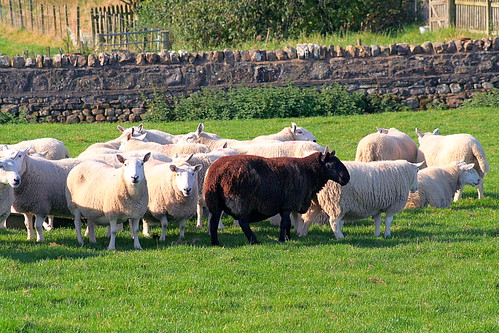
Sheep in the State House

I woke up to the news that seemed in the tank all week: the state House of Representatives voted, overwhelmingly, in favor of legalizing casino gambling and installing slot machines at the state's race tracks.

This follows a completely opposite vote in the same legislative body a couple of years ago, when the same legislative body was against legalizing gambling.

What changed?

The legislators are still using the same "studies" written by the casino industry and its lobbyists, not independent analysis. In fact, this time around they asked only for a "benefits" study, not a "cost-benefits" analysis. Good lord. At least figure out what it is you're getting into before you vote for it.

The legislators are using the same arguments that casinos would create lots of new jobs -- vastly inflated numbers that don't make sense, and are made with the crazy methodology that is "standard" among all kinds of developers (where one hour of subcontracted work qualifies as an entire "job," rather than expressed in FTEs). The unemployment rate might be higher today than it was a couple of years ago, but I predict that the unemployment rate will have dropped significantly by the time that the first shovel goes in the ground.

The legislators are faced with the same arguments that gambling destroys people's lives, such as the nine-year-old boy who had to watch loan sharks repeatedly slam a meat cleaver in-between his father's fingers.

It's the same arguments. In fact, it's virtually all the same representatives voting again, since most of their seats aren't challenged.

What changed?

The speaker of the house, that's who. State Representative Robert DeLeo, whose father we learned this week used to work in the gambling industry at the race tracks, is now the speaker, having replaced disgraced former speaker and former State Representative Salvatore DiMasi.

The old leadership told the representatives a couple of years ago to vote against legalizing gambling, and they did it. The new leadership told the representatives this week to vote for legalizing gambling, and they did it.

A large number of the members of the state house of representatives appear to have no principles behind their voting records; they are just following their speaker like a flock of sheep.

Their benefits for cowing behind DeLeo? Continued leadership positions in the house and the extra pay that comes with it.

Since these legislators appear to operate under no principle other than following their leader, then what does this mean about their votes a few years back to kill efforts to ban gay marriage? Were those votes not based on principle? Will they gladly reverse their votes when a new speaker takes over who wants to get rid of gay marriage?

Gay marriage advocates watch out.

Do I sound cynical? Angry?

Maybe. It's because I learned that our state's representatives ain't got no... you know.


In Allston-Brighton, Representative Michael Moran and Kevin Honan both voted yes in favor of the casino bill. Both voted against the casino bill in 2008.

Image of sheep:

Wednesday, February 24, 2010

Reps. Moran and Honan Nearly Always Vote With House Speaker DeLeo

State Representative Michael Moran [right] has voted identically with House Speaker Robert DeLeo on all 214 roll call votes since DeLeo became speaker, according to an analysis by David Bernstein at the Boston Phoenix. State Representative Kevin Honan has only voted differently from DeLeo once.

The pattern of voting in virtual lock-step with house leadership is not a new phenomenon, although the trend has abated somewhat in comparison with the previous house speaker:
"The Phoenix, in a review of roll-call votes since DeLeo became Speaker, has found an easing of the lock-step voting habits seen by Democrats under DiMasi. Overall, House Democrats have been twice as likely to vote against DeLeo and his leadership team as they were under DiMasi."

Tuesday, January 19, 2010

Lessons From the U.S. Senate Special Election

Now that State Senator Scott Brown has defeated Massachusetts Attorney General Martha Coakley in the special election for the U.S. Senate seat by a margin of around six percentage points, it's time for me to join the chorus of armchair politicos to draw lessons learned from the election.

Base Elections are the Exception, Not the Rule. Politicos like to point to Karl Rove's electorate base strategy in 2004 as the model for an effective presidential campaign, but that strategy worked well because so many states had anti-gay marriage constitutional amendments on their ballots that year. President George W. Bush won running towards the middle in 2000; Senator John McCain lost running towards the right in 2008; while now-President Barack Obama in 2008 had a platform full of progressive policies, in many ways he won in the middle (52-44% of moderates) using conciliatory language and vows of bipartisanship.

If you look at the mailings and phone calls in this campaign, it is plainly obvious that Coakley was contacting pretty much only Democratic voters while Brown was going for unenrolled (independent) voters. It is absolutely amazing how stark the difference was. Coakley seemed to make no attempt to contact unenrolled voters -- who make up more than 50% of registered voters -- while Brown did so repeatedly. Polls in the week before the election showed Brown winning unenrolled voters by 2:1 or 3:1 margins.

The 2004 presidential election was an outlier. Independent voters continue to be where close elections are won or lost -- even in liberal Massachusetts.

The Third Maxim of Politics.
The first maxim of politics is that All Politics Are Local. The second maxim is that You Have to Ask People For Their Vote.

Now we have learned the third maxim: You Have to Shake People's Hands. Not hide away in your campaign office or substitute meetings with members of town school committees -- even though they are elected officials. Shake people's hands; don't ever say that it isn't important to do so. And then shake some more hands.

Massachusetts Corollary #1: Sox with an "x," tot "cks". Not only shake people's hands, but don't make fun of people who shake voters' hands outside Fenway Park -- or mock Red Sox legends like Curt Schilling. That'll kill you with the crowd that is looking for any reason to say that you're Out Of Touch.

Establishment Candidacies Are Bad News In This Political Climate. Coakley ran a campaign that was amazingly similar to then-Senator Hillary Clinton's presidential campaign in 2007-8: the establishment candidate whose election is inevitable. Until that inevitability hits a big pothole, that is. Even though Clinton wrapped up lots of Democratic superdelegates early in the primary and caucus season, then-Senator Barack Obama eventually caught up with her on that score; meanwhile, Obama had churned out substantially more elected delegates.

You don't need to lock up the support of every single member of a school committee, board of selectmen, water district board, union organizing committee, or ward committee. There are far more voters out there than there are selectmen. Meet some ordinary voters, shake their hands, and ask them for their vote.

Don't Make Easy Assumptions: They Can Be Wrong. People assumed Coakley, as the woman in the race, had the women's vote wrapped up. But at least one poll in the past week broke down the numbers and showed she was surprisingly weak among women voters. I wouldn't be surprised if that were true back in the December 2009 primary, too. Do the Capuano, Khazei, or Pagliuca campaigns have polling to share on this point?

Coakley's Future In Doubt. Coakley's amateurish campaign immediately makes her appear vulnerable this fall -- from either a Republican or a Democratic challenger. Coakley is now perceived as such a weakened candidate for state-wide office that a challenger is inevitable.

I will venture a bit close to the precipice and make a bolder prediction: Democratic Party leaders in Massachusetts will quietly pull Coakley aside and suggest that she not run again for attorney general. Those leaders talking to Coakley will not be the leadership in the state legislature, however, since they are all scared to death that Secretary of the Commonwealth William Galvin will run for Attorney General -- and get subpoena power. They would rather see a no-name Republican as attorney general than Galvin.

I predict that Galvin moves forward with a run for the seat and scares Coakley into not running for re-election -- just like 2002 when Mitt Romney drove then-Acting Governor Jane Swift out of the race for governor.

Tuesday, July 14, 2009

How To Combine Zoos to Create "Efficiencies"

Governor Deval Patrick declared over the weekend that Zoo New England, the public-private partnership that runs the Franklin Park Zoo in Boston and the Stone Zoo in Stoneham, should explore ways to combine the two zoos as one way to resolve a budget shortfall resorting from Patrick's veto of part of the state funding for the zoos. The Boston Globe editorial page seconded the motion that ZNE at least entertain the idea of combining the two zoos:
Legislators shouldn’t rush to override Patrick’s veto of zoo money unless Zoo New England - which hasn’t responded to media inquiries - answers some basic questions: Why not consolidate the Stone Zoo with the Franklin Park Zoo?...
Combining zoos in order to save money -- create "efficiencies," in bureaucrat-speak -- could be accomplished in a number of novel ways by moving the Stone Zoo animals to existing exhibit space at the Franklin Park Zoo. The key is that new exhibit space cannot be built, otherwise such expensive new construction would not save money.

Here are some ideas for how to combine animal exhibits to save money:

Mexican Gray Wolves. These animals are one of the most popular attractions among the children at Stone Zoo, particularly due to the challenge to find them hiding up top a rocky promontory. Kids go crazy over the challenge of finding them, even if all they can glimpse are a few ears over the tops of some rocks.

At Franklin Park, the wolves could easily be incorporated into the Children's Petting Zoo in a pen alongside the sheep and goats. Just lock the barn doors at night, and let nature do its course. Cost savings: much reduced expenses for feeding not just the sheep and goats, but also the wolves. Bonus: occasionally take a few chickens next door and toss them into the barn before closing it for the night. More savings.

Coyotes. Ditto. Easy answer, similarly good cost savings. Added benefit: watch the wolves and coyotes duke it out, and charge admission to raise even more money.

Bald Eagles. The bald eagles at Stone Zoo could be put to good use in the Tropical Forest Pavilion, even though the climate inside (warm and humid) isn't quite to their liking. Just alternate them between the mandrill and lemur exhibits, both places where the eagles would have a field day catching hordes of mice. Kill two birds with one stone.

Flamingos. There are flamingo exhibits at both zoos, so a bureaucrat could easily look at a piece of paper and determine that putting them all into a single enclosure at Franklin Park would save money. Never mind that the Franklin Park enclosure looks horribly crowded already -- or that it was an (originally) temporary location for them when they were evicted from the bottom of the aviary next door, which itself had to be evacuated of birds a couple of years ago to make way for an installation of a dinosaur exhibit featuring fake animals. No worry. Just cram all those flamingos into that little enclosure and watch the mayhem that ensues. It'll look like Fantasia 2000, I'm sure!

River Otters. These frisky animals have a recently-renovated exhibit at Stone Zoo. They require water for swimming around, so the obvious place for them is the aquarium tank in the Tropical Forest Pavilion. Saves feeding costs for both river otters and fish (see Wolves, above).

Hornbills. There are a number of different birds at Stone Zoo that could be housed, at least in summertime, in the wide open space inside the Butterfly Pavilion netting. There's just a lot of extra, unused airspace waiting for animals to be crammed inside. Further efficiencies: some of the birds eat butterflies.

Lion Exhibit. The male lion's exhibit at Franklin Park -- his female companion died a couple of years ago due to a blood illness -- is full of lots of empty space. He spends pretty much the whole day in a little 10' x 10' area, sunning and sleeping and periodically roaring.

Save money by fencing this 100 square foot space off so that the lion can keep it, but create new, fenced-in cages for other animals with the remaining space. In order to add interest, populate those adjacent cages with animals that will tempt the lion: reindeer, pygmy zebu, markhur goats, yak, zebras, wildebeest, etc. The lion will be clawing at through the fence all day, and the kids will eat it up!

Jaguars, Cougars, Snow Leopard. These animals look sort-of similar to tigers, so you can just put them in with the yellow and white tigers in their recently-built exhibit. Or maybe just rotate the animals daily just to see if anybody notices. What's the difference?

Meerkats. The Stone Zoo has some of these small animals from southern Africa, who like to hang out in tunnels and stand on their haunches above-ground. Franklin Park has prairie dogs from North America that share the same interests. Any old bureaucrat can see that they're bound to become BFF. Just throw 'em all together.

Bonus: maybe they'll cross-breed and we'll get some new kind of mutant that can have its own series on Animal Planet. Licensing rights bring more money to the zoo, so it's gotta work.

Birds-Of-Prey Show. Stone Zoo has a show during the summer where zookeepers fly birds-of-prey around the audience to display their prowess. Turn these animals into a traveling show that sets up shop at a different North Allston corner every hour. You know, North Allston has something of a rodent problem.

Bonus: charge Harvard for the cost of the show, which they can then bill as a community benefit for their stalled Allston science complex. Win-win all-around.


Alternatives If Zoo New England Folds

If Zoo New England shuts down in October due to a budget shortfall, terms of the private-public partnership turn over all the property (including the animals) to the state. How would the state government find space for all the animals, without resorting to euthanizing them? Here's a few ideas:

Bats. The bat exhibit in the "Sierra Madre" area of the Stone Zoo is located behind a darkened cloth entry, so that visitors can see the bats in their nighttime behavior.

These animals are easy to find a home: I hear that the Governor's office has some nice new drapes that could provide the bats with their darkness.

Goats. The U.S. Naval Academy always needs more goats, so ship 'em off to Annapolis.

Snakes. Chairs of the committees at the state legislature would have first dibs in deciding where in the state house to release the snakes.

Kangaroos. These animals have a large pouch on their front, which a perfect hiding place for stashing wads of cash in order to slip through security. House the kangaroos in the Dianne Wilkerson Memorial Office at the state house?

Oh, and whose office would get the mountain gorillas? The stinky porcupines? The two condors?


Image of a Poitou donkey, a new introduction into the Franklin Park Zoo's petting area, from Zoo New England's twitterPic.

Thursday, May 08, 2008

Proposal to Tax University Endowments All Mixed Up

A state proposal to tax university endowments in excess of $1 billion at 2.5% per year appears to be gaining a little bit of steam, according to an article in the Boston Globe this morning.

Critics of the institutions of higher education point to their massive endowments -- especially Harvard University's $34.6 billion -- as out-of-line with their mission and managed in a way that, for all intents and purposes, looks like a for-profit corporation. Harvard's endowment now exceeds the $28 billion annual operating budget of the entire state government.

The proposal to tax the endowment funds greater than $1 billion, however, is particularly odd because for-profit corporation taxation is usually based on income or earnings -- not on the value of the capital itself. Harvard earned nearly 20% return on their endowment investments last year, resulting in a profit of approximately $6 billion; taxing those earnings at the capital gains rate would seem to be a more credible proposal than taxing the endowment itself.

A rule-of-thumb for non-profit endowments is that they ought to be spending roughly 5% of their endowment per year, otherwise they are hoarding money rather than operating in the public interest. A 10% return on their endowment can be considered then as a reasonable way to allow for modest growth of 5% (after the 5% expenditure is removed). Most universities have, in recent years, earned a little bit more than this rate of return.

How about if the state legislature considers a different law: tax earnings in excess of 10% at the capital gains rate of 15% on endowment capital exceeding $1 billion? That would mean that 10% of Harvard's 20% return on $28.7 billion in 2007 would be taxable at a rate of 15%, resulting in a tax payment of $831 million. It would be the non-profit equivalent of a windfall profits tax.

I am not claiming that such a state law would be a good idea, but it would at least make more sense from a tax perspective than the proposal to tax endowment capital itself that was mentioned in the Globe article. The "endowment windfall profits tax" would protect smaller institutions with endowments under $1 billion, and would not tax institutions when they have poor investment returns for the year.


Image by Tracy O provide by a Creative Commons license.


UPDATE: CNN's right-winger Glenn Beck seems to have picked up the term "endowment windfall tax" without attribution. He must be a reader of Brighton Centered.