Showing posts with label Councilor Flaherty. Show all posts

Sunday, November 15, 2009

Could the Plymouth Rock Studios Fiasco Happen in Boston?

The Boston Globe's Spotlight Team reported today about substantial holes in the developer's plans to build a large movie studio on a former golf course in Plymouth. Several days ago, the developer's $550 million financing fell through, and the Globe's investigative report shows how many of the players have financial backgrounds -- bankruptcies, lawsuits, and jail time for fraud -- that are extensive and messy, even by Hollywood standards.

Could this mess happen here in Boston?

Before addressing this question, let's look at who are the winners and losers in the Plymouth Rock Studios collapse.

Winners. Governor Deval Patrick's administration is a big winner in this mess, having turned down a request for $50 million in infrastructure improvements related to the project because the developers had been unable to come up with private financing to back the project:
The state’s decision in June not to grant the studio $50 million for roads and other infrastructure was a particular blow... Patrick administration officials said last week that the state still wants to aid Plymouth Rock - if the studio comes up with long-term funding first.
The state appears to have learned its lesson after the Columbus Place hole-in-the-ground disaster.

And don't forget the other big winner: the Globe's Spotlight Team for hard-hitting reporting that may well get nominated for an award in the next year.

Losers. The big loser appears to be starry-eyed city officials and town meeting in Plymouth, who have green-lighted the project without doing much due diligence into the developers:
When Plymouth’s Town Meeting convened in October 2008 to pass judgment on Plymouth Rock Studios executives’ grand proposal to bring to town what they called “Hollywood East,’’ the results of the vote were a foregone conclusion...

Soon, it was time for Plymouth’s town meeting members to debate tax breaks and re-zoning a golf course for 2 million square feet of sound stages, office space, retail businesses, housing, and a hotel.

Except there was no debate. Members voted to cut off discussion before it started, and hoots and applause filled the hall.

And the chairman of the Plymouth Board of Selectman didn't seem bothered by any of the financial problems of the lead developer:
[Dick] Quintal has known for some time about Kirkpatrick’s bankruptcy and several of the lawsuits against him. And he accepted Kirkpatrick’s explanations.

“I didn’t pay no attention to that,’’ he said. “That’s none of my business.’’

The utter failure of city officials and town meeting members to vet fully the developers and their financing is the lesson that Boston city officials ought to learn.


Could This Happen in Boston?

Boston itself has been beset by three recent messes of financing and oversight: Downtown Crossing, where city officials approved a development plan and allowed a building tear-down despite the project's inadequate financing; North Allston, where city officials approved Harvard University's proposal for a massive science complex, under the apparently false assumption that the university's vast endowment was more than enough to fund the project; and Columbus Center, where the state approved a development, including a promise of public money that was later withdrawn, despite the project's lack of financing.

All three projects are currently holes-in-the-ground with no short-term prospect for construction.

The Downtown Crossing example is the most worrying, since the Globe reported earlier this year that the Boston Redevelopment Authority "cut corners in allowing half a city block to be torn down," "set aside requirements for key disclosures and agreements," and "did not perform an examination of the developer's financing plans, which are not required under city rules."


Prediction: Flaherty to be Wifi-ed on Performance Bonds

In the mayoral campaign this year, candidate Michael Flaherty pushed the idea of requiring performance bonds for major development projects to ensure that they have adequate financing and complete the proposed work. At least one city official scoffed at the idea, calling it "a bit of political rhetoric."

As a result of the Downtown Crossing approval mess, Mayor Thomas Menino vowed that the city would more closely scrutinize project financing in the future.

I have a prediction on this one: Flaherty will get wifi-ed on the performance bond idea. I suspect that there are city officials, behind the scenes, who are more in favor of the idea than those who have spoken on-the-record. As a result, Mayor Menino will, within six months, take up the idea as his own and push for the BRA to implement it.

Expect Boston College's first proposed project in their institutional master plan -- likely a dormitory on the current site of More Hall -- to be an early test of what I predict will be a new city policy.


Update (11/16/09): I thought about drawing a parallel with the Wampanoag tribe's proposed Middleborough casino, but wasn't up to speed on the exact details of that ongoing scandal. Dan Kennedy, an avowed opponent of the plan, tweets, "Change "Plymouth" to "Middleborough" and "studio" to "casino," and you've got pretty much the same story."


Image of proposed Plymouth Rock Studios development project from the developer's website.

Tuesday, November 03, 2009

Ciommo Over Selvig 64-35% in District 9 City Councilor Race

With 26 of 27 precincts reporting, incumbent Mark Ciommo has defeated challenger Alex Selvig for District 9 City Councilor by a margin of 64-35%.

With 95% of precincts reporting city-wide, incumbent Thomas Menino has defeated challenger Michael Flaherty for mayor by a margin of 57-43%.

Incumbents John Connolly and Stephen Murphy, along with challengers Felix G. Arroyo and Ayanna Pressley, have taken the four City Councilor-At-Large seats.

My predictions were surprisingly on-the-mark, getting each candidates' percent of the vote to within 1-2 percentage points -- although Pressley took 4th place stronger over Tito Jackson and Andrew Kenneally than I had predicted.


Who Did Worst Against "None-of-the-Above"?

For those candidates running unopposed, it is instructive to see how many people didn't cast a ballot in their race or voted for a write-in -- together representing the "none-of-the-above" vote. This is one way of gauging which district councilor is least liked in his or her district, or who might be the most vulnerable two years from now:
  • District 2: Bill Linehan 60.4%, None-of-the-Above 39.6%
  • District 3: Maureen Feeney 66.9%, None-of-the-Above 33.1%
  • District 4: Charles Yancey 64.1%, None-of-the-Above 35.9%
  • District 5: Rob Consalvo 64.0%, None-of-the-Above 36.0%
  • District 6: John Tobin, Jr. 67.6%, None-of-the-Above 32.4%
District 2 Councilor Bill Linehan won over None-of-the-Above with the lowest margin. Ouch.

Wednesday, October 28, 2009

BRA Ought to Drop the Shovel and Stop Digging

One of the basic rules of crisis management and organizational communications is that when you find yourself deep in a hole, the first thing you do is stop digging.

The BRA slipped into that mistake on Monday.

The Boston Redevelopment Authority has been criticized during the last few days over a project manager's emails that were viewed as disparaging towards some Allston-Brighton residents. Mayoral candidate Councilor-At-Large Michael Flaherty, his unofficial running mate Councilor-At-Large Sam Yoon, District 9 City Councilor Mark Ciommo, and Ciommo's challenger Alex Selvig -- as well as Mayor Thomas Menino himself -- all expressed criticism of the BRA's emails on Monday.

The BRA was doing a reasonably good job at crisis management over the issue: the employee was disciplined in response to a Boston Globe reporter's inquiries; the employee offered an apology; criticism from Flaherty was forcefully rebutted by BRA director John Palmieri; etc. Political campaigns are fair game for this kind of back-and-forth; that's what the sport of politics is all about.

All of this followed the crisis management script until BRA spokesperson Susan Elsbree went beyond criticizing mayoral candidate Flaherty's proposals to reform the BRA to point her finger once again at a few Allston-Brighton residents:
Elsbree said [BRA project manager Jay] Rourke has already apologized for his statements and said his comments were not aimed at the Allston-Brighton community as a whole, but rather a product of frustration at “two or three individuals who are trying to stop the relocation of 700 residents” [in the Charlesview redevelopment proposal]. [emphasis added]
Oops.

Who might she be speaking about? I can think of some.

Four Allston-Brighton residents wrote to the BRA on October 13, 2009, stating that they "support a Charlesview relocation proposal incorporating the following revisions and recommendations." And those were some pretty substantial revisions they requested.

They wrote requesting the BRA and developer to: expand the area of land in the development to include the Brookline Machine building; reduce the number of rental units (those that are beyond the low-income units for the current Charlesview tenants); reduce overall the project's density; increase the number of home ownership units; reduce of the height of the eight-story Telford Street building; express a concern about a "lack of open and recreational space" in the project; increase the amount of retail space; and halt further development of Harvard property in North Allston-Brighton until "significant development of the Holton Street Corridor is realized." Pretty broad stuff which will take a while for the BRA and the project's developers to modify and accommodate.

Who are these obstructionist A-B guys who are "trying to stop the relocation of 700 residents"?

State Senator Steven Tolman, State Representative Kevin Honan, State Representative Michael Moran, and Boston District 9 City Councilor Mark Ciommo. (Cambridge State Senator Anthony Galluccio was also a co-signer of the letter to the BRA.)

That hole just got a bit deeper. I think the BRA needs to drop the shovel again and stop digging.


Image of Digging in the Dark by Wessex Archaeology provided through a Creative Commons license.

Monday, October 26, 2009

Flaherty, Yoon, and Selvig Decry BRA Attitude Towards Neighborhood

Mayoral candidate Michael Flaherty, currently a Boston City Councilor-At-Large, came to the Brighton Mills shopping center this morning to decry the negative attitude expressed in email by some city officials towards Allston-Brighton residents over the proposed Charlesview relocation development project. He was joined by his unofficial running-mate, Councilor-At-Large Sam Yoon (together, "Floon"), as well as District 9 City Councilor candidate Alex Selvig (together, "Floonig"?).

Flaherty noted at the press conference that he and Yoon "work for you, and Mayor Menino works for you, [and] the BRA does, too. But you would never know it from the emails. One of the things we don't need to be doing is disrespecting [residents of] the neighborhood."

"The residents of Allston-Brighton deserve better than this," added Yoon. The emails "communicate a message that the people [of Allston-Brighton] don't matter."

"What we're up against is resistance, what we're up against is contempt," said Selvig. He said that their campaigns are about trying "to build us a city hall that will fight for us... instead of rich and powerful developers."

The Boston Globe published extracts Saturday from internal emails written by Boston Redevelopment Authority officials -- particularly by senior project manager Jay Rourke, who is in charge of the BRA's review of the proposed project -- which were disparaging towards a number of people in the community. The emails were obtained by North Allston resident Harry Mattison in response to a request for documents under the state's Public Records Law, and were published by Mattison on his Allston Brighton Community Blog.

The Globe article states that the BRA last Thursday, in apparent response to their reporter's inquiries, issued a verbal reprimand to Rourke and a letter in his personnel file. Rourke also issued some kind of apology to the neighborhood. “These are internal e-mails," the Globe quoted him saying. “They are my comments to staff members and should not reflect on the agency."

Flaherty said that he, as a city-wide official, wanted to apologize to the neighborhood residents on behalf of the city for the "disrespectful" language of the emails, even though he did not author them.


Candidates Propose Change in Development Process -- Including for Charlesview

The press conference was held at the site of the proposed Charlesview relocation project, which would construct 360-units of low-income rental and market-rate home-ownership housing.

In response to several questions about the development Floon flailed a bit, not appearing to be knowledgeable about controversial aspects of the project -- such as an allegation that the project entails economic segregation by spatially separating the low-income housing units from the market-rate ones. Selvig was well-versed on the project, however, and noted that the proposed development only includes far less than the city-wide average of green space and a lower home ownership rate than both the city-wide average and Allston-Brighton itself.

Both halves of Floon pointed instead to broader deficiencies in the approval process itself, and the BRA's role relative to Mayor Thomas Menino, in describing how they would have approached the Charlesview project differently.

Yoon said that the development process works better starting with community input and a blank sheet of paper, rather than have the BRA run it based on a developer's proposal. Yoon's community-led process "respects [the community's] integrity. It's doable. It's been done. It's not happening now." It's ironic that he didn't seem to realize that a group of residents of North Allston-Brighton obtained the services of a city planner to do exactly what he envisioned by creating an alternative development plan for the Charlesview relocation.

Flaherty took a more direct tack. People need to "realize the mayor is the BRA," said Flaherty. "The whole sham needs to be disclosed. They make decisions unilaterally." He was also deeply critical of the BRA's public meeting process.

He repeated his proposal that developers should submit to a "performance bond," whereby they would "commit to doing what they promised to do." He broadened his criticism to the mayor's handling of Harvard's expansion into North Allston-Brighton. "I wouldn't have sat on the sidelines while Harvard used straw buyers" to purchase many acres of land.

Added Selvig: "Harvard has really done wrong to this community. The Charlesview plan is only good for Harvard."


Councilor Ciommo Responds to BRA Emails

Reached by telephone later in the day, Councilor Mark Ciommo had some choice words to say about the BRA emails.

"Without question, totally unprofessional, disrespectful, and inappropriate," said Ciommo of Rourke's emails. "It just doesn't help the public discourse or process."

When asked whether he thought that Rourke's verbal reprimand and letter in his personnel file was an appropriate punishment, Ciommo responded that he as a supervisor ascribes to a procedure of "progressive discipline action."

"If [Rourke] had no other prior issues," then this would be the appropriate first step of discipline, he said. "I hope he's learned a valuable lesson from this."

As for whether these emails indicate that the BRA is responding to community input, Ciommo noted that, between the Charlesview project's first filing in 2008 and its revision in 2009, the emails as a whole indicate that the BRA was pushing the developer to modify the project to be less dense and have more home ownership. Both were issues voiced by neighborhood residents and the elected officials -- although Ciommo acknowledged that it is difficult to identify exactly whose input the BRA was being responsive to. Ciommo also noted that he assisted Mattison in obtaining the emails from the BRA without the cost that the agency had originally proposed to charge.


Media Coverage of Event

Monday's press conference was attended by a number of media outlets, including NECN, Fox25 News, the Boston Globe, WBUR, the Allston-Brighton TAB, and the Boston Bulletin.

The Globe received no comment from the Menino campaign, but NECN did:
The mayor says the BRA has done a good job, both in present projects and in the future. Menino bristles at the accusation that the BRA is a failure of his administration. He acknowledges the poor taste of the e-mails, and says action has been taken.
John Palmieri, director of the BRA, responded angrily to Flaherty's salvos:
"It's more a reflection of a desperate campaign than the way we try to conduct business at the redevelopment authority," Palmieri said. "I found it insulting"...

"[Rourke's] lapse doesn't reflect the authority's point of view in how we deal with the neighborhood," Palmieri said. "On the contrary, we make every effort to maintain our balance and integrity with how we deal with these neighborhood issues."
BRA spokesperson Susan Elsbree echoed these comments to the TAB, pointing at frustration with “two or three individuals who are trying to stop the relocation of 700 residents." She also criticized Flaherty's performance bond idea:
Elsbree called the plan “a bit of political rhetoric” and questioned how the Flaherty administration would replace the BRA, which currently has a $50 million operating budget generated by leased properties throughout Boston. She also stated the BRA has requested Harvard reactivate empty business properties throughout the neighborhood, but did not set any deadlines for the school to make these locations available.
There were a lot of hugs offered, too, at least metaphorically.


BRA's Rourke a Familiar Name in Mayoral Campaign

Followers of the mayoral election may remember Rourke's name as having appeared in the Boston Globe last month. A Hyde Park resident and Menino campaign contributor, Rourke bought a city-owned parcel of land for 5% of its assessed value -- one of around 600 such far under-market-price sales of city land over the last 16 years:
Another property, which McCrea highlighted during the debate, went to James Rourke, who works for the city’s development agency. He and his Hyde Park neighbor got a 10,000-square-foot property for $5,000 in June. It was assessed at $99,400.
Then-mayoral candidate Kevin McCrea brought this property sale arrangement to the public's notice during a mayoral debate and on his blog.

All 13 members of the Boston City Council, including Flaherty and Yoon, voted unanimously on November 2, 2008 to surplus the land at 0 Prescott Street to the city; Mayor Menino subsequently signed the surplus order on November 10, according to the deed for the property on file at Suffolk County Registry of Deeds.

Rourke this year contributed $200 to Mayor Menino's reelection campaign on June 19th -- ten days before the city concluded the sale to him of the Hyde Park parcel. He also contributed to Menino's campaign in 2005 and 2006.

Earlier this year, Rourke appeared to be uninformed about statutory requirements of the state's Open Meeting Law which permit public videotaping of a public meeting held by the BRA as part of the regulatory review of the Charlesview relocation development proposal submitted to the city.

Rourke was also the project manager several years ago overseeing review of St. Elizabeth's Medical Center institutional master plan amendment to construct a new emergency room -- and approving a neighborhood-opposed access road alongside an historical monastery building. The access road encountered its own roadblocks in subsequent review at the state level, and was never built.

Saturday's Globe article noted that Rourke lived in Allston for 27 years when growing up.


Image of, left-to-right, Michael Flaherty [blue jacket], Harry Mattison [blue shirt], Alex Selvig, and Sam Yoon.

Update (10/27/09): Added comments by Elsbree from TAB article.

Indictment of the BRA's Public Meetings

During the Floon press conference this morning, I was busy taking some photos when Councilor-At-Large Michael Flaherty, candidate for mayor, launched into a hard-hitting criticism of the way that the Boston Redevelopment Authority runs its public meeting process as part of the review of proposed development projects.

Fortunately, Michael Levenson of the Boston Globe got the quotation:
“A lot of the community meetings you reference -- I got to be honest with you -- they're dog-and-pony-shows,” Flaherty said, jabbing his finger in the air. “The cake is baked. The decisions have been made. They’ll comment out there and 'yes' you to death. But most of your concerns are never, ever reflected in the final submission of a project. So you can go to a hundred community meetings and you'll be banging your head up against a wall because that's the way development works in the Menino administration."
Flaherty's soliloquy was offered in response to North Allston resident Paul Alford's criticism of Flaherty's and Councilor-At-Large Sam Yoon's spotty attendance record at community meetings in A-B. Brent Whelan offered a defense of Yoon, mentioning a two-hour tour Yoon attended with neighborhood residents (including me) a while back to give him a visual layout of the area.

I have in the past obtained pages and pages of sign-in sheets for BRA public meetings as part of finding out which candidates for public office have been involved in the community in this particular way. Flaherty's office (whether him or his staff) have fared poorly, while Yoon (mostly his staffers) have been a bit better. Alford's criticism is not inaccurate.

Yoon's retort in the form of a question -- How many BRA public meetings has Mayor Thomas Menino attended? -- was met with the Socratic answer: zero, i.e., fewer than either Flaherty or Yoon. (It should be acknowledged, however, that a member of the mayor's staff, the Allston-Brighton coordinator in the Mayor's Office of Neighborhood Services, is a regular attendee.) None of the three has a particularly good record of attendance at community meetings, while Yoon noted that Mayor Menino is a regular attendee instead of ribbon cuttings all over the city.

Flaherty's impassioned statement shows the frustration that he feels at the public process in these development project reviews.

And Flaherty's response is a dead ringer with dozens and dozens -- if not hundreds -- of identical comments that I have heard repeatedly expressed by Allston-Brighton residents about the BRA review process. Literally -- I'm not exercising hyperbole here. I have heard such comments so often that I don't write them down anymore. Flaherty's words could've been spoken verbatim by many of the residents lined up behind him who have been at all those community meetings, week-after-week, month-after-month, year-after-year.

Alford can raise Flaherty's absence at public meetings as possibly indicating that Flaherty's new-found involvement in North Allston-Brighton is a campaign ploy.

But while Flaherty may have been AWOL, his summation of the BRA public meeting process makes it clear that he has heard, and taken to heart, repeated complaints by Allston-Brighton residents.

Tuesday, October 20, 2009

Whacking the Knees of the Mayoral Debate

For those of us who have been spending many waking hours trying to prepare for a series of city councilor candidates forums -- er, fora -- and debate, lots of those hours are spent figuring out the logistics: what days venues are available; religious holidays to avoid; candidate appearance schedules; food and drink for attendees and setup/cleanup crew; arranging for, and setting up, the sound system; publicity; setting the format; arranging the hall, including tables and/or podiums; convincing someone to take audio and/or video, then getting it online; talking with people and researching questions; etc. And then actually running the event that night.

A lot of work, only a small amount of which is substantive about city and neighborhood issues.

John Carroll watched the debate last night between incumbent Mayor Thomas Menino and challenger Councilor-At-Large Michael Flaherty and has some sharp criticism of the event. Carroll, a professor of mass communications at Boston University, can always be counted on to see through the clutter and posturing to judge how effective the various tools of the media work -- or don't -- to further the political process.

Two thumbs up for Carroll, who invented a new term by saying that he was "dead blogging" the event, i.e., to wait until the event is over to write about it. He brings in analogies to trailer parks ("doublewide podiums"), Halloween ("Spooky World" lighting), arcade games (so many moderators "had sort of a pinball effect on the proceedings"), and Homer's Odyssey (Menino was more incoherent than usual, such that he was "totally channeling James Joyce").

And then the coup de grĂ¢ce:
Was the most uncomfortable moment of the night when Menino was pressed about the lack of diversity in his administration by an all-white panel of journalists?
Ouch. Clever, biting, sarcastic... but totally fair criticism. I only hope Carroll doesn't watch our district 9 city councilor debate tonight, sponsored by the Brighton Allston Improvement Association.


Image of Menino [left] and Flaherty [right] taken from a screen capture of NECN's video feed of the debate.

Saturday, September 26, 2009

Councilor Ciommo Running Reconnaissance for Mayor Menino?

In Mayor Thomas Menino's escalating Delete-Delete-Gate controversy, the Boston Globe reported that the city released on Friday a set of 5,018 emails sent by, or received by, Michael Kineavy, chief of policy and planning and one of Menino's top aides. The emails appear to be those found on city backup servers that were saved by other city employees, not Kineavy; the city's forensic contractor has not yet retrieved additional emails from Kineavy's computer hard disk.

In the newly-released emails, Allston-Brighton District 9 City Councilor Mark Ciommo was apparently tipping Mayor Menino off about what two of his competitors in this year's mayoral campaign might be planning to do:
Some city councilors, including Allston-Brighton District Councilor Mark Ciommo, also offered Kineavy a heads-up about separate issues that the mayor’s reelection challengers, [Councilors-At-Large] Michael F. Flaherty and Sam Yoon, were preparing to raise in council hearings.
This is not particularly surprising, since "Ciommo is considered a Menino ally," according to politics reporter David Bernstein of the Boston Phoenix.

Earlier this year, Councilor Ciommo ran interference with Councilor Yoon over a hearing about the Boston Redevelopment Authority's review process of Boston College's Institutional Master Plan, where Ciommo got Yoon to scale back the language of the hearing order in order to "remove politics from the discussion and focus on the BRA process," according to Ciommo. Ciommo's actions minimized the potential fallout from hearings that could have been critical of the BRA -- as well as the mayor's oversight and control of the agency.

Meanwhile, the city's computer forensics contractor has estimated the cost of the email recovery work to possibly reach as high as a quarter of a million dollars. Since the recovery is the direct result of Kineavy's own failure to save his emails as he is required to do under the state's Public Records Law, will he be asked to foot the bill himself?

Wednesday, September 23, 2009

Cost Per Vote in A-B District 9 Preliminary Election

Incumbent Mark Ciommo yesterday sailed into a first-place win in the preliminary municipal election for Allston-Brighton District 9 City Councilor.

But challenger Alex Selvig outspent him by nearly three-to-one in the cost-per-vote metric. Selvig's expenditure of more than $26 per vote cast for him puts him in the same ballpark as mayoral candidate Michael Flaherty and incumbent Mayor Thomas Menino.

Ciommo took 3,493 votes compared to second-place Selvig's 1,353, third-place Abigail Furey's 784, and fourth-place Benjamin Narodick's 188.

Comparing these vote totals to the money spent by the campaigns as of the last reporting period (through September 4th), the candidates rank differently in the price per vote:
  • Selvig: $26.57 per vote
  • Ciommo: $9.41 per vote
  • Furey: $7.46 per vote
  • Narodick: $2.45 per vote
Of course, none of this money was directly handed to voters in exchange for their votes. The big expenditures were primarily mailings, polling, phone banking, consulting and staffing, get-out-the-vote efforts, and so on.

There were some significant expenditures in the last couple of weeks -- i.e., bulk mailings -- that have not yet been accounted for in the campaign finance reports to date, so this estimate of cost-per-vote will be revised upwards next month upon receipt of the new reports.

The A-B District 9 City Councilor expenditures compare to the city-wide costs of $26, $25, $17, and $4 per vote for mayoral candidates Flaherty, Menino, Sam Yoon, and Kevin McCrea, respectively.


Image of "Day 4 - Paying off debt" by quaziefoto provided through a Creative Commons license.

Sunday, September 20, 2009

No-Shows at Allston-Brighton Day Parade

The Allston-Brighton Day Parade normally occurs one or two weekends before the fall primaries or preliminary municipal election.

Sure, crowd-wise this parade is nothing compared to the St. Patrick's Day Parade in South Boston. But the timing has, in recent years, made it a popular event for political hopefuls to attend a public event and gain publicity before the A-B voters.

This year was no different -- except for a surprising number of no-shows, particularly among the candidates for councilor-at-large.

Little did they know that we in A-B would be taking attendance -- and broadcasting it on the intertubes.

You know, if Mayor Thomas Menino himself thinks a parade important enough to show up, then it is probably important enough for a councilor-at-large wannabe, too.

[right] Mayor Menino, his wife, and state Representative Michael Moran lead the parade ahead of the Boston College Marching Band.


Mayor's Race

In attendance:
  • Thomas Menino, incumbent
  • Michael Flaherty
  • Sam Yoon
No-show:
  • Kevin McCrea
McCrea as a no-show is not too surprising. He's running a gadfly-like insurgency campaign, not following conventional wisdom in his unconventional campaign. His anti-BRA message had the potential to resonate with A-B voters bothered by the issue of institutional expansion, but he doesn't appear to have been spending much time in the district and spent the afternoon at the Allston Village Street Fair and Moran's barbecue.


Allston-Brighton District 9 City Councilor

In attendance:
  • Mark Ciommo, incumbent
  • Abigail Furey
No-shows:
  • Alex Selvig
  • Ben Narodick
Narodick's absence is not surprising, since he is running a very-low expense campaign that probably couldn't afford the parade entrance fee given the Rosh Hashanah holiday season.

But Selvig's absence is very surprising because of family commitments (attending a nephew's birthday). Two years ago he ran the 5-K race and then marched in the parade.


Boston City Councilor-At-Large

In attendance (in order of appearance):
  • Stephen Murphy, incumbent
  • Andrew Kenneally
  • Ayanna Pressley
  • Doug Bennett (no, he does not look like a auto-dialer-machine)
  • Robert Fortes
  • update: John Connolly, incumbent
No-shows:
  • John Connolly, incumbent
  • Ego Ezedi
  • Tomas Gonzalez
  • Tito Jackson
  • Sean Ryan
  • Jean-Claude Sanon
  • Scotland Willis
  • Bill Trabucco
  • Hiep Nguyen
  • Felix Arroyo, Jr.
Most surprising was Connolly's absence as an incumbent in the race. He has been seen periodically in the last two years at community meetings in A-B, so we know that he's not ignoring the district. He has a politically-savvy team, however, and may have calculated that he would get better exposure elsewhere. On the other hand, could Connolly's no-show have something to do with an imminent bundle-of-joy?

Update: Connolly's team tells me that he was, in fact, in the parade. He had no banner, only a small group, was marching out-of-order (nearer the front), and I obviously missed him. Sorry!

Another surprising move is the absence of Nguyen, since A-B has a substantial Asian-American population -- not just Chinese-American, but a growing number of Vietnamese-Americans, too.

The bottom six candidates in cash-in-hand as of the end of August were all among the ten no-shows in the A-B parade. That can't be a coincidence, suggesting that a parade entrance fee (and the effort/expense of organizing people to attend) was considered by many of them to be a poor use of limited resources. But Felix Arroyo, Jr., is wallowing in cash -- and his father attended the parade back in 2007 -- so his absence is hard to explain.

Wednesday, September 09, 2009

Mayoral Candidate Flaherty Sends Children to School a Day Early

In an email message sent out Wednesday morning (September 9th), Councilor-At-Large Michael Flaherty, who is also running for Mayor of Boston this year, talked about sending his three kids off to their first day of school today:
As my wife, Laurene, and I prepared our kids - Michael, Jack and Ella - for their first day of school this morning, we had to balance the excitement and anxiety that all children experience when beginning a new school year. As a parent of three children in the Boston Public Schools (BPS)...
Does anyone want to break the news to him that the Boston Public Schools open for grades 1-12 starting tomorrow (September 10th), not today? I hope he didn't just drop off the kids at the school and drive away...

Monday, January 26, 2009

Where Does Flaherty Stand on the Issues?

Boston City Councilor-At-Large Michael Flaherty announced on Sunday his candidacy for Mayor of Boston. His announcement seems to have rushed to the (kitchen) table after Adam Gaffin, curator of UniversalHub, noticed a test version of Flaherty's video on YouTube. As such, his "Flaherty for Mayor" website isn't yet up, and won't be for a week or so.

Want to know where Councilor Flaherty stands on some of the issues before the city?

When he last ran for Councilor-At-Large in 2007, I assembled the following background on him via questionnaires, candidate forums, websites, and the like. It's a good start, although I acknowledge that these are his positions as of 15 months ago -- some of which might have changed in the interim.


City Planning Department: Should the city create a planning department in order to return to the model tossed aside when the Boston Redevelopment Authority was created and took over the city planning role? Flaherty's position: Yes. (Note that most large cities have a planning department.)

Casino Gambling in the City of Boston:
Should Boston have a casino, particularly at the Suffolk Downs site in East Boston? Flaherty's position: Undecided, but noted that the idea holds "much promise." (Note that approving a casino is a state issue, but that a Mayor could easily help green-light a project or put up roadblocks at every step of the way.)

Neighborhood Schools: Should Boston return to the neighborhood school model, where children attend the nearest school, rather than the current system that allows parents choice among schools within their zone? Flaherty's position: Maybe, but it would be "
it is unrealistic and socially reckless to go to 100% neighborhood schools overnight."

Delivering Constituent Services: Is the "Mayor's 24-Hour Constituent Service Hotline" an effective tool, or does it need changing? Flaherty's position: has called for adopting the "CitiStat" to track constituent service requests better. (Note: there have been some improvements to the hotline in the past 15 months, but I assume Flaherty continues to want more improvement in this service.)

BC Dorms on the Former St. John's Seminary Grounds:
Should Boston College be allowed to build undergraduate dormitories on their "Brighton Campus", i.e., the property purchased from the Archdiocese of Boston? Flaherty's position: non-committal, but generally supports the city's universities constructing dormitories to house more of their students. (Note: he is a "double eagle", graduating from both Boston College High School and Boston College.)


Brighton Centered Questionnaire (October 2007)
Allston Brighton Community Blog Questionnaire (October 2007)
Asian Pacific American Agenda Coalition Questionnaire
GLBT Issues
Adrian Walker column on candidate forum
Candidate Forum audio (October 10, 2007)
Allston-Brighton TAB candidate profile


Note: I will be trying to assemble information on other candidates again this year. Kevin McCrea has also already announced he will be running for Mayor this year. Mayor Thomas Menino has not yet announced whether he will seek re-election.

Sunday, January 25, 2009

Snow, Southie, and the Mayor

The last snow emergency in Boston was two weeks ago, but residents across the city continue to guard their shoveled street parking spaces with all kinds of old furniture, cones, trash barrels, and the like.

Boston has an unofficial policy allowing such space-saving for 48 hours following a snowstorm. The Boston Globe reported Saturday that city employees aren't picking up the junk guarding parking spaces:
City sanitation workers, under orders to throw away anything left in the street more than 48 hours after a storm, cruised Dorchester yesterday collecting garbage. But parking space savers stayed in place.
Why aren't city employees picking up the junk?

Seven words: Michael Flaherty of South Boston for Mayor.

Many people consider snow removal to be the third rail of city politics. Screw up and you'll get voted out. Anger the public and they'll have your scalp. Just ask former Chicago Mayor Michael Bilandic.

The last time Mayor Thomas Menino made a big issue of enforcing the city's official policy banning such space-saving garbage he caused a near-riot that made national news. The late District Councilor James Kelly led the opposition to the Mayor, saying that Kelly had "more barrels than [Menino's] got trucks."

Compare the city's current silence on enforcing the ban to the Mayor's open involvement in 2005:
[Mayor Menino] extended the 48-hour grace period for holding spaces after snowstorms by four days.

Calling an end to the city's snow emergency today at 8 a.m., he said residents can keep their claims on spots until 8 a.m. Wednesday. Then, city crews will start picking up parking space markers -- everything from paint cans to trash barrels to a snow-packed picnic basket -- that now line the streets in some neighborhoods.

Councilor Flaherty is actually on record about the issue, looking for middle-ground:
"I don't think people should be entitled to the space until spring," Flaherty said. ''But I don't think 48 hours is enough. It should depend on the snowfall. If we get a light dusting, I don't think you should be allowed to put anything out. But in heavier snowfall, a week makes sense. It's fair and it's reasonable."
Since it's been two weeks since the last snow emergency, we can infer that Councilor Flaherty thinks that the city should currently be picking up the space savers.

In December 2007, it was hot line complaints led to the city taking action to remove the junk:
"The mayor's hot line has been receiving numerous complaints about space savers and a majority of those calls have come from South Boston," Menino spokeswoman Dot Joyce said.
Now in January 2009, will Councilor Flaherty's South Boston supporters flood the Mayor's 24-hour Constituent Service hot line (617-635-4500) with new complaints, forcing a confrontation with South Boston residents that could alienate them from the Mayor in an election year?

It seems backwards, but Councilor Flaherty's South Boston supporters might help out their candidate by forcing a confrontation over the space savers -- losing their spaces in the short-term.

If I were betting on the outcome at one of Governor Patrick's casinos, I would put money on the city quietly letting people save their spaces indefinitely. South Boston has a lot of votes; were the neighborhood to unify in opposition to the Mayor, he could have quite a fight this fall.


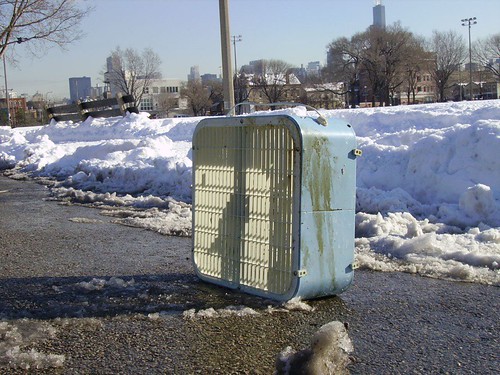
Image of parking space-saving fan by stephanie says provided through a Creative Commons license.

Tuesday, April 08, 2008

Councilor Flaherty Fires Opening Salvo of the 2009 Mayoral Campaign

I recently wrote on this blog that Councilor Michael Flaherty years ago called for the City of Boston to adopt the "CitiStat" system to track constituent service complaints. Since it is well-known that Councilor Flaherty is interested in running for Mayor, I predicted that he would raise up this issue after the Boston Globe published an article in Sunday's newspaper about how long Mayor Thomas Menino's administration is taking to roll out such a service:
I am under the impression that Councilor Flaherty and his team consider this one of his signature issues, so the Globe story in Sunday's paper will add fuel the fire of his Mayoral ambitions by giving him a strong issue for campaigning. Mayor Menino therefore has a deadline for rolling out his version of the system before election day in November 2009 -- not in 2010, the date told to the Globe by Bill Oates, the city's chief information officer.
I pointed out that the Globe article missed this key element in their story. Councilor Flaherty seems to agree, because today he sent out a bulk email making the same point:
In its extensive coverage of Boston's citizen complaint tracking efforts, the Globe's article contained a glaring oversight: Since 2005, I have been pushing for the city to adopt CitiStat -- an online accountability and assessment tool for tracking constituent services as well as long-term planning goals.

In fact, I am holding yet another hearing on Thursday to debate the feasibility of implementing the tracking program in Boston.
Is Councilor Flaherty going to make this into an issue for the Mayoral race? You betcha. His email continues to attack the "Administration", although without explicitly naming the Mayor:
In the end, our city's stubbornness hurts everyday residents who just want the city to respond to their needs in a timely and responsible manner...

Had the [Menino] Administration listened three years ago when a tracking system like CitiStat was first proposed, perhaps we too could have claimed three years of savings and quality constituent services. I am hopeful that we can all get serious about saving residents money and delivering better services...

I strongly encourage the Administration to take an active role in this debate.
I believe we have just heard the opening salvo of the 2009 Mayoral campaign.

The public hearing Councilor Flaherty refers to will be held on Thursday, April 10, at 1 pm in the Boston City Council's Iannella Chambers. Bring your own ordinance. Remember to look both ways before entering the chamber.

David Berstein of the Boston Phoenix's Talking Politics Blog thinks that Mayor Menino's actions are part of a broader pattern where: a City Councilor occasionally comes up with a good idea: Mayor Menino takes the idea as his own via a press conference; and then Menino doesn't follow through with implementing the project. Bernstein adds the example of the city-wide Grove Hall-wide WiFi system. Bernstein has, in effect, proposed Boston's new parlor game: come up with other examples.

Sunday, April 06, 2008

More On 311 -- And Could It Be Flaherty's Issue in 2009?

In a nice piece of investigative reporting, the Boston Globe found out how little the city has progressed in the last two years in rolling out a city-wide constituent complaint tracking service (often referred to as a "311" service). While the city has a system called the Mayor's 24-Hour Constituent Service Hotline, the system doesn't provide full tracking of complaints throughout the city's various departments, resulting in little knowledge as to how well complaints are resolved.

The Globe story fails to note five rather important angles to the story:
  1. There already is an online constituent service webform (actually two webforms!) that generates a small (but non-zero) amount of tracking information;
  2. The online webform that accepts complaints about building, health, housing, code enforcement, environmental services, and weights and measures has been broken for more than one year for at least some web browsers;
  3. The city has begun regularly summarizing various departments' performances through average response times to complaints, despite not having a system fully trackable to the public;
  4. Mayor Thomas Menino may very well be slow to embrace a city-wide 311 system because he has already associated constituent services with his "Mayor's Constituent Service Hotline"; and
  5. One of Mayor Menino's likely challengers next year, Councilor Michael Flaherty, has been pushing the 311 service, and may renew his push if Mayor Menino doesn't get the new system running soon.
The Globe story noted that Mayor Menino vowed two years ago to roll out such a complaint tracking service by the end of 2006, but city officials now say that it may be 2009 or 2010 before the system is ready -- and for a total price tag of $4 million.

Why the service has been so slow to roll out was not addressed in the Globe story. I can guess that the basic problem is that various city departments probably use different software to do their core tasks, so the process requires bringing all of their work under a common system. That is an awfully hard task when you're dealing with a large organization -- although New York City was able to do so relatively quickly for $20 million in 2003. Where there's a will there's a way.


Online Constituent Services. The Globe story completely missed the fact that constituent complaints can be submitted online, not just by phone (617-635-4500). Why does this matter? An online complaint (eventually) returns a ticket number, so that you can keep track of the complaint; phone calls do not generate a ticket number. The number helps for follow-up calls -- but you still cannot view the status of the complaint online, ticket number or not.

Weekend staffing for the online form has been spotty in my experience: once I even received an email on Monday morning from a city employee saying that I shouldn't use the online form over the weekend because it wouldn't necessarily be answered. (I have subsequently been told that requests submitted online during the weekend are being read over the weekend, but I have not confirmed that in practice.)


Broken Web Forms.
One or more of these web forms has been broken for well over one year, at least in my browsers (Firefox, Konqueror, Opera). The form fails to identify any street address that I enter in order to submit a building complaint (e.g., work after hours). The building, health, housing, code enforcement, environmental services, and weights and measures departments probably think that nobody is submitting complaints online; in fact, since the web forms fail for at least some people (like me), people are stuck sending their complaints back to the Mayor's 24-hour line.


City Department Tracking of Response Times to Constituent Complaints.
To his credit, Mayor Menino is using measured metrics to track the response of his various departments to constituent complaints. For example, in 2006 88% of potholes were filled within 24 hours. Obviously, some amount of information is getting stored and analyzed in the current system -- which seems to obviate the need for the Boston Globe to do their own investigation of the city's response to 50 randomly selected complaints, since the city's statistics cover a much larger statistical sample.


Why Turn the "Mayor's 24-Hour Constituent Service Hotline" Into the "City of Boston Constituent Service Hotline"?
Come on, Globe, recognize the obvious reason why the Mayor doesn't want to get rid of the "Mayor's 24-Hour Constituent Service Hotline" by creating a "311 Constituent Service Hotline." Do you detect a word that would disappear from the name? Much of an elected municipal official's work is in constituent services, so they understandably want to claim the credit for their (staff's) work. Why not call it the "Mayor's 311 Constituent Service -- That You Can Also Access By Calling 617-635-4500?" I think that name is catchy.

Wait... Councilor Sam Yoon already thought of that idea, and told it to the Boston Globe two years ago:
Some inside City Hall believe Menino may be reluctant to give up a number that's become part of his own urban brand. ''I recognize the mayor, for good reason, could be worried that he'll lose the connection he has with people through the mayor's hot line," says Yoon.

Yoon's solution: ''Let's call it 'the Mayor's 311.' "


Councilor Flaherty Has Been Pushing For 311 Service.
In last fall's campaign for Boston City Councilor-At-Large, three of the current office holders -- Councilors John Connolly, Michael Flaherty, and Sam Yoon -- responded to a questionnaire here on the Brighton Centered Blog about revamping the constituent services system. Councilor Connolly called for a 311 service; Councilor Yoon expressed how impressed he was with Somerville's 311 service, and that Boston should improve their service; and Councilor Flaherty noted that he called for the city to implement a "CitiStat" system four years ago:
COUNCILOR MICHAEL FLAHERTY: The city has an obligation to responsibly and efficiently meet the needs of constituents. However, I am unsure that the 24-hour hotline is the appropriate tool as it lacks the ability to track constituents’ requests. That is why we need CitiStat, which is a government accountability program that I called for in 2004. CitiStat enables every request to be tracked so that the city – and its residents (by phone or internet) – can comprehend how quickly and adequately requests are addressed.
I am under the impression that Councilor Flaherty and his team consider this one of his signature issues, so the Globe story in Sunday's paper will add fuel the fire of his Mayoral ambitions by giving him a strong issue for campaigning. Mayor Menino therefore has a deadline for rolling out his version of the system before election day in November 2009 -- not in 2010, the date told to the Globe by Bill Oates, the city's chief information officer.

Wednesday, November 28, 2007

Brighton Challengers for Mayor Menino?

Mayor Thomas Menino has been flexing his fund-raising muscle this fall, despite the fact that he was not on the ballot. Many are viewing this as a sign that he wants to run for re-election in 2009. More evidence? David Bernstein of the Boston Phoenix couldn't get anyone to speak on -the-record, but provides this nugget ("Menino's Hit List"):
Sources also say that Menino’s people — particularly former chief of staff David Passafaro — are warning off anyone who provides aid and comfort to a potential rival. Those who contribute to a rumored mayoral candidate’s campaign committee, or who make introductions at ward committee meetings for a rumored candidate, these sources say, receive a reproachful call from Passafaro.
Who is poised to take on an incumbent Mayor Menino in 2009? Bernstein has a top-40 list. A number of Brighton residents show up in the list -- some real possibilities, others unlikely (Brighton residency given in the Phoenix article, not by my research):

6. Peter Meade, 61, Executive Vice President, Blue Cross Blue Shield of Massachusetts
11. Steven Tolman, 53, State Senator
12. Joe Kennedy, 55, Chairman, Citizens Energy; former Congressman
18. William Galvin, 57, Secretary of the Commonwealth
37. Kevin Honan, 49, State Representative
38. Michael Moran, 36, State Representative

It is a big step to go from a local district to a city-wide Mayoral race, so I find ranking our local representatives as quite a leap. On top of that, both Rep. Honan and Rep. Moran appear genuinely devoted to local issues and constituent services, as opposed to constantly aspiring to higher and higher office. That said, Secretary Galvin made the leap to state-wide office quite effectively.

Senator Tolman is an intriguing possibility: connections from brother Warren could be very useful for the vast fund-raising required by a city-wide election. But why hasn't Senator Tolman been raising much money in recent years? He had only $88,677.63 in his account as of year-end 2006, less than you would expect for someone thinking about getting a bigger office and poised to take on a powerful Mayor. Those connections of Tolman's may not be as profitable as you might think at first.

Former Congressman Kennedy and Secretary Galvin would be strong contenders if they had any interest in being Mayor; the Phoenix provides no evidence of such interest, so I find their inclusion in the list as odd. Secretary Galvin's associates may also be stinging a bit from their inability to throw a local election to their favorite candidate.


How About Flaherty?

My odds-making? The Phoenix's #1 pick, Councilor Michael Flaherty, has a shot only if he can knock off the Mayor neighborhood-by-neighborhood by aggressively adopting those residents' key local issues as his own.

He has to go to East Boston and take the residents' side by fighting hard against the Mayor on having a casino at Suffolk Downs. Go to Allston-Brighton and take the residents' side by fighting hard against unchecked expansion by Harvard and Boston College and their facilitator, the BRA. Walk the streets of Dorchester and Mattapan every night, arm-in-arm with community leaders, railing against rising violent crime rates and how City Hall isn't doing anything about it. Help South Boston residents replace garbage cans in the streets, after City workers remove them, thereby reserving their shoveled parking spaces. (OK, maybe a bad example.) Blame every major woe in every neighborhood on the Mayor, even if it isn't quite true.

That's the only way someone like Councilor Flaherty could take on incumbent Mayor Menino in 2009: on a neighborhood-by-neighborhood basis, standing alongside the local residents on their biggest issue, and all-the-while blaming it everything on the Mayor. It would be a fun election to watch, but bound to be immensely negative.

Tuesday, November 13, 2007

Election Urban Legends: Checking Out the Facts

Rain Caused the Low Voter Turnout

Boston's 13.6% turnout was far less than the 23-32% turnout in all previous municipal elections without a mayoral race since 1985. Inclement weather can certainly reduce the turnout for elections, and November 6, 2007 had a good amount of it: half an inch of moderate rain coming down during the day. The rain stopped by 3:00 pm, and the Sun began showing by 3:30 or 4:00 pm.

Did this rain cause the low turnout? Last time I checked, Quincy, Brockton, and Fall River all have weather highly-correlated with Boston; those cities still had around 50% turnout among registered voters for their mayoral elections. You can't tell me that half the people stayed home in Boston, Quincy, Brockton, and Fall River because of the weather... unless the latter three can expect voting rates of 100% -- or more -- when the Sun is shining. Yeah, right.

More likely: voter turnout was depressed a bit by bad weather, but mostly by the blizzard-like-whiteout of horrendously inadequate coverage of the race and issues by the city-wide papers, the Boston Globe and the Boston Herald. Those newspapers could have written their campaign coverage via computer program: IF (not cover the campaign && rainy weather) THEN (write column about low voter turnout on election day and a news story the day after). I wonder if all their news coverage could be coded up like this.

Memo to Globe and Herald city news desks: you got the election you asked for. Brian McGrory is my candidate for local news editor of the year, since he appears to have been the most powerful influence in the election via his reporters' non-coverage in the race.


Allston-Brighton Residents Don't Vote

A staple of Boston election politicking is that Allston-Brighton residents don't vote. You can explain it in many different ways, primarily through the transient nature of much of the A-B population, but the bottom line result keeps coming up. A-B Wards 21 and 22 (which includes Ward 21, Precincts 1 and 2 which are not part of District 9) voted in the 2005 municipal election at 23.6% of registered voters, while the city as a whole voted at 35.6%. In the 2005 preliminary municipal election, Wards 21 and 22 voted at 11.5% while the city voted at 15.1%. Conventional Wisdom of city politics dictates that city-wide candidates shouldn't spend much time campaigning in A-B -- or delivering constituent services -- because the residents don't vote enough to make it worthwhile.

In the 2007 election, we have all learned a lesson: Allston-Brighton electoral interest is resurgent. For the first time in recent memory, voters in Wards 21 and 22 turned out at a rate of 12.6% -- a rate nearly matching the city-wide average of 13.6%.

Why? The open A-B District 9 City Council seat likely motivated voters here to turnout for their favorite between Mark Ciommo and Greg Glennon. This local race also brought to the fore important neighborhood issues on many voters' minds, particularly those of institutional expansion and the exodus of families from the area. The A-B turnout has its silver lining: A-B residents are showing that they want their neighborhood issues dealt with during the next two years. The City Council and Mayor are bound to take note.


Councilor Michael Flaherty So Encouraged by 2007 Finish That He Will Run for Mayor in 2009

Hold your horses! In 2005, Councilor Flaherty got 49,220 votes to take first-place in the Councilor-At-Large race, thereby beating second-place finisher Councilor Felix Arroyo by more than 5,600 votes. This time, Councilor Flaherty got only 25,847 votes, beating second-place finisher Councilor Stephen Murphy by only 2,206 votes. The difference between first and fourth place in 2007 was only 3,867 votes: the first four candidates ran pretty much neck-and-neck.

On a positive note for him, Councilor Flaherty managed to get a vote off of 55.9% of ballots cast in 2007, up from 50.7% in 2005, in a Councilor-At-Large race that allows voters to cast up to four votes. Nonetheless, in 2005, Mayor Thomas Menino got a vote out of 65.9% of the ballots cast (including blank ballots) in a Mayoral race where voters do not have the opportunity to cast more than one vote. Without a massive voter revolt over the horizon, it's hard to reconcile Menino's and Flaherty's numbers to make it look like the latter would have any chance in a head-to-head competition.

While Councilor Flaherty was bringing in the big bucks for his fundraising in an election year, Mayor Menino decided to do a little bit of his own fundraising in an off-year. During September and October, Mayor Menino raised $229,890; in the same reporting period, Councilor Flaherty only brought in $147,480. Does Councilor Flaherty have piles of his own money to throw into his own race like Maura Hennigan did in her failed 2005 Mayoral bid?

Councilor Flaherty needed to win big on November 6th to make his Mayoral aspirations look credible, but he only won marginally, not overwhelmingly. And the Mayor flexed his fundraising muscles to make it clear.


Bullet Voting in West Roxbury

John Connolly's campaign sent out two anonymous mailings attacking Councilor Stephen Murphy in the last week before the municipal election. There were three additional, anonymous mailings that were sent out around the same time (according to the Boston Globe's summary), but which nobody has stepped out to take responsibility for. Two of those were sent to voters in the Parkway neighborhood (i.e., West Roxbury) lobbying for "bullet votes" for a local candidate, presumably Connolly; one of those mailings also included the bulk mailing permit number previously used by Connolly's campaign.

Did Connolly's lobbying for West Roxbury bullet votes swing the election to him?

Ward 20 includes West Roxbury as well as some of Roslindale; Connolly was born in Roslindale but currently resides in West Roxbury. Ward 20 historically turns out to vote at rates well above the city-wide average: in the 2005 municipal election, the Ward voted at 48.4%, compared to the city-wide rate of 35.6%; in the 2007 municipal election, they turned out at 23.8% compared with city-wide 13.6%. In 2007, Ward 20 was therefore disproportionately voting at a higher rate even than is usual even for them. This is exactly the behavior expected in a low turnout election, where neighborhoods with white/elderly/wealthy residents turnout at higher rates than minority/young/poor neighborhoods.

What did this disproportionately high turnout in Ward 20 mean to the Connolly vs. Councilor Felix Arroyo race for the fourth Councilor-At-Large seat? If Ward 20 had voted at 18.5% in 2007 (matching their usual higher turnout) instead of 23.8%, Connolly would have lost only 635 votes out of his 3421 margin of victory over Arroyo. Ward 20's disproportionately high turnout in 2007 was not nearly enough, by itself, to elect Connolly.

Did these Ward 20 voters engage in bullet voting? City-wide in 2007 there was an average of 2.7 votes (out of an allowed four votes) for City Councilor-At-Large; in Ward 20, the average was 2.5 votes per ballot. Compare this to the 2005 municipal election which had 2.9 city-wide votes per ballot, versus 3.0 votes per ballot in Ward 20. While city-wide voters did a little bit more bullet-voting in 2007 than in 2005, West Roxbury and Roslindale voters did substantially more bullet voting in 2007 than in 2005.

Did this bullet-voting make the difference? We don't know for sure, because you would need to know how each and every ballot voted. But we can take two cases: an extreme case, where all the bullet votes took a vote away from Arroyo (unlikely); and an average (and likelier) case, where all the bullet votes took a vote away from one of the other four candidates, taken at random. In the extreme case, all of Ward 20's 0.5 fewer votes per ballot in 2007 than in 2005 removed 3142 votes from Arroyo, almost all of the margin between him and Connolly. In the more likely case, only 3142/4 = 786 votes were taken away from Arroyo, not nearly enough to produce the difference between Connolly and Arroyo.

OK, so the numbers back up that West Roxbury and Roslindale utilized the bullet vote more in this election than previously. But are they the masters of the bullet vote? No! Ward 6 (South Boston, Councilor Flaherty's ward of birth) averaged 2.3 votes per ballot, Wards 1 (East Boston), 7 (South Boston, Councilor Flaherty's home ward), and 22 (Allston-Brighton) all averaged 2.5 votes per ballot, similar rates of bullet voting to the West Roxbury/Roslindale recent converts.

What do we make of all this? Yes, Ward 20 (West Roxbury/Roslindale) voted at a disproportionately high rate and used significantly more bullet voting than in previous elections, but neither effect was sufficient to explain how Connolly beat Arroyo for fourth place. The combination of the two effects only explains around 40% of their margin differentiating the two.

Look elsewhere for bigger causes of Connolly's defeat of Arroyo, such as: Arroyo's failure to raise money; Arroyo's failure to get-out-the-vote; the mainstream media's failure to cover the race resulting in low voter turnout; etc. Those will likely be fingered as the real factors leading to Arroyo's ouster at the polls in 2007.

Why Ciommo Won and Arroyo Lost in the 2007 Municipal Election

Just before the polls closed last Tuesday night, I posted my predictions for the City Council race. I was pretty much spot-on for the Allston-Brighton District 9 seat (albeit missing the turnout numbers by a lot), but got the wrong odd-man-out in the Councilor-At-Large seat. Here is some analysis of what I thought happened on election day.


Allston-Brighton District 9 City Councilor

I predicted that Mark Ciommo would beat Greg Glennon by at least 900 votes and by at least 57-43% (possibly as high as 60-40%). My prediction couldn't have been closer: Ciommo won by 948 votes by 59.8-39.8%. The full precinct results can be found here.

That said, I screwed up on two points -- one moderate mistake (Wallingford Road) and one a big mistake (voter turnout) -- which magically cancelled each other out to make it look like I hit the lottery.

Turnout. I guessed 6500 voters would turn out, which was at the low end of previous municipal elections. It was far worse at 4745, which was barely over the 4521 votes in the preliminary municipal election.

Why was I so wrong? Not because of the weather. I think that the rank-and-file voters got so little information from the mainstream media (Allston-Brighton TAB excepted), that there was little motivation to vote. I also heard from many voters in the preliminary election who were dissatisfied with the two choices in the final election; I suspect many of them just stayed home, unwilling to be forced to choose.


Wallingford Road.
Glennon carried Ward 21, Precinct 13, full of elderly Russian Jewish voters at the Wallingford Road housing project, over Ciommo 303-142 in the preliminary election. I predicted that he would add to that lead by +200 votes, but the forces of arm-twisting pushed it the other way: Ciommo won 333-242, giving Ciommo a net +252 votes. I blew the vote difference by 452. Oops.

But this is a really, really big story in the neighborhood. Tim Schofield told host Joe Heisler on the Talk of the Neighborhood show that the Russians mostly listen to former State Representative Brian Golden and Mayor Menino; to that I add a likely third party, the Mark Alford-Pat Galvin-(and-his-brother) trifecta. Golden, Alford, and Pat Galvin all supported Glennon -- and Ciommo holds progressive social positions incompatible the conservative Russian voters, at least in the conventional wisdom -- so this means that the Mayoral power in A-B is now at the point that it trumps all else in specific cases of arm-twisting (like Wallingford in this election).

The other big feature of the Wallingford Road vote is that it actually didn't matter in the election. Ciommo could have won without a single vote from the Russians. In looking back on this year's election, the message we should all take away is that the Russian vote can impact a preliminary (or three-way) election in an important way by determining the second-place finisher, but their strength cannot dominate over the powerful base of a long-time resident.


Oak Square battleground.
I predicted that several precincts in the Oak Square neighborhood would represent battlegrounds between the long-term Brighton residents (Ciommo's base) and socially conservative Irish Catholics (Golden's base, and hence Glennon's). Many people in the neighborhood have one foot firmly in each camp, so predicting how they would swing was the parlor game of the election.

Ciommo carried the combined Ward 22, Precincts 7, 11, and 13 in the preliminary, with Glennon and Schofield in a virtual tie for second. Schofield's voters generally swung heavily for Ciommo, regardless of his endorsement, but this was the one neighborhood where that pattern might have been broken.

In the final election, Ciommo won 22/7, 22/10, and 22/11 heavily, and barely nudged Glennon 102-98 in more conservative 22/13. I predicted, "if Ciommo carries 7, 10, and 11 with big margins, then it's lights out." That it was.

My model was that Schofield's supporters went 80-20% for Ciommo, Selvig's 65-35%, and Hanlon's 50-50%. Using that model on Ward 22, Precinct 7, for example, my prediction was Ciommo over Glennon by 137 to 61 votes; the actual result was 131-67, off by six, but within the margin of error of 14 votes (for 198 cast).


Ward 21 Progressive Precincts. I predicted that you should forget-about-it without a strongly identified progressive in the case (like Schofield). Ward 21, Precinct 8 actually doubled their turnout over the preliminary election -- from 1.6 to 3.2%. In the end, the progressive precincts still didn't show up.


Summary. The bosses of Ward 22 were able to get Councilor Jerry McDermott elected in 2002 (he is the cousin to the Galvins, after all), even though McDermott claimed after the election that he was not the Mayor's candidate. (Ciommo told me earlier in the year that he disputes that characterization of the 2002 race, however, since the Mayor did not formally endorse a candidate.) In 2007, however, the Ward 22 bosses no longer appear to be able to throw an Allston-Brighton election to their favorite candidate -- although they can get him a second-place finish and into the finals.

Councilor-elect Ciommo enjoyed powerful support from middle-aged men who chose to stay in Brighton to raise their families here. He won out over the younger, more transient constituencies -- like former Representative Golden and lame duck Councilor McDermott -- who leave town with their young families.

Long-time Brighton residents and the Mayor's influence ended up winning over the ward bosses and families in transition through the neighborhood.


Boston City Councilor-At-Large Race

While many in the city thought that the race for the fourth seat among the Boston City Councilors-At-Large was between Councilor Stephen Murphy and challenger John Connolly, there were many soothsayers predicting Councilor Felix Arroyo to be the odd man out.

I called the race a toss-up until the last moment, when I thought that Connolly's strategic blunder of sending out the anonymous attack mailings would cost him enough votes to lose out on fourth place. I was obviously wrong, and the Arroyo predictions were right.

Why did Arroyo lose? The pundits have rained in with some pretty convincing reasons: low voter turnout working against minority candidates; Arroyo raised little money, while Connolly raised around ten times as much; Arroyo didn't campaign very hard or send out many mailings, while Connolly campaigned like crazy (and sent out quite a few flyers!); Arroyo's record on attendance at City Council meetings and hearings; etc. None of the reasons seems enough by itself, but, taken together, they seem plenty to explain why he got around 15% fewer votes than Connolly.

This year's City Council election is an important one for data mining purposes in the future, because it shows clearly how low voter turnout impacts voting from ward-to-ward. Connolly's West Roxbury Ward 20, for example, voted disproportionately higher than the rest of the city.


The election numbers, plus analysis on a ward-by-ward basis, for the Councilor-At-Large race can be found at Matt O'Malley's website.  He ran, albeit unsuccessfully, in 2005 for Councilor-at-Large, so he knows the ins and outs of all the different neighborhoods and their voting trends.

Tuesday, November 06, 2007

Spending Like Crazy At the Last Minute on City Council Campaign

I have been carefully trying to keep track of all the money that the candidates for Boston City Councilor-At-Large have -- not just their standard checking accounts, but also the money that they transfer to savings and/or money market accounts.

By my accounting, John Connolly did not have money in savings accounts at the end of 2006, but had transferred $90,000 to savings between June and October 2007. Combined with his checking account ending balance of $25,916.52 as of 10/15/07, he had a good amount of cash on-hand for last minute spending.

Between October 16st and 31st he pulled in another $23,428.10 in contributions, such that I think he should have had nearly $140,000 on-hand at the end of October. His campaign did not itemize the transfers from savings to checking in the expenditures on their 10/31/07 filing, but they do give the total in receipts during 10/16/07-10/31/07 as a whopping $220,279.73! The $220,000 should include the $23,428.10 in contributions above, plus any additional savings account money transferred into checking; since I thought they had another $90,000 in the savings account, that leaves around $106,000 mysteriously showing up in their receipts in the 10/31/07 report.

Where did that extra $106,000-plus come from??? I'm bamboozled. I knew he had a lot of money lying around, but not that much. I hope to see some clear accounting of this money beyond the mere itemization of around $23,000, because I really cannot figure out where the extra $106,000 came from. Then again, maybe I'm just dumb. That must be it: stupid me.

On the expenditure side, Connolly spent like crazy during the second half of October, making two wire transfers totalling more than $200,000. Past campaign finance reports indicate that such expenditures are usually updated later to indicate that they are media buys -- which can include mailings, radio advertisements, and television advertisements. (Councilor-At-Large finance reports get audited at some level, which appear to result in the OCPF requesting the campaign to clarify such expenditures with an amended report.) We also know that Connolly has been sending out some mailings city-wide in the last week, which probably account for some of the total. (Councilor Michael Flaherty lists two different expenditures on mailings of $27,000 and $28,000 during the second half of October, so this gives an indication of the cost of a city-wide mailing.)

Connolly has now spent more than $330,000 on the campaign to-date this calendar year, according to my calculations. Councilor Flaherty has topped him with $350,000 this year, spending nearly $60,000 in the second half of October. During late October, Councilor Stephen Murphy spent another $52,000, Councilor Sam Yoon only spent $10,000, and Councilor Felix Arroyo spent $4,600.

My estimates have the total in expenditures currently around $957,000 by all candidates in the Councilor-At-Large race.

Is this a quiet City Council election? Not with that kind of money being spent.

When it's all over, I will assemble the reports and figure out the total expenditures. I'm predicting the 2007 City Councilor-At-Large will be by far the most expensive race on record. With predicted low voter turnout, the expenditure cost per vote cast will also undoubtedly be a record for Boston.


Campaign Finance Year-To-Date to 10/31/07
Boston City Councilor-At-Large

NAMEEND DATEBEGIN BALANCERAISEOWN MONEYSPENDEND BALANCE
Felix Arroyo10/31/07 3720.04 29878.49 0.00 32498.19 1101.30
John Connolly10/31/07 35926.65 309174.77 10000.00 334722.83 20378.19
William Estrada10/31/07 0.00 0.00 0.00 0.00 0.00
Michael Flaherty10/31/07 447262.56 337821.15 0.00 350947.80 434135.91
Matthew Geary10/31/07 0.00 3672.01 0.00 3147.35 524.66
Martin Hogan10/31/07 0.00 1621.13 0.00 1601.80 19.33
Stephen Murphy10/31/07 43710.09 100000.00 250.00 96192.66 47767.43
David Wyatt10/31/07 0.00 363.00 0.00 341.78 21.22
Sam Yoon10/31/07 47636.17 209257.33 0.00 138422.17 118471.33
TOTAL10/31/07 578255.51 991787.88 10250.00 957874.58 622419.37

Monday, November 05, 2007

Mayor Menino Dangles a Toe Into A-B City Councilor Waters

Boston Mayor Thomas Menino has not openly endorsed any candidate for Tuesday's election of a new Allston-Brighton District 9 City Councilor. Like any election campaign in the city, word constantly swirls about the neighborhoods, wondering if the Mayor is pulling strings behind the scenes for this candidate or that. Maybe some rumors are true, others not, but without a clear endorsement, the Mayor isn't making a major move to support his favorite candidate -- if he had one.

A week ago at the Brighton Main Streets annual gala, the Mayor spoke briefly about the race. He said that he wasn't making any endorsements, but then said of candidate Mark Ciommo, who was in the crowd, that he would do a great job if elected. Ciommo's opponent, Greg Glennon, wasn't there that night.

Is Ciommo the Mayor's candidate? He was asked this in the September 17, 2007 candidates forum, when two of the other candidates nominated him as the Mayor's candidate. (Both have subsequently endorsed Ciommo following the preliminary election.) Here's what Ciommo had to say:
QUESTION: Since the other candidates also closely associate you with the Mayor, is this a blessing or a curse?

CIOMMO: All I can say is that for the past 20 years in this community, I've been in an executive position for the better part of those 20 years working on the behalf of the citizens of this community -- first, as the assistant director of the Jackson-Mann Community Center, and for the past 14 years, at the Veronica Smith Senior Center. And I have to work with the Mayor. He helps provide services that I deliver to the seniors in Allston-Brighton. I have to work with the Mayor as president of Little League, to make sure our parks and playgrounds get cleaned and the fields get mowed. As a Hobart Park Neighborhood Association founding member, I had to work with the Mayor to re-design the park, organize a community build, find funding from the grounds funds to erect the ornamental fencing and the historical markers. So, I will work with the Mayor, but I've always been a strong and independent voice on behalf of the citizens of this community, and I will continue to be that as your next City Councilor.
I'm not sure that the Mayor makes sure that the grass in the parks gets mowed, but that's beside the point. Instead, Ciommo was eager to connect anything to he could between him and the Mayor -- even mowing the grass -- to make it look like he was working with the Mayor. Methinks Ciommo counts the Mayor's good words as a blessing, no matter how well the Mayor might pretend it is a non-endorsement. (wink-wink)

(In the City Councilor-At-Large race, it sounds like Councilor Stephen Murphy has received similarly nice words from the Mayor this weekend.)

Why hasn't the Mayor come out more strongly with a full-fledged endorsement of a candidate? One City Hall insider told me, "What's the upside?" After the Mayor endorsed a candidate in the East Boston special election for State Representative last month, and his candidate tanked, he must have been leery of making two bad endorsements in a row and looking like a liability. Another possibility is that the Mayor thought that Ciommo's position in the election is strong, and so he didn't need to intervene. Nonetheless, if a sitting Mayor can only think of downsides for endorsing a candidate, then how strong a position must the Mayor think he's in?