Showing posts with label boston college. Show all posts

Friday, July 30, 2010

Judge Rules BC Task Force a Government Body -- At Least For Now

The City of Boston was dealt several setbacks recently in a lawsuit against them over the city's approval of the Boston College institutional master plan.

In the case of Galvin et al. vs. Boston Zoning Commission et al., Superior Court Justice Charles Spurlock [right] issued a preliminary ruling on June 29th that there are "sufficient facts to support an inference" that the BC Task Force, an official advisory body of the Boston Redevelopment Authority (or, in the judge's words, "a subcommittee of the BRA"), is a government body, and hence subject to the state's Open Meeting Law. The ruling was issued in response to a series of pre-trial motions by lawyers on both sides of the case.

The ruling is significant in that it is consistent with the ruling of Suffolk County District Attorney Dan Conley in June 2007 that the BC Task Force and the Harvard Allston Task Force are government bodies that are subject to the state's OML, a ruling that the city continues to dispute.

Two Brighton residents, Patrick Galvin and Mark Alford, filed their lawsuit against the city in July 2009 in response to the city's approval of BC's IMP. The BRA Board voted in January 2009 to approve the IMP; the Boston Zoning Commission approved it, with modification, in June 2009; and Mayor Thomas Menino subsequently signed it.

Justice Spurlock's order, while not a final ruling in the case, indicates that the task force will continue to be a defendant in the lawsuit. To date the task force has not, to my knowledge, responded at all to the complaints nor have they been represented in front of the court by legal counsel.

Implicit in the judge's ruling is that the lawsuit will go forward into additional phases, such as discovery and, potentially, trial. This alone suggests that there may be a protracted legal battle over BC's IMP that could impact the university's ambitious expansion plans.

This preliminary ruling by Justice Spurlock appears to be a major headache for the city, since its lawyers argued strongly to try and keep the task force out of the lawsuit. Now not only is the task force in this lawsuit as a defendant, but the judge has made an initial ruling that would appear to imply that all of the BRA's task forces are subject to the state's OML -- and, by extension, the state's Public Records Laws and ethics laws.

Let's hope the task force members -- now confirmed by the preliminary ruling to be part-time, unpaid municipal employees -- are doing a better job at retaining their emails than some other city employees who have recently been in the news.


Other Rulings by Judge

The judge also turned down two separate motions by the defendants that would send the case to Land Court and expedite it.

While not noted in the ruling, the judge appears to have allowed Boston College earlier this spring to join the lawsuit as a defendant without objection from the plaintiffs (as expressed in a December 2009 hearing). BC's lawyers have been filing motions repeatedly with the court -- including the Land Court and expedition motions -- actions that are normally allowed only for parties to the case.

The plaintiffs did not, however, win on every issue. The judge: ruled that their allegation of OML violations were filed too late according to the statutory 21-day limit; rejected their attempt to make a claim for violations of civil rights and their rights under the Equal Protection Clause; said that he would not consider possible criminal violations of the state's ethics laws, since those should be brought in front of the district attorney instead; that the individual members of the task force could not be named separately as co-defendants in the lawsuit, appearing to lift their individual liability (while not ruling on the government body's collective liability); and that the task force itself did not impact the rights of the plaintiffs, because the task force was only an advisory body to the BRA.

I suspect that that last ruling will be hotly contested in the case, and that we haven't heard the last of it.

The ethics issue, too, promises to be complicated as the case moves forward. While ruling that this civil action is not the appropriate venue for a criminal allegations of conflict-of-interest against individual members of the BC Task Force, the judge also stated case law that ethics civil violations are administrative matters that are rectified by processes within governmental agencies. But if the BRA Board and BZC relied upon recommendations from their advisory panel (the task force) that were allegedly biased due to financial conflicts-of-interest, then nothing in the ruling appears to prevent the plaintiff's arguments from going forward in seeking to invalidate approval of BC's IMP in a tainted process.

Spurlock was assigned to the case earlier this year after the previous judge, Christine Roach, recused herself after repeatedly suggesting her potential conflicts to the lawyers.


Update: The Boston Bulletin has a story on the ruling.

Friday, April 16, 2010

PILOT Numbers Behind McGrory's Metro Column on BC

The Boston Globe's Brian McGrory has done his best to channel Howie Carr in today's metro op-ed column about how Boston College should be paying more in Payments in Lieu of Taxes (PILOT) to the City of Boston.

The problem with McGrory's argument that BC should contribute more PILOT to the city is that he didn't give a handle on what might be a reasonable expectation for those payments, particularly since only some of BC's property is located within Boston's city limits.

By looking at what BC might be expected to contribute in PILOT under the proposal recently made by the city's PILOT reform commission, BC ought to be contributing at least $1.6 million more to the city than they are currently paying through PILOT and real estate taxes.

Here's how I come by that number: Boston College's existing Chestnut Hill campus (just that part within the Boston city limits) are currently assessed at a valuation of around $480 million, according to the city's website. Add to that the 16-story apartment building at 2000 Commonwealth Avenue they purchased in 2008 and the former St. John's Seminary land they purchased from the Archdiocese of Boston for $177.4 million in a series of transactions between 2004 and 2007. Added together, those properties lying within Boston have a current value in the ballpark of $722 million, no small change.

The current property tax rates in Boston -- the amount that BC would be paying if they were not a tax-exempt institution -- are $12 (residential) or $29 (commercial) per year per $1000 of valuation for residential property. Since BC's primary financial activities are in education and research, not rental income, most of the land would fall under the commercial rate; I'll assume 75% commercial, 25% residential, or $25 per $1000 of valuation.

If BC were to pay full taxes on their property at that $25 rate it would total around $18.05 million per year. The city's commission that is looking at PILOT reform is recommending that tax-exempt institutions, like universities, voluntarily contribute PILOT at a rate of 25% of the tax rate -- corresponding here to $4.5 million -- of which the institution could elect to pay half in payments-in-kind (e.g., community benefits). The 25% figure is based on a calculation of the cost of city services the institution requires as part of its operation, such as the emergency response to many campus incidents (including Tuesday's ammonia leak at BC's Conte Forum).

Applying the commission's recommendations implies that BC should be contributing a minimum of $2.3 million cash in PILOT to the city, while BC is currently, according to McGrory, paying only $0.3 million in PILOT and $0.4 million in real estate taxes for taxed property. (Nearly all of the valuation for the taxed property is 2000 Commonwealth Avenue; since I include it in the PILOT calculation above, it is appropriate to consider it alongside BC's current PILOT.)

So BC should be paying at least $2.3 million in cash to the city, while they are currently paying only $0.7 million, a shortfall of at least $1.6 million. Based on the commission's recommendations, McGrory has a point that BC is underpaying the city for required city services.


McGrory's tone has evinced a torrent of outraged (and outrageous) comments -- channeling the tone of Howie Carr fans who comment at the Boston Herald's website -- nearly all from people defending BC from what they view as his unfair attacks on their alma mater. Read at your peril.


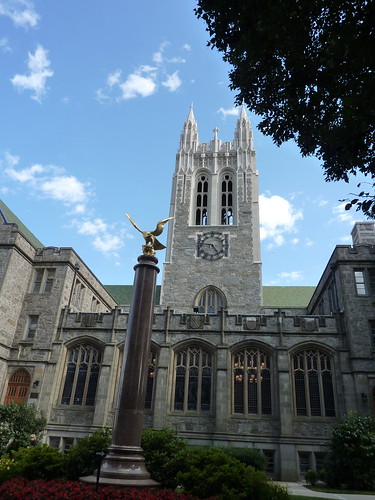
Image of BC's campus:

Friday, February 26, 2010

Burrito Battle Escalates Into War

First, there was Boloco, a burrito joint on Beacon Street in Cleveland Circle.

Two years ago, Chipotle moved in down the street and the first Burrito Battle of Cleveland Circle was joined.

And in a few weeks the battle for the burrito dollars of Boston College undergraduate students will escalate into outright warfare.

The Boston Restaurant Talk blog announces that El Pelon Taqueria, a store damaged by fire -- twice! -- in the Fenway, is moving to the top of Lake Street at 2197 Commonwealth Avenue, the former site of the College Sub Shop and across the street from BC. They plan to open March 15, although no word as of yet if they will be handing out free burritos on the first day like Chipotle did.

What kind of weaponry will El Pelon bring to the battle? Their menu can be found at The Burrito Blog, natch.

The only question I have is this: Do you eat your burrito with the outer end of the strip up or down?


Image:

Tuesday, December 15, 2009

Judge Repeatedly Suggests She Be Recused in BC Expansion Lawsuit Case

At Tuesday's first hearing in the case of Galvin et al. v. Boston Zoning Commission et al., Judge Christine M. Roach considered three motions by the defendants in the lawsuit: adding Boston College as a defendant in the case (plaintiffs were unopposed); whether the Boston College Task Force should be removed from the defendants in the case (plaintiffs opposed); and whether the whole case should be moved to land court instead of superior court (unclear plaintiffs position, but I suspect they were opposed).

In the process of hearing the arguments about the task force's status as a governmental body, Judge Roach repeatedly offered up reasons why the attorneys could ask her to be recused from the case: first, that prior to becoming a judge, she was a commissioner in the State Ethics Commission in 2003-5; and second, that she has previously represented the City of Boston (although not the BRA or BZC) when she worked in private practice.

It seemed to me that the judge really wanted to be asked to be recused from the case. It was as if she were saying: Please, please, will somebody ask for me to be recused? Here are all the reasons you could use to justify recusal! I won't be offended!

Judge Roach's ethics background may be relevant because the defendants introduced an opinion letter on Monday -- marked "confidential" -- sent by the legal counsel of the State Ethics Commission that reaches a different opinion on the applicability of the state's Open Meeting Law from the Suffolk County District Attorney's office June 2007 advisory opinion. Violations of the OML by the task force are among the allegations in the lawsuit.

The judge's previous litigation work for the city also may be relevant because two of the named defendants are city agencies (Boston Redevelopment Authority and Boston Zoning Commission), while a motion being discussed Monday had to do with whether or not a city advisory body -- the Boston College Task Force, an official advisory body to the BRA's Board -- would be kept as a defendant in the case.

The judge added to these reasons by further pointing out that the current year's docket is ending later this month, so that the continuation of the case will almost certainly be passed on to another judge in 2010.

She put a deadline of next Monday for the parties to file motions both on whether or not she should be recused and whether or not she should rule on any of these three motions before the court.

And, no, Jan Schlictmann did not make a court appearance Monday for the plaintiffs.


No Obvious Relief to Task Force Members

During Monday's hearing, Judge Roach suggested that one possible ruling the court could enter would be to remove the task force as a defendant, but still allow the usual discovery process. If discovery later resulted in the task force appearing to be involved in the substance of the case, then they could be re-entered as defendants.

This hypothetical outcome would still seem to entail some kind of testimony by members of the task force during the discovery process, regardless of whether or not they are named as defendants. So removing the task force as a defendant in the case might not necessarily get them off the hook.


Image of gavel by vitualis provided through a Creative Commons license.

Sunday, December 13, 2009

BC Files With Court to Enter Lawsuit Over IMP Approval

Boston College filed court papers last month in order to join the lawsuit filed by two Brighton residents against the city of Boston over it's approval of BC's institutional master plan.

Those two Brighton residents, Patrick Galvin and Mark Alford, filed their lawsuit with the city in Suffolk Superior Court in July over the city's review and approval of BC's IMP earlier in the year. The Boston Redevelopment Authority's Board voted to approve the IMP in January and the Boston Zoning Commission voted to approve the IMP in May and June; both the BRA and the BZC are named as defendants in the lawsuit. Mayor Thomas Menino signed his approval of the IMP in June, although neither he nor his office are named as defendants.

BC was not named as a defendant in the lawsuit, but in the motion they filed with the court on November 9th they seek "leave to intervene as a defendant." They assert in the motion that they meet the requirements "for both intervention as of right and permissive intervention."

No response regarding BC's motion had been filed by the plaintiffs with the court as of last Thursday.


Big Gun Lawyers Involved in Case

BC was represented in the motion by legal counsel from the large law firm Goodwin Procter LLP. In their court filings, Goodwin Procter has at least two partners -- Anthony M. Feeherry and Lawrence E. Kaplan -- involved in the case, as well as two other associates.

I reported on Friday that the plaintiffs are now themselves represented by counsel which includes Jan Schlictmann, the attorney who was the subject of the best-selling book A Civil Action by Jonathan Harr.

The city is in various documents represented by its own Corporation Counsel as well as a smaller firm Rosenberg, Schapiro, Englander, Chicoine & Leggett, P.C -- which appears to have the direct involvement of two of the named partners, Edward S. Englander and Denise A. Chicoine, in the case.

With all those lawyers involved in the case -- particularly the partners -- I would be willing to bet that quite a lot of money is being spent on both sides.

Saturday, September 26, 2009

Councilor Ciommo Running Reconnaissance for Mayor Menino?

In Mayor Thomas Menino's escalating Delete-Delete-Gate controversy, the Boston Globe reported that the city released on Friday a set of 5,018 emails sent by, or received by, Michael Kineavy, chief of policy and planning and one of Menino's top aides. The emails appear to be those found on city backup servers that were saved by other city employees, not Kineavy; the city's forensic contractor has not yet retrieved additional emails from Kineavy's computer hard disk.

In the newly-released emails, Allston-Brighton District 9 City Councilor Mark Ciommo was apparently tipping Mayor Menino off about what two of his competitors in this year's mayoral campaign might be planning to do:
Some city councilors, including Allston-Brighton District Councilor Mark Ciommo, also offered Kineavy a heads-up about separate issues that the mayor’s reelection challengers, [Councilors-At-Large] Michael F. Flaherty and Sam Yoon, were preparing to raise in council hearings.
This is not particularly surprising, since "Ciommo is considered a Menino ally," according to politics reporter David Bernstein of the Boston Phoenix.

Earlier this year, Councilor Ciommo ran interference with Councilor Yoon over a hearing about the Boston Redevelopment Authority's review process of Boston College's Institutional Master Plan, where Ciommo got Yoon to scale back the language of the hearing order in order to "remove politics from the discussion and focus on the BRA process," according to Ciommo. Ciommo's actions minimized the potential fallout from hearings that could have been critical of the BRA -- as well as the mayor's oversight and control of the agency.

Meanwhile, the city's computer forensics contractor has estimated the cost of the email recovery work to possibly reach as high as a quarter of a million dollars. Since the recovery is the direct result of Kineavy's own failure to save his emails as he is required to do under the state's Public Records Law, will he be asked to foot the bill himself?

Saturday, July 11, 2009

Two Brighton Residents Sue City Over Boston College Expansion

Two Brighton residents, Patrick Galvin and Mark Alford, have jointly sued the City of Boston over its approval of Boston College's expansion plans into the former St. John's Seminary land purchased by BC in 2004-7 from the Archdiocese of Boston.

The suit was filed in Superior Court Thursday afternoon. It names three defendants, all official governmental bodies of the City of Boston: the Boston Redevelopment Authority, whose Board approved BC's Institutional Master Plan in January 2009; the Zoning Commission, which approved the IMP in May 2009; and the BC Task Force, an official advisory body to the BRA Board (and appointed by Mayor Thomas Menino), who wrote a letter to the BRA Board generally supporting most of the elements in BC's IMP.

Mayor Menino was not named as a defendant in the suit, which is a bit surprising (to this non-lawyer) given that he also had to approve BC's IMP. He objected to several details of the IMP as initially approved by the Zoning Commission; the ZC later approved modifications, and then Mayor Menino formally signed off in June 2009.

The plaintiffs own property on Lake Street abutting the former St. John's Seminary land BC refers to as their "Brighton Campus." BC's approved IMP calls for construction on that land of athletics facilities (baseball stadium, softball stadium, support building, tennis courts), an auditorium, museum and new building for their fine arts department, and a parking garage. A related Article 80 large project at 188-196 Foster Street (also part of the land bought from the Archdiocese of Boston) to build housing for BC's School of Theology and Ministry was submitted by the Jesuit society and approved in November 2008 by the BRA Board, although it was initially included in BC's IMP. The Zoning Commission changed the zoning at the property as part of its June 2009 IMP approval process.

No monetary figure for damages is specified in the suit.


Image of the scales of justice in Haarlem, The Netherlands by lant_70 provided through a Creative Commons license.


UPDATE: The Boston Globe now has a story on it.

Friday, January 30, 2009

Globe Moves Brighton to Newton to Appease GateHouse

Last night, the Board of the Boston Redevelopment Authority approved Boston College's 10-year Institutional Master Plan, despite objections from Brighton neighbors.

In a head-scratching move, the Boston Globe published the story online in their YourTown Newton website, even though the BRA's decision only impacts development of BC's property owned in Boston, not Newton.

Brighton just became a mini-battlefield in the conflict between the New York Times Company, owner of the Boston Globe, and GateHouse Media, which runs the WickedLocal sites and well over 100 community newspapers in New England.

The Times and GateHouse recently settled a lawsuit by the latter alleging that the Globe violated fair use practices through aggregation of GateHouse stories onto the Globe's new YourTown websites. Evidence in support of GateHouse's allegations were the large number of GateHouse stories that at times appeared on the Globe YourTown websites alongside very little originally Globe content.

In the settlement, the Times appears to have agreed to change from an automated aggregation format -- where GateHouse story titles and ledes were automatically inserted onto the YourTown webpages -- to a curated aggregation format more akin to blogging, where a short, human-written description accompanies the link to GateHouse content.

By putting a Brighton story into the YourTown Newton, the Globe appears to be trying to beef up the quantity of Globe content on their YourTown Newton website, probably so that it doesn't appear to be so heavily dominant on a competing newspaper's content.

The Boston Globe's City Weekly has regularly covered the debate between the university, neighborhood, and the City of Boston over proposed dormitories and athletic stadiums for the university's new Brighton Campus (the former St. John's Seminary site purchased from the Archdiocese of Boston in 2004-7), but, as far as I can remember, has done so by categorizing the stories with Brighton, not Newton, bylines. Nothing in today's story described how the process will impact Newton, which has its own project-by-project approval process -- as opposed to the master planning process found in Boston. The advance boston.com story was solely located on the YourTown Newton website, while another advance story on the BRA's BC Task Force was on the boston.com website. The story linked to from Friday's online Globe itself was then separately categorized in the higher education category.

Thursday, January 29, 2009

BRA Board Approves Boston College Master Plan -- But Rejects Brighton Dorms (For Now)

After a three-and-a-half-hour hearing, the Boston Redevelopment Authority's Board today approved Boston College's 10-year Institutional Master Plan -- but without the 500-beds of undergraduate dormitories on the former St. John's Seminary land (aka Brighton Campus).

The move came after Dan Roan, Allston-Brighton Coordinator from the Mayor's Office of Neighborhood Services, notified the board that Mayor Thomas Menino was requesting that the 150-bed dormitory along Commonwealth Avenue be removed from the IMP. Instead, the 150-bed dorm and another 350-bed dorm further inside the Brighton Campus will be the subject of a future study in order to determine a suitable location for them.

More details to follow.

Wednesday, January 28, 2009

"Broken Promises": Globe Op-Ed on BC's Institutional Master Plan

Two Brighton residents have an op-ed appearing in Thursday's edition of the Boston Globe which lists a series of reasons the Boston Redevelopment Authority should reject Boston College's Institutional Master Plan at the BRA Board's meeting on Thursday afternoon.

Ram Rao and Abigail Furey detail some of the broken promises from the university:
Among the most significant examples are its promises not to expand further into Brighton and not to build dormitories for undergraduates on the former archdiocese site. It also claimed it would not accept high-density housing for its students, but subsequently purchased, without notice to the city or the community, a 17-story high-rise about a half mile from campus for dormitory use.

When the college purchased the archdiocese property in 2004, the Globe reported that college officials "do not foresee using the land for core campus functions."

Yet in 2007 BC made a hard turn and is now insisting on putting those "core campus functions" -- dormitories, athletic fields and stadiums, parking garage -- onto their new property. By shifting from low-impact, day-time use facilities -- like administrative buildings, classrooms, offices, laboratories -- to high-impact, night-time uses, BC chose a path of confrontation with the surrounding neighborhood.

BC Task Force Meets in Secret and Relents on 150-Bed Dormitory

The Boston Redevelopment Authority's Boston College Task Force will recommend to the BRA Board approval of 150-bed dormitory on the former St. John's Seminary land purchased by BC in 2004-7, while recommending against an additional 350-bed dormitory on the property. They will further recommend that the BRA Board require that a different site be adopted for the 350-bed dorm, rather than allow it to be re-proposed by the university after conducting a site study.

The recommendations were crafted as the result of a secret meeting held by the task force last week -- and through subsequent email activity and phone calls -- according to several members of the task force.

Such meetings -- unannounced and not open to the public -- in order to deliberate, vote, and craft recommendations on various elements of BC's Institutional Master Plan, appear to be in violation of the Massachusetts Open Meeting Law for municipalities (MGL 39, Section 23B), according to an opinion issued on June 1, 2007 by Suffolk County District Attorney Janis Noble. (In the statute, the district attorney is charged with its enforcement.) The DA's opinion rejected the BRA legal counsel's arguments that the task force should not be subject to the law.

Several members of the task force have repeatedly stated during the past year-and-a-half that they would not follow the OML, relying on the BRA legal counsel's position instead of the DA's opinion.

The task force's position on the 150-bed dorm is a concession by the task force from their previous positions in a series of letters they wrote between 2004 and September 2008. The recommendations are described in a letter released by the task force in advance of their presentation to the BRA Board Thursday afternoon, part of which reads:
  1. Working with the BRA, the Task Force and the community, Boston College must house the remaining 350 students not accommodated by its current housing proposals on its traditional campus. The Task Force pointed to multiple sites for additional housing on the traditional campus (page 13 of our letter of September 5, 2008). A majority of the Task Force accepts the College’s plan to locate a 150-bed dormitory on the Brighton campus as a means to house all of its undergraduate students on-campus by 2018. The Task Force recognizes that this reverses our long-standing position on housing students on the so-called Brighton campus; we also recognize widespread community opposition to this proposal. In making this most difficult concession, the Task Force believes that the College should act decisively to forge common ground with the community by accepting an affirmative obligation to house 350 more students on its traditional campus.
  2. Given the clear sensitivity to housing students on the so-called Brighton campus, the proposed residence hall must be a “dry dorm” where alcohol is prohibited.
  3. The siting of the 150-bed dormitory needs to be sensitive to the landscape and physical features of the former Archdiocesan grounds. The historic stonewall, for example, needs to be preserved.
BC has resisted preservation of those stone walls along Commonwealth Avenue because they instead wish to have the roadway widened in order to allow for the "Boston College" T station (the terminus of the Green Line "B" train) to be moved into the center of the roadway.


Image of "The Secret And Magic Circle Meeting Begins" by :Duncan provided through a Creative Commons license.

BC Busing Students to Pack the Audience at BRA Board Meeting

Boston College's 10-year Institutional Master Plan goes to the Boston Redevelopment Authority's Board Thursday afternoon for a public hearing and likely vote.

Word out of the Chestnut Hill campus is that BC officials are trying to pack the room with students, going so far as providing a bus direct from campus to City Hall.

Alumni have been emailed in a last-minute attempt to deluge City Hall with support. And BC employees who live in Brighton have been contacted directly to ask them to attend and speak at the hearing.

The last time BC used hard-ball tactics like these, Mayor Thomas Menino was none-too-pleased.

Jack Dunn, Director of Public Affairs at BC, called for students to attend in Monday's edition of The Heights, the BC student newspaper:
Dunn encouraged students to attend the meeting in support of the IMP.

"It's a public hearing. Anyone can go. Anyone can speak, and they hear all voices," Dunn said. "We would encourage members of the BC community, students, faculty, and staff to support the plan."
The editorial board of The Heights further called for students to attend.

Those general appeals were followed up by an official email from Judy Robinson, Assistant Dean for Student Development ("off-campus dean"), which was sent out to many undergraduate students to notify them that one (or more?) buses would be running them from campus direct to City Hall for Thursday's hearing.

Who arranged the full-sized bus to convey the students direct to Mayor Menino's digs? None other than the Office of Governmental and Community Affairs at BC, who wants students to "be a presence" at the meeting, according to the email. Packing the hearing room with students doesn't sound like a very community-friendly program, does it?

Email appeals went out to BC alumni this week asking them to contact city government (both the BRA and the Allston-Brighton coordinator of the Mayor's Office of Neighborhood Services) to express last-minute support for the university's IMP; they were also encouraged to attend the BRA hearing Thursday, thereby further packing the room.

This week's alumni appeal email was written by Thomas Keady, Jr., Vice President for Governmental and Community Affairs, and John Feudo, Associate VP of the BC Alumni Association.

Last June, Mayor Menino objected strongly to William Leahy, S.J., President of BC, sending letters to BC alumni encouraging them to write or call the BRA to submit public comments.

Keady doesn't appear to be satisfied with packing the hearing room with just students and alumni. He is reportedly personally calling BC employees who live in Brighton to twist their arms to attend. One such recipient of Keady's tactics felt manipulated by such a high-ranking BC official, realizing that he had little choice but to attend. There were many such BC employees in attendance at the BC Task Force meeting earlier this month, sitting towards the back, mostly silently.


Image of tour buses by Proggie provided through a Creative Commons license.

Sunday, October 26, 2008

Demolition Completed of Three Foster Street Houses by BC

Boston College's demolition of three houses on Foster Street was completed this past week.

The image at right show the third house at 188 undergoing demolition; the ruins of 192 can be seen over the fence at right.

The three houses were demolished to make way for construction of Jesuit seminarian and theological graduate student housing for BC's School of Theology and Ministry -- a school which recently absorbed the Weston Jesuit School of Theology. The national Jesuit organization has obtained a lease for the site from BC and is the proponent for the new housing project.

BC ignored calls from the community to find a way to preserve the three houses, which sat on one corner of the five-acre lot, as part of the new development. The Massachusetts Historical Commission noted historic and architecturally significant features of the houses, although the Boston Landmarks Commission, in a July 2008 hearing, found those features insufficient to warrant issuing a demolition delay on the houses.

BC insisted on applying for the demolition permit, proceeding with the demolition, and initiating the Article 80 review process for the housing development in advance of approval by the BRA of the Institutional Master Plan itself.

Wednesday, September 17, 2008

Tax-Exempt Bonds and the Purchase of Land from the Archdiocese

Boston College completed the final portion of the purchase of the St. John's Seminary lands and buildings (except for St. John's Hall) from the Archdiocese of Boston in August 2007 for $65 million.

Where did the actual cash for that transaction come from?

At Tuesday night's meeting of the BC Task Force, while discussing a broader issue of the credit crunch and how it might apply to the 10-year construction plan BC has proposed, I made a statement that BC was given authority in August 2007 to issue $177 million in tax-exempt bonds, some of which was to go to the purchase of that property from the Archdiocese. I didn't think it was a controversial statement.

BC's Director of Public Affairs, Jack Dunn, strongly disagreed, saying that "the notion that BC used public money to purchase the archdiocese land is inaccurate."

In so doing, Dunn made a statement in direct contradiction with one from the Massachusetts Development Finance Agency ("MassDevelopment").

The press release put out by MassDevelopment on August 13, 2007, announcing that the agency was granting approval for BC to issue $176,980,000 in tax-exempt bonds, was clear in stating that BC would be using the money to purchase the remaining portion of the archdiocese land:
The school will use proceeds from a tax-exempt bond to finance several construction projects and purchase 18 acres of land and buildings from the Roman Catholic Archdiocese’s former Brighton headquarters. Projects include the construction of three new academic buildings, a recreation complex and student center on the school’s Chestnut Hill campus.
Sounds rather declarative to me.

What's more, the press release, issued on MassDevelopment letterhead, listed two contacts for further information: Alicia Tildsley of MassDevelopment; and Jack Dunn of BC. Dunn's name was right on the top of the release.

The difference between Dunn's statement and the MassDevelopment press release raises the question: Did BC actually spend the money from the bonds in the way that MassDevelopment last year thought they would spend it?


Image of tax-exempt bonds by Paul Levy at the Running a Hospital blog.

Wednesday, September 10, 2008

City Planner Floats a Trial Balloon on BC Master Plan: Just Give Them Pretty Much Everything

Boston's Chief City Planner, Kairos Shen, ventured out to Brighton for the first time to meet with neighborhood residents on the topic of Boston College's Institutional Master Plan.

The university and neighborhood are locked in a battle over a proposed undergraduate housing plan which would put dormitories with 500 students on the former St. John's Seminary land (BC's new "Brighton Campus") -- as well as convert the newly-purchased apartment building at 2000 Commonwealth Avenue into an undergraduate, off-campus dormitory. In a written letter, the BC Task Force, a Mayoral-appointed community group advising the BRA, called for revisions in BC's proposals to relocate the Brighton Dorms onto BC's main campus.

Shen proposed a possible solution to the master plan approval process -- which was akin to floating a trial balloon with neighborhood residents -- with the intention of breaking the logjam.

Shen was so smooth and polished, it took two hours for the residents to figure out that he was proposing basically to give BC every single thing they proposed in their master plan. Well, everything except for 350 of the 500 beds of housing on the Brighton Campus -- but those 350 might still end up exactly where BC wants them.

For the most part, residents didn't seem to like what they heard, with comments that became increasingly concerned as the meeting went on and they realized what was in Shen's proposal.

Shen promised to attend next week's meeting of the BC Task Force. I suspect he will hear an increasingly animated and negative crowd unless he shows up with a modified proposal that better addresses the Brighton Dorms and 2000 Comm Ave.


Shen's Trial Balloon: A Phased Master Plan

Shen said that his mandate from Mayor Thomas Menino was to "see if there are certain elements of this [master] plan that can be advanced."

He broke up the master plan into projects which were mostly non-confrontational and could potentially be approved in the first phase of the master plan (although with modest modifications). More controversial projects would be put off into a second (or subsequent) phase, which would like entail one or more IMP amendments being proposed during the 10-year time period.

He listed those projects that he thought could go forward: parking expansion of Beacon Street Garage (next to football stadium); Shea Field Dorms; More Hall Dorms; Recreation Center; Brighton Fields (baseball and softball stadiums and intramural field); approval of a dormitory at 2000 Comm Ave; and Brighton Fields Garage (which may need modification to "minimize impact on the landscape").

On the hot-button issue of the Brighton Dorms on the St. John's Seminary site, Shen said "we feel that needs to be taken off the table." The room broke into applause.

Not so fast.

The audience applause was short-lived when Shen then back-tracked to say that "we feel like the 150 [beds in the Comm Ave dorm] has the potential of being more approve-able... with the right kind [of design]... but the 350 [beds at the interior site] we don't believe" can be approved. The 150 bed dormitory, sited on a granite out-cropping on the southern side of the seminary land site, was only off-the-table for about ten seconds.

As the meeting wore on, it was increasingly clear that Shen was floating a series of different ideas on the two dorms (one 150 and the other 350 beds), trying to see which, if any, of the trial balloons would take flight:
  • "I believe this [scoping determination] needs to be expanded to deal with these last 350" beds, meaning that alternative siting would be considered.
  • The idea would be to test some of the ideas about dorm location and design using testable metrics on buildings constructing in the first phase of the plan. The results would indicate where the 350 beds would go.
  • Shen admitted that BC might well come back in several years and re-propose putting the 350 beds at the exact same site, anyway.
  • He hypothesized that conditions might change within a few years, much as they changed when 2000 Comm Ave hit the real estate market, to create a game-changer that could provide an alternate site.

Giving BC the Whole "Enchilada"

Shen's trial balloon gives BC everything they proposed in their IMP -- all the various dorms, conversion of 2000 Comm Ave, the recreation center, the athletics fields and stadiums -- everything except for 350 of the 500 dormitory beds on the Brighton Campus, although those beds could very well make their way back onto the exact same site. (BC's proposal was already, after all, to construct those 350 beds in years 8-10 of the IMP, so the dorms could even end up constructed at the same site on the same proposed timeline.)

There appeared to be a cognitive dissonance between Shen's trial balloon and his claim that "you're not being asked to eat the whole enchilada."

It's no wonder that Thomas Keady, Jr., Vice President for Governmental and Community Affairs at BC, said at the end of the meeting that "we found this meeting positive and headed in the right direction."

Leland Webster, a supporter of BC's proposal to construct dorms on the Brighton Campus as part of a 100% housing solution, didn't take to Shen's solution. "[The] 150 [bed] plan includes the possibility that 350 [students] could be left [living] in the neighborhood," Webster said. "[In the] final anaysis, it's got to be 100%."

While I don't normally quote myself at such meetings, many people applauded in apparent agreement with my comments:
BC's master plan inherently has a domino effect between athletics facilities, the recreation center, and undergraduate housing. Furthermore, [the solution to 500 beds on the Brighton Campus] may require additional stories on the More Hall site... the Mods site... a [new] building on the other side of the Mods site that they are not proposing to develop... more stories on the Shea Field site... revisiting renovating (or replacing on-site) Edmonds Hall.

All of these are relatively inseparable. They are part of the solution to the 500 beds on the seminary land. So I don't see why you can separate them now and hope to come back to find a solution -- because you are structurally creating a situation where there is going to be no other location for those [500] beds...

[I have heard] a lot of people [say] about this idea of the 150-bed [dorm]... that it is a bad idea because it is a toe-hold and more [dorms] will follow [in the seminary] in the future. And that is one of the reasons that people have been so opposed to even the smallest [dormitory] on the site...

I think you are violating your own... city planning principles here by taking a piecemeal approach to what is fundamentally a master plan process to last for ten years. And I think that it's going to make everyone here come back a year from now, three years from now, five years from now, eight years from now, and fight the exact same battles again and again. I think that you should solve the [undergraduate] housing problem, and solve it now.
Maria Rodriguez expressed the same sentiment: "Does [this proposal] mean that we will have to mobilize again" in five years?

A resident asked if Shen could produce a written document that the neighborhood could study in order to evaluate, and Shen said he would create one.


A Fast-Track?

The trial balloon was not only Shen's way of trying to free the review process from the logjam, but also to fast-track city approval of it.

He let drop that they could conceivably go to the BRA Board on September 25th to ask for an October 16th public hearing and decision on the master plan.

Several comments were made that this sounded like a rushed process. From what I heard spoken Tuesday night there was no widespread acceptance of Shen's trial balloon, so his ambitious timetable appears unworkable.


Meeting With Everyone Except the Neighborhood... Until Tonight

Tuesday night's meeting took place only four days -- only two working days -- after the close of the public comment period on BC's revised IMP filing with the city. The BC Task Force's comment letter was likewise dated Friday.

Shen was asked several times if the city considered all the public comments, particularly the task force's letter, in arriving tonight's proposal he presented. At first Shen pointed out that "many of the elements in the [task force's] letter were what we were already considering."

"I'm a little troubled that [4 days later] we're being asked to consider compromise," said Daina Selvig. What follows now "must be a much more robust and open" process than the one that appears to have transpired.

"There has not been sufficient consideration" of the public comments and task force's letter, said Sandy Furman.

But Shen went on to describe all the people with whom he had been working behind the scenes. He had met not just city officials from various departments and repeatedly mentioned the Mayor, but Shen also appears to have met with every BC official from stem-to-stern -- including a meeting with the President of BC, Fr. William Leahy, S. J., that Mayor Thomas Menino also attended.

Yet this was Shen's first meeting with Brighton residents. And, he admitted, he had not met once with the task force.


City Planner in Peculiar Role as Deal-Making Politician

Shen is a highly-respected city planner who was recently glowingly profiled in the Boston Globe Magazine piece titled, "The Shaper of Things to Come":
In a world where developers, architects, community activists, and politicians almost never agree on details, Shen has managed to earn a reputation as an intelligent, thoughtful, creative visionary with a knack for crafting compromise where once dwelled only conflict, animosity, and great gnashing of teeth.
His considerable polish and smooth presentation was on vivid display Tuesday night. Said one attendee afterwards, "[Chen's] a lot better politician than a lot of the guys in the back [of the room] here."

If you thought that city planners were dry and boring, then Shen will change your view.

While he took questions Tuesday night, most of the time was devoted to his presentation of the trial balloon. Issues of planning principles were mentioned here and there, but the presentation really was a strong sales pitch from someone who could easily run for elected office.

Mayor Menino has previously and repeatedly expressed his opposition to all 500 beds in both dorms, so this dance proposing approval of the 150-bed dormitory was a political two-step. He sent one of his best salesmen to pitch the idea, but it's not an easy sell. But Shen did have everybody going there, if just for an hour or so. It will be harder to understand how the Mayor will explain his potential flip-flop on this controversial neighborhood issue.

What's the difference between two dorms and a 150-bed dorm plus maybe 350-bed dorm? Lipstick.


Next meeting of the BC Task Force: Tuesday, September 16th, at 6:30 pm at the Brighton Marine Health Center.


Image of Oneonta Gorge, Logjam by Squash713, of balloon by OpenThreads, of enchilada by hackett, and of steamroller by Tellstar_Logistics, all provided through a Creative Commons license.

Tuesday, September 09, 2008

BC Task Force Letter to BRA: Need for "Substantial Modifications" in BC Master Plan

The BC Task Force released their letter dated September 5, 2008 addressed to the Boston Redevelopment Authority on Boston College's revised Institutional Master Plan. You can find it at the AllstonBrighton2006 (AB2006) Google Group.

The Boston Globe's boston.com reports on the letter:
A community task force reviewing Boston College's proposed expansion is urging city officials to seek "substantial modifications" to the plan and require a 10-year moratorium on expansion into the Allston-Brighton neighborhood.

In a strongly worded 17-page letter received Monday, the Allston-Brighton advisory group cited a range of concerns about the $1 billion campaign's impact on the neighborhood. It voiced opposition to the university's plan to build dormitories for 500 undergraduates on its Brighton campus, the former headquarters of the Roman Catholic Archdiocese of Boston.

Instead, it urged the college to house those students on the college's main Chestnut Hill campus and called for a 10-year moratorium on expansion to "safeguard Allston-Brighton's residential character." The panel asked city officials to deny the college a permit to convert a high-rise apartment complex near its campus on Commonwealth Avenue into a dormitory unless it accepted the conditions.
The letter also calls for:
  • Not closing the current route of St. Thomas More Road regardless of whether or not a new spur road is constructed along the Evergreen Cemetery;
  • No athletic field lights on the multipurpose field;
  • No use of field lights for intramural use on the Brighton Campus (former St. John's Seminary land);
  • Strictly limit the use of those fields (i.e., limit the hours from the proposed master plan);
  • Not install artificial turf on those fields;
  • Decrease the number of spaces on the parking garage adjacent to it, siting the parking instead along both sides of Commonwealth Avenue;
  • Not use Foster Street for part of the shuttle bus route; and
  • Conservation easements to protect open space along Lake Street and the orchard (which BC refers to as "buffer" space) to protect against future development.

UPDATE: The final Globe story is here.

Image of fabulous lettering by Caro Wallis provided through a Creative Commons license.

Sunday, September 07, 2008

Boston Chief City Planner to Meet With Residents Over BC Master Plan

Kairos Shen, the Chief City Planner of Boston and the Director of Planning at the Boston Redevelopment Authority, will be meeting with Brighton residents in order to discuss the path forward for Boston College's master plan following the close of the public comment period last Friday. Shen was named to the chief planner position in January 2008.

In an email announcing the meeting, BRA Project Manager John Fitzgerald noted that the meeting will cover the "issues that all of [the community's] comment letters have produced, specifically on [undergraduate] housing." (I previously posted on several petitions submitted as part of the public comment period.)

Shen was recently profiled by the Boston Globe Magazine as the "Shaper of Things to Come."

The article notes that Mayor Thomas Menino relies heavily on Shen's input in judging development projects:
It is conventional wisdom that Menino wields the power over which projects get built, how they get built, and which get, well, not "rejected" so much as endlessly tied up until they just fade away. Menino, however, credits Shen with guiding his thinking on these issues...

"I rely on him because I have total trust in his creativity and his judgment," [said Menino]. That, Menino adds, is why he named him chief planner, giving him the responsibility for determining where the city is going, what it needs, where it needs it, and how it's going to get there.
Shen was involved a bit with the review process of Harvard University's Science Complex, now under construction in North Allston, by attending a few meetings -- but is becoming much more involved with Harvard's master planning process. This will be his first public meeting with Brighton residents on the BC review process.


BRA Meeting on BC Master Plan With Kairos Shen
Tuesday, September 9th
6:30 - 8:30 pm
Brighton Marine Health Center, 3rd Floor
77 Warren Street, Brighton

500 Residents Petition BRA and Mayor on BC Master Plan

A petition with 438 signatures regarding Boston College's Institutional Master Plan was hand-delivered to Mayor Thomas Menino's office and sent to the Boston Redevelopment Authority last week; several additional sheets of signatures were delivered later, upping the signature count to roughly 500. Several other petitions were also circulating in the neighborhood -- including one organized by condo owners at a Commonwealth Avenue apartment building, and apparently another one (which I haven't seen) from the Jewish Orthodox community -- supporting many of the same points.

The petitions were submitted as part of the public comment period that closed last Friday on the revised IMP that BC filed with the BRA in June 2008. The number of signatures expressing opposition to key elements of BC's master plan will likely raise eyebrows in Brighton -- and in City Hall, too.

The main petition read:
"I support Boston College housing 100% of its students. I do not agree with BC's proposed plan to house students on the Brighton Campus and in a 575 bed off-campus dormitory at 2000 Commonwealth Avenue.

I support low impact athletic use on the lower Brighton Campus. I oppose the construction of a 1500 seat stadium on the Brighton Campus due to its impact on the neighborhood in terms of noise and additional traffic.

I oppose the reconfiguration of the traffic patterns as proposed by Boston College without further study by an independent traffic consultant as requested by residents and Task Force members."
I have seen many other public comment letters sent separately which make many or all of the same points, suggesting that the number of Brighton residents supporting these positions is significantly higher than the roughly 500 on these petitions.

Inspecting the petition, I see that most signers are abutters or living within a few blocks of Boston College-owned property in Brighton, particularly the Brighton Campus (former St. John's Seminary land). Examples from some streets mostly having large numbers of off-campus student apartments:
  • 17 residents of Kirkwood Road;
  • 31 residents of Radnor Road;
  • 12 residents of Lane Park;
  • 14 residents of Lake Street; and
  • four residents of Glenmont Road.
By comparison, during the previous round of public comments in February 2008 on BC's IMP Notification Form, 454 people or organizations wrote or signed petitions in opposition of the Brighton Dorms:
  • Six elected officials;
  • The BRA's BC Task Force;
  • Seven organizations and civic groups;
  • 61 individual comment letters; and
  • 379 signatures to petitions.
There were 186 people or organizations who wrote or signed petitions in February 2008 asking for BC to house all of its undergraduates on their main campus, so the new petitions substantially increases the number on this issue.

Comparing both sets of petitions (February vs. September 2008) shows that there is a substantial number of signers on only one or the other, indicating that the total number of Brighton residents who have signed their name to these positions on undergraduate housing is significantly higher than 500.

It takes little analysis to figure out that a significant fraction of the people in owner-occupied residential property in Brighton have signed onto these petitions. Voting trends usually find higher turnout among such long-term residents than the so-called "transient" population, so I wouldn't be surprised if a number of elected officials in City Hall are taking careful note of these numbers.


Image of The Interactive Museum of News by afagen provided through a Creative Commons license.

Friday, July 18, 2008

Headed in Reverse on Construction Management Plans

In what is hopefully not a bad omen for Boston College's proposed ten-year, $1 billion capital construction project, questions surfaced in the last week over the city approval process for renovations underway at the library on BC's new Brighton Campus.

How did neighborhood residents sense something was going awry? A week or two ago a construction truck drove down one-way Lake Street, the driver probably realized his mistake, and then he backed up several hundred feet in order to get to an entrance into the Brighton Campus -- the former St. John's Seminary land purchased by BC in 2004-7.

At the October 16, 2007 meeting of the BC Task Force at which the library renovations were discussed, I had mentioned that construction vehicles ought to enter the Brighton Campus only through the Commonwealth Avenue entrance. A logical extension is that no construction trucks should travel down Lake Street or Foster Street -- particularly since the latter has a posted 2.5 ton weight limit banning heavy trucks. BC officials seemed to nod in agreement.

After seeing the truck go in reverse up Lake Street, several residents thought that there ought to be a construction management plan (CMP) for the renovation work -- and that it ought to say that there would be no truck traffic on Lake Street. Queries to BC and the BRA caused city workers to scramble for a few days to figure out what was going on -- and if the city's processes regarding the construction work were being followed.

The BRA requires large development projects to negotiate a signed CMP with the Boston Transportation Department after BRA Board approval but before construction begins. The problem: there wasn't a CMP on file for the library renovations.

In the end, everything appeared to be OK: BC told the BRA that renovation work on the library only started after the city issued a building permit on June 18th; and the BRA determined that a CMP was not required for the renovation work because the BRA had issued a "notice of exemption" for the work on May 14th.

And BC officials apparently told their contractors in no uncertain terms what entrance they should be using.


Update on BC's IMP Amendment

The renovation work on the library provided an opportunity to get an update on BC's institutional master plan amendment first filed in October 2007.

The revised IMPA of April 2008 requested approval of temporary occupancy of Bishop Peterson Hall as the offices and classrooms for the new School of Theology and Ministry, along with renovations of the library and St. William's Hall. After the renovations of St. William's Hall are complete, the STM would move there permanently. (St. William's Hall was already approved as the site for the STM in the 2006 IMPA, so BC returned to this previous plan.) The Bishop Peterson Hall kitchens will be permanently used jointly by STM seminarians and the diocesan seminarians at St. John's Seminary. (The former rector of St. John's Seminary won't be happy!)

The "notice of exemption" of May 14, 2008 was issued by the BRA because the library renovations, with the exception of a handicapped access ramp, were entirely interior to the building. While the library renovations are still formally part of the IMPA, the notice meant that BC could proceed with them without waiting for approval of the IMPA itself.

The public comment period for the IMPA closed on June 6, 2008 without any letters received, according to BRA project manager John Fitzgerald.

Since that date, BC and the BRA appear to have been too busy with other issues to follow-up on the IMPA. Even though Article 80 review dictates that a BRA Board vote should follow soon after the close of the public comment period, it has not yet taken place. Nor has the Zoning Commission taken it up.

Fitzgerald offered his assurances that, when the St. William's renovations are approved, the BRA will make sure that a construction management plan is signed with BTD prior to the start of any construction work.

And that no more trucks would be backing up on Lake Street.


Image of a dump truck by cindy47452 provided through a Creative Commons license.

Thursday, July 17, 2008

A-B TAB Op-Ed: Time to Step Back and Slow Down Master Plan Review

The Allston-Brighton TAB last week published an op-ed I wrote arguing that BC and the city of Boston should slow down their master plan review process, particularly in the light of recent comments by Mayor Thomas Menino:
With the tensions having risen between BC on the one hand and the residents and mayor on the other, now would be a good time for BC to: postpone its planning process for a few extra months; go back to the drawing table to improve its plan; engage with the city and community in an iterative process to modify it; and, in the end, produce a consensus plan that accommodates the needs of everyone, not just BC.
One particular way in which the city ought to consider requiring further review is that the purchase of the apartment building at 2000 Commonwealth Avenue -- and subsequent proposal to convert to an undergraduate dormitory -- were not part of the original institutional master plan notification form of December 2007.

In reading the 409 pages of public comments I was unable to find a single case where a letter writer requested BC to purchase off-campus buildings, nor did I find a case where a letter writer used terminology such as "university-controlled housing" or "university-owned housing" when calling for BC to house all their undergraduate students (the term "on-campus" was the typical language used in the letters).

The issue of an off-campus undergraduate dormitory was not raised in the IMPNF and, as a result, the public comments did not consider that possibility.

The Boston Redevelopment Authority has therefore not issued any kind of scoping determination on BC's proposal for an undergraduate dormitory at 2000 Comm Ave. Now would be the time to do so.