Showing posts with label PILOT. Show all posts

Friday, April 16, 2010

PILOT Numbers Behind McGrory's Metro Column on BC

The Boston Globe's Brian McGrory has done his best to channel Howie Carr in today's metro op-ed column about how Boston College should be paying more in Payments in Lieu of Taxes (PILOT) to the City of Boston.

The problem with McGrory's argument that BC should contribute more PILOT to the city is that he didn't give a handle on what might be a reasonable expectation for those payments, particularly since only some of BC's property is located within Boston's city limits.

By looking at what BC might be expected to contribute in PILOT under the proposal recently made by the city's PILOT reform commission, BC ought to be contributing at least $1.6 million more to the city than they are currently paying through PILOT and real estate taxes.

Here's how I come by that number: Boston College's existing Chestnut Hill campus (just that part within the Boston city limits) are currently assessed at a valuation of around $480 million, according to the city's website. Add to that the 16-story apartment building at 2000 Commonwealth Avenue they purchased in 2008 and the former St. John's Seminary land they purchased from the Archdiocese of Boston for $177.4 million in a series of transactions between 2004 and 2007. Added together, those properties lying within Boston have a current value in the ballpark of $722 million, no small change.

The current property tax rates in Boston -- the amount that BC would be paying if they were not a tax-exempt institution -- are $12 (residential) or $29 (commercial) per year per $1000 of valuation for residential property. Since BC's primary financial activities are in education and research, not rental income, most of the land would fall under the commercial rate; I'll assume 75% commercial, 25% residential, or $25 per $1000 of valuation.

If BC were to pay full taxes on their property at that $25 rate it would total around $18.05 million per year. The city's commission that is looking at PILOT reform is recommending that tax-exempt institutions, like universities, voluntarily contribute PILOT at a rate of 25% of the tax rate -- corresponding here to $4.5 million -- of which the institution could elect to pay half in payments-in-kind (e.g., community benefits). The 25% figure is based on a calculation of the cost of city services the institution requires as part of its operation, such as the emergency response to many campus incidents (including Tuesday's ammonia leak at BC's Conte Forum).

Applying the commission's recommendations implies that BC should be contributing a minimum of $2.3 million cash in PILOT to the city, while BC is currently, according to McGrory, paying only $0.3 million in PILOT and $0.4 million in real estate taxes for taxed property. (Nearly all of the valuation for the taxed property is 2000 Commonwealth Avenue; since I include it in the PILOT calculation above, it is appropriate to consider it alongside BC's current PILOT.)

So BC should be paying at least $2.3 million in cash to the city, while they are currently paying only $0.7 million, a shortfall of at least $1.6 million. Based on the commission's recommendations, McGrory has a point that BC is underpaying the city for required city services.


McGrory's tone has evinced a torrent of outraged (and outrageous) comments -- channeling the tone of Howie Carr fans who comment at the Boston Herald's website -- nearly all from people defending BC from what they view as his unfair attacks on their alma mater. Read at your peril.


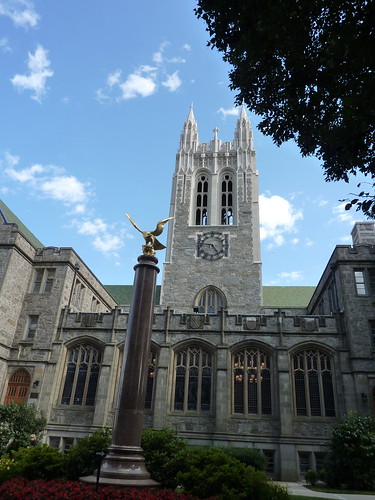
Image of BC's campus:

Tuesday, July 08, 2008

Oh, And One More Thing... Send a Check for $424k -- Er, Make That $660k

While Mayor Thomas Menino spent a couple of days last week in various interviews with reporters stating his opposition to key elements of Boston College's undergraduate housing proposals in their revised institutional master plan, he forgot to mention one thing: BC's proposed conversion of the apartment building at 2000 Commonwealth Avenue into an undergraduate dormitory would remove more than $400,000 from the city's tax rolls, because BC is a tax-exempt institution.

Today Mayor Menino continued his feud with the BC administration by insisting that BC should increase their Payment In Lieu Of Taxes (PILOT) by the $424,000 that will be removed from the tax rolls, according to the Boston Globe:
Today, Menino, through his spokeswoman, took aim at the college. "He believes BC should make that up somehow," said Menino press secretary Dorothy Joyce. "They don't do as much as their counterparts, and he'd like to see them do more."
Missing from the story is that the building is currently heavily under-assessed relative to similar, nearby comparable apartments; the city should be pushing for $660,000 in increased PILOT, not $424,000.

Mayor Menino's comments Tuesday echo earlier comments by District 9 Councilor Mark Ciommo, who called into question the wisdom of BC removing the property from the tax rolls.


Under-Assessed Property: Taxes Ought To Be $660,000 Not $424,00

Missing from the story is that the apartment building appears to be significantly under-assessed relative to a comparable apartment building in the immediate neighborhood.

The apartments at 2000 Comm Ave are typically split between 1-bedroom/3-room units with 700 square feet assessed around $165,000 (e.g., #806), and 2-BR/4-room units with 1000 sf assessed at around $240,000 (e.g., #805).

Comparable apartments at 1933 Comm Ave across the street are 1-BR/4-room units with 660 sf assessed at nearly $280,000 (e.g., #408), and 2-BR/5-room units with 1150 sf assessed at $350,000 (e.g., #403).

At $36 million, the total assessed value for the 188-unit apartment building at 2000 Comm Ave is therefore under-assessed; a more accurate assessment would be around 56% higher, or $56 million. The current property taxes for the entire building ought not to be $424,000 per year, but instead 56% higher, or $660,000 per year.

Note that 2000 Comm Ave is also a more modern building than 1933 Comm Ave and offers a range of additional, luxury amenities -- including the swimming pool in the photograph, spectacular views of the Chestnut Hill Reservoir, and others features you can see at Archstone's website. So, if anything, 2000 Comm Ave should be assessed even higher than the comparables.

When Mayor Menino is pushing for BC to increase their PILOT to account for the property tax payments on 2000 Comm Ave, the city should use $660,000/year as the baseline for negotiations -- not $424,000/year.

Why would the apartments at 2000 Comm Ave be so heavily under-assessed? I can only speculate that the developers of the building managed to get a "sweetheart" deal with the city to assess the property so low -- but, admittedly, I have no evidence whatsoever of any such agreement. It's a good question to ask the city's Assessing Department.


Is Raising PILOTs an Implicit Acceptance of the Conversion to a Dormitory?

One other problem with Mayor Menino's statement on Tuesday is that, as long as BC continues to operate the building as open market rentals, they already have to continue to pay property taxes since the property is not an "institutional use." Only if and when it switches to institutional use -- such as if it is converted into a dorm -- does the loss of property tax revenue come into play and the modified PILOT is a way to address it.

By raising the PILOT issue now, it sounds like Mayor Menino is implicitly accepting that BC will convert the building into a dorm. Doesn't the city have a say about the conversion? Doesn't BC need approval of that conversion both through the Article 80 review process (requiring approval of both the BRA Board and the Zoning Board) and through a city-issued dormitory license? If so, then the city could easily erect hurdles for BC by blocking their move through either the Article 80 review or the required dorm license.

University PILOT vary widely in their amount. Harvard University pays Cambridge, Watertown, and Boston a combined $5.1 million, while BC pays Newton and Boston a combined $315,000. Better uniformity in the PILOT would make sense, particularly since BC has demonstrated that they are not in dire straits -- having paid $173.4 million for the St. John's Seminary land in 2004-7 and $67 million for 2000 Comm Ave last month.

Monday, October 22, 2007

University PILOT Payments Detailed

The Boston Globe ran another story about university PILOTs (payments in lieu of taxes) to Boston and surrounding cities.  (BTW:  I carefully avoid repeating that repetitious phrase of redundancy, "PILOT payments.")  The story hook was a recent study by Newton's Blue Ribbon Commission on the Municipal Budget. 

A summary:

Berklee School of Music:  $175 thousand to Boston
Boston College:  $215 thousand to Boston; $100 thousand to Newton
Boston University:  $3.20 million to Boston
Harvard University:  $1.77 million to Cambridge; $1.75 million to Watertown; $1.60 million to Boston
MIT:  $1.22 million to Cambridge
Northeastern:  $137 thousand to Boston

How much is brought in by each city?

Boston:  $23 million per year (as of 2003)
Cambridge:  $3.6 million
Newton:  $100 thousand (apparently BC is the only university/college contributing)
Watertown:  $1.75 million (I'm not sure if there are any PILOTs other than Harvard)

The point put forward by Newton's Blue Ribbon Commission is that, for example, Boston College owns property in Newton with a combined, assessed value of $355 million -- one-third of the value of all the tax-exempt property owned within Newton -- and yet Newton only receives a very small PILOT.  (The remainder of the tax-exempt properties?  Roughly $300 million in governmental and religious institutional property.  Also, "Newton-Wellesley Hospital...  reported $392 million in net assets to the IRS in 2005," although assets are not the same as property holdings.)  BC's property value holdings are substantial, and their PILOTs appear disproportionately small by comparison to the other institutions listed here.
