Showing posts with label Archdiocese of Boston. Show all posts

Friday, April 16, 2010

PILOT Numbers Behind McGrory's Metro Column on BC

The Boston Globe's Brian McGrory has done his best to channel Howie Carr in today's metro op-ed column about how Boston College should be paying more in Payments in Lieu of Taxes (PILOT) to the City of Boston.

The problem with McGrory's argument that BC should contribute more PILOT to the city is that he didn't give a handle on what might be a reasonable expectation for those payments, particularly since only some of BC's property is located within Boston's city limits.

By looking at what BC might be expected to contribute in PILOT under the proposal recently made by the city's PILOT reform commission, BC ought to be contributing at least $1.6 million more to the city than they are currently paying through PILOT and real estate taxes.

Here's how I come by that number: Boston College's existing Chestnut Hill campus (just that part within the Boston city limits) are currently assessed at a valuation of around $480 million, according to the city's website. Add to that the 16-story apartment building at 2000 Commonwealth Avenue they purchased in 2008 and the former St. John's Seminary land they purchased from the Archdiocese of Boston for $177.4 million in a series of transactions between 2004 and 2007. Added together, those properties lying within Boston have a current value in the ballpark of $722 million, no small change.

The current property tax rates in Boston -- the amount that BC would be paying if they were not a tax-exempt institution -- are $12 (residential) or $29 (commercial) per year per $1000 of valuation for residential property. Since BC's primary financial activities are in education and research, not rental income, most of the land would fall under the commercial rate; I'll assume 75% commercial, 25% residential, or $25 per $1000 of valuation.

If BC were to pay full taxes on their property at that $25 rate it would total around $18.05 million per year. The city's commission that is looking at PILOT reform is recommending that tax-exempt institutions, like universities, voluntarily contribute PILOT at a rate of 25% of the tax rate -- corresponding here to $4.5 million -- of which the institution could elect to pay half in payments-in-kind (e.g., community benefits). The 25% figure is based on a calculation of the cost of city services the institution requires as part of its operation, such as the emergency response to many campus incidents (including Tuesday's ammonia leak at BC's Conte Forum).

Applying the commission's recommendations implies that BC should be contributing a minimum of $2.3 million cash in PILOT to the city, while BC is currently, according to McGrory, paying only $0.3 million in PILOT and $0.4 million in real estate taxes for taxed property. (Nearly all of the valuation for the taxed property is 2000 Commonwealth Avenue; since I include it in the PILOT calculation above, it is appropriate to consider it alongside BC's current PILOT.)

So BC should be paying at least $2.3 million in cash to the city, while they are currently paying only $0.7 million, a shortfall of at least $1.6 million. Based on the commission's recommendations, McGrory has a point that BC is underpaying the city for required city services.


McGrory's tone has evinced a torrent of outraged (and outrageous) comments -- channeling the tone of Howie Carr fans who comment at the Boston Herald's website -- nearly all from people defending BC from what they view as his unfair attacks on their alma mater. Read at your peril.


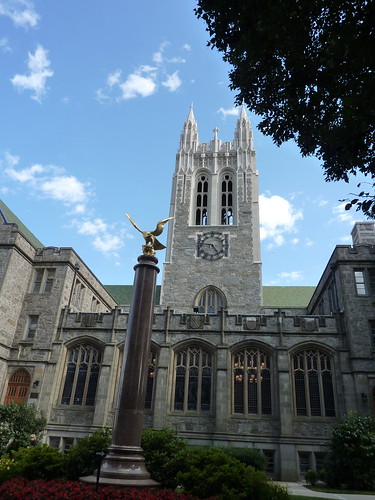
Image of BC's campus:

Wednesday, September 17, 2008

Tax-Exempt Bonds and the Purchase of Land from the Archdiocese

Boston College completed the final portion of the purchase of the St. John's Seminary lands and buildings (except for St. John's Hall) from the Archdiocese of Boston in August 2007 for $65 million.

Where did the actual cash for that transaction come from?

At Tuesday night's meeting of the BC Task Force, while discussing a broader issue of the credit crunch and how it might apply to the 10-year construction plan BC has proposed, I made a statement that BC was given authority in August 2007 to issue $177 million in tax-exempt bonds, some of which was to go to the purchase of that property from the Archdiocese. I didn't think it was a controversial statement.

BC's Director of Public Affairs, Jack Dunn, strongly disagreed, saying that "the notion that BC used public money to purchase the archdiocese land is inaccurate."

In so doing, Dunn made a statement in direct contradiction with one from the Massachusetts Development Finance Agency ("MassDevelopment").

The press release put out by MassDevelopment on August 13, 2007, announcing that the agency was granting approval for BC to issue $176,980,000 in tax-exempt bonds, was clear in stating that BC would be using the money to purchase the remaining portion of the archdiocese land:
The school will use proceeds from a tax-exempt bond to finance several construction projects and purchase 18 acres of land and buildings from the Roman Catholic Archdiocese’s former Brighton headquarters. Projects include the construction of three new academic buildings, a recreation complex and student center on the school’s Chestnut Hill campus.
Sounds rather declarative to me.

What's more, the press release, issued on MassDevelopment letterhead, listed two contacts for further information: Alicia Tildsley of MassDevelopment; and Jack Dunn of BC. Dunn's name was right on the top of the release.

The difference between Dunn's statement and the MassDevelopment press release raises the question: Did BC actually spend the money from the bonds in the way that MassDevelopment last year thought they would spend it?


Image of tax-exempt bonds by Paul Levy at the Running a Hospital blog.

Saturday, March 08, 2008

Mass Attorney General Calls for St. Elizabeth's to Become Community Hospital

Massachusetts Attorney General Martha Coakley released a report yesterday making series of recommendations related to governance, management, and organization to help the Caritas Christi Health Care System (CCHCS) to "address the challenges it faces and achieve stability." The Attorney General's study was done by an outside group, the Health Strategies & Solutions, Inc. (HSS).

The Caritas system as a whole has been plagued by financial problems, including a very low operating margin of 0.8% (compared with 3% for a "healthy" non-profit) and continued losses in the Caritas Physician Network (expected to be $15 million in 2008, down from $30 million in 2007). It has been without a permanent replacement for its chief executive officer for nearly two years.

St. Elizabeth's Medical Center in Brighton Center is part of the Caritas system, and operates as a teaching hospital affiliated with Tufts Medical School. The Boston Globe noted that St. Elizabeth's "is among the worst-performing hospitals in the Boston area, according to statistics compiled by the state Division of Health Care Finance and Policy."

The Attorney General's report makes a series of recommendations that, if fully implemented, could change the nature of the services provided by St. Elizabeth's. Some of the report's recommendations, from the Attorney General's press release and the viewgraphs accompanying it, are:
  • Diocesan leadership should relinquish control over strategic, operational, and financial matters to the independent Board of Governors. Diocesan leadership should retain influence only over matters of religious direction.
  • St. Elizabeth’s Medical Center in Brighton should continue its realignment as a community teaching hospital, with a concentration on two or three major service lines:
    • CCHCS leadership perceives one opportunity to be in the area of cardiovascular services.
    • Caritas St. Elizabeth’s should focus on its core service area, for the most part competing with local hospitals for patients.
    • HS&S understands that CCHCS has initiated a process to develop a contemporary strategic plan for Caritas St. Elizabeth’s.
  • The previous CCHCS administration developed a “System Forward” strategy which identified Caritas St. Elizabeth’s as the tertiary/quaternary referral center hub of CCHCS. Current CCHCS management understands that this is not a practical strategy.
  • Caritas St. Elizabeth’s has insufficient resources and capabilities to compete successfully for a wide range of tertiary care services in the highly competitive Greater Boston marketplace.
  • Caritas St. Elizabeth’s should function as a community teaching hospital, with continued emphasis (and development of advanced capabilities) in two to three major service lines where it can be competitive.
  • CCHCS has initiated a process to develop a contemporary strategic plan for Caritas St. Elizabeth’s.
  • Financial losses resulting from employment of or contractual arrangements with physicians should be addressed as a top priority.
  • Failure to successfully address these issues in a timely manner will result in deterioration of CCHCS’ competitive and financial positions.
According to the HHS presentation, having St. Elizabeth's operate as a tertiary care services facility appears not to have worked because: (1) St. Elizabeth's is "not clinically prepared or capable" of being a tertiary center; and (2) doctors from other hospitals in the system were not making referrals to St. Elizabeth's due both to the geographical distance between Caritas hospitals.

The Archdiocese of Boston owns the Caritas system. It has been looking to sell it for several years, but has limited the search to buyers who would maintain the religious foundation of the system. One buyer, Ascension Health of St. Louis, backed out of an agreement to purchase the system after disclosure that the physicians group had overstated its revenue by $10 million. A subsequent sale attempt to Catholic Health Initiatives of Denver also fell through.

The recommendation for the Archdiocese to relinquish governing control over the system is the top priority, according to a letter written by the Attorney General:
The most compelling priority confronting Caritas is the need for the Archdiocese of Boston to relinquish direct and indirect control over strategic, operational, and financial matters of Caritas while retaining influence only over matters of religious direction. Operating a hospital system is an extraordinarily complicated business, a recognition that has led virtually all religious organizations throughout the nation to transfer control to lay boards while in most cases maintaining a commitment to the religious principles upon which the systems were founded. Indeed, last year, the Archdiocese approached three different national organizations about potentially assuming control of Caritas -- all are lay organizations that adhere to and promote the religious principles of the Catholic faith.

It is in the best interests of Caritas that the Archdiocese transfer total control of the business of the system to an independent Board of Governors, which should have the sole authority to choose Board members and the chief executive, and to run Caritas in the manner it deems appropriate with no outside influence except on matters of religious direction.
Governance has been a recent problem for the Caritas system. Its chief executive officer, Dr. Robert Haddad, stepped down in 2006 due to allegations of sexual harassment. Caritas has been unable to fill that position ever since, resulting in a lack of top leadership during a time of challenging finances and competition.

St. Elizabeth's is currently undergoing a major construction project to expand and modernize its emergency department with a new building at the intersection of Washington Street and Cambridge Street. A new access road, which would start from near the intersection of Washington Street and Monastery Road, appears to be on hold since it was disclosed last summer that the archeological excavation would be required at the site. The access road also would pass close to St. Gabriel's Monastery, which is classified as a Local Landmark and is on the State Register of Historic Places.

Here's a link to the Boston Globe story about the Attorney General's Report in Friday's paper.

Sunday, February 24, 2008

It's Official: In Boston, St. Patrick's Day Will Be Celebrated On St. Patrick's Day

As most people know, the Roman Catholic Church's celebration of St. Patrick occurs annually on March 17.

This year the lunar calendar has resulted in an early Easter on March 23, which causes St. Patrick's Day to fall on Holy Monday -- the second day of Holy Week. (March 22nd is the earliest possible date for Easter.)

Irish bishops decided in 2007 to move the feast day of St. Patrick in 2008 to be earlier, on Saturday, March 15, to avoid the conflict. They didn't want to postpone St. Patrick's Day to April 1st, because it would create a scheduling mess with the civil celebrations.

Seán Cardinal O'Malley, Archbishop of Boston, notes, however, that Saturday, March 15 now conflicts with the official church calendar schedule for celebration of St. Joseph. (Did the Irish bishops realize this conflict?) Cardinal O'Malley doesn't want to bump the feast of St. Patrick a day earlier because March 14 is a Friday during Lent -- which is a traditional day of fasting (although now it is observed by not eating meat).

So Cardinal O'Malley has chosen instead to strike out a different path within the Archdiocese of Boston by celebrating the liturgical Mass for St. Patrick on March 17th, i.e., on St. Patrick's Day itself. That day also happens to fall on Evacuation Day, a civil holiday here.

There we have it: this year, St. Patrick's Day will be celebrated as a religious day on St. Patrick's Day -- here in the Archdiocese of Boston, but not in Ireland or in many other dioceses that follow the Irish bishops' lead.

Fortunately, this big mess won't happen again any time soon:
This marks the first time the date has been changed since 1940. The next conflict with Holy Week is not expected until 2160.
The construction mess over at St. Elizabeth's Medical Center has caused their annual Easter Egg Hunt to be moved over to the (former) St. John's Seminary land for the second straight year. But this year, it will occur a week early -- on Saturday, March 15th, the date of the entire church's St. Joseph's Day as well as the Irish bishops' St. Patrick's Day.

Next week: How I Learned to Stop Worrying and Start Leaping by Loving the Gregorian Calendar.

Monday, October 08, 2007

Presentation School Foundation Celebration Friday 10/12 in Oak Square

The Presentation School Foundation will be holding a celebration in Oak Square that is open to the public. Mayor Thomas Menino is scheduled to attend. Pizza and cake will be served. While the announcement of the event did not specify the reason for their celebration, my guess that it has something to do with securing sufficient funding to go through with the actual purchase of the former Presentation School building from the Archdiocese of Boston. The PSF has proposed to create a community center at the building, and have received wide-spread support across Allston-Brighton and among city leaders.

Presentation School Foundation Celebration
Friday, October 12th
3:30 - 8:00 pm -- Note earlier start time!!!
Oak Square, Brighton
For more information, contact Jennifer Doyle

Tuesday, August 21, 2007

Brown and Dying Pine Trees in Former Seminary Property


Along the northern side of Commonwealth Avenue in Brighton, in the land currently owned by Boston College (or about to be purchased by them from the Archdiocese), are many pine trees. A lot of these pine trees -- but not all -- appear to be browning and dying.

What is going on? Disease or pests? Inadequate watering? Chemicals being used on the soil?

It long seemed like the Archdiocese didn't have the financial resources to maintain the Seminary property (e.g., trees along Lake Street), but Boston College probably does. And they have a highly knowledgeable Urban Ecology Institute who ought to be able to figure out what to do to save these trees.

Monday, August 13, 2007

Boston College Gets $177 million in Tax-Exempt Bond Financing

The Boston Globe (boston.com) reports that Boston College has been approved for a $177 million, tax-exempt bond financing package for land purchase and building construction:
MassDevelopment, the state's finance and development authority, announced today a $177 million financing package for Boston College.

The school will use proceeds from a tax-exempt bond to finance several construction projects and purchase 18 acres of land and buildings from the Archdiocese of Boston; the property is the archdiocese's former Brighton headquarters, Mass Development said.

Projects include the construction of three new academic buildings on BC's Chestnut Hill campus, Mass Development said.
I have personally wondered where BC was getting the money they needed for their $172.400001 million land purchases since 2004 from the Archdiocese of Boston.* They are somewhwat financially poor relative to other area universities, having a comparatively small endowment of $1.6 billion as of May 2007. Their institutional master plan projects probably run, in sum, $500 million to $1 billion, but those are only poorly-informed, ballpark estimates. It is well-known that they are currently trying to raise large amounts of money from donors (particularly alumni) to fund their land purchases and expansive building and stadium construction projects, but I am not aware how much money they have managed to raise for that campaign.

Securing the tax-exempt bonds announced today are probably a major route for them to raise cash very quickly to fund their building boom.

Notice how the press release / Globe article only states: "Projects include the construction of three new academic buildings on BC's Chestnut Hill campus." I wonder if they will also use some of the funds raised by these bonds to pay for their proposed undergraduate dormitories and baseball stadium on the former Seminary land.


One last note: the Globe article quoted above includes hyperlinks. This has been something that online Globe articles have lacked (or been spotty to include), despite repeated criticism from the online blogging community. Nice to see them inserting hyperlinks!


* $99.4 million in 2004 for part of St. John's Seminary land and 192 Foster Street, $8 million in 2006 for tribunal building and parcel, $1 in 2006 for 188 Foster Street, and $65 million in 2007 for remainder of Seminary land and all buildings except for St. John's Hall.


NOTE (added 8/14/07): The press release provided by MassDevelopment includes other projects which are clearly part of BC's future, unapproved institutional master plan:
The school will use proceeds from a tax-exempt bond to finance several construction projects and purchase 18 acres of land and buildings from the Roman Catholic Archdiocese’s former Brighton headquarters. Projects include the construction of three new academic buildings, a recreation complex and student center on the school’s Chestnut Hill campus.
The recreation complex is certainly part of the master plan, the "student center" probably also is (i.e., probably referring to something contained within the recreation complex), and the 18-acre land purchase is slated to be completed later this month.

Wednesday, June 20, 2007

Boston College Details Building Uses for Latest Land Purchase from the Archdiocese

At the BRA's BC Task Force Meeting last night (June 19, 2007), Boston College officials described the land purchase of the remaining St. John's Seminary land (and all but one building).

Boston College will not file their Institutional Master Plan Notification Form (IMPNF) until late August or early September 2007, according to Thomas Keady, Jr., BC VP for Government and Community Affairs. The delay is due to the Archdiocese recently exercising their sale option on most of the remainder of the St. John's Seminary land; while this was expected to happen eventually, the timing appears to have been more rapid than anticipated. The sale is currently slated to be completed around late August, according to Jeanne Levesque of BC's Office of Government and Community Affairs.

In particular, BC will be purchasing Bishop Peterson Hall (but not St. John's Hall), which means that they are planning moving some uses around among buildings on the Brighton Campus. Here's a map from a previous post:

Here's a breakdown of the new uses for buildings on/around the Brighton Campus:
  1. St. John's Hall: remain as property owned and operated by St. John's Seminary, although its form of ownership will be re-classified as confdominium unit(s). BC will own the land under and around St. John's Hall, while the Seminary will own the building itself. BC and the Seminary will jointly run a kitchen. St. John's Hall has four floors plus a basement level.
  2. St. John's Seminary will receive an exclusive easement for parking and access to St. John's Hall. They currently have approximately 40 parking spaces; there was no indication of the number of spaces to be included in the deal.
  3. Bishop Peterson Hall will convert to BC ownership and use for offices/classrooms of the Weston Jesuit School of Theology. There will be no residential uses for the building. These offices/classrooms for WJST were originally slated for St. Williams Hall (which BC already owns).
  4. St. Williams Hall will now be used for academic, administrative, and/or business offices. It sounds like More Hall offices, for example, will now be moved to St. Williams Hall to free up the More Hall site for a new development.
  5. St. John's Library will be used jointly between BC and the Seminary; WJST will relocate their library collection into this building.
  6. Chancery will remain administative offices for Archdiocese for one year after BC purchases the property, prior to the Archdiocese's move to Braintree. BC's long-range plan shows that the Chancery will eventually be razed to make way for new buildings (e.g., academic) and their new access road into the campus. Ditto for the Creigh Library, as best as I could tell.
  7. Parking garage (?) and parking uses will remain for the time being.
Jeanne Levesque also announced that they would have a master plan website go public on July 16, 2007. Tom Keady said that the IMPNF and IMP would be made available on their website. Gerald Autler of the BRA said that BC Task Force meeting minutes will eventually be made available on the BC website; he planned on sending them out electronically to "everyone on his list" in the meantime.

The meeting had a lot more activity going on, though... and that will have to wait for post #2. Unless the A-B TAB beats me to it with their teaser:
"We know BC task force meetings can generate a lot of anger, but last night’s apparently took the cake is word on the street –at least as far as the amount of yelling and screaming it generated. One person apparently even felt the need to call the cops. We’ll have a story later."

Wednesday, June 13, 2007

Liberal and Conservative Catholics In Conflict Over Archiodecsan Sale to Boston College

The Boston Globe reports that the Rev. John Farren, a Dominican friar who resigned May 24 as head of St. John's Seminary, has written a letter to Sean Cardinal O'Malley objecting to the sale of most of the remaining seminary land to Boston College. It seems to be pitting at least one prominent, conservative Catholic against the more liberal Jesuits about to move in.

While Rev. Farren raised a number of "financial and legal concerns," he saves his harshest words for his staunch opposition to having Jesuit seminarians (from BC's new affiliation with the Weston Jesuit School of Theology) alongside St. John's Archiodesan seminarians:

The Rev. John A. Farren... warned in the letters last month that the "doctrinal integrity" of St. John's is at risk because of increased proximity to two Jesuit-run Catholic institutions, Boston College and Weston Jesuit School of Theology, which are expected to move into buildings currently held by the seminary.

"A sign of this is found in the fact that several professors of WJST are currently under investigation by the Congregation for the Doctrine of the Faith," [Rev. Farren] wrote, referring to the Vatican agency that investigates theologians accused of doctrinal error. "Several professors at WJST are self- professed gays or lesbians. Collaboration at such an institution is not good policy for St. John's Seminary."

Weston Jesuit and Boston College are generally considered liberal institutions open to a wider range of theological views than St. John's. Under Farren's leadership, several members of the seminary faculty perceived as liberal were ousted.

Cardinal O'Malley explained the sale on his blog and, in more detail, in a letter to Boston's Catholic newspaper, The Pilot. He has apparently written another letter to Archdiocesan priests in response to Rev. Farren's comments, but it appears not to have been released.

Monday, May 28, 2007

Two Perspectives on Sale of St. John's Seminary Lands to Boston College

First, Seán Patrick Cardinal O’Malley, in his blog, writes about his perspective on the sale of most of the remainder of St. John's Seminary to Boston College:
Proceeds from this sale will allow the Archdiocese to invest resources for the benefit of our parishes, clergy, St. John’s Seminary and the many important programs that serve a large number of people.
Several of those items were made very clear in the unprecendented release of the Archdiocesan financial records in the past year, but it is hard to avoid pointing out an apparent omission from Cardinal O'Malley's list: financing the settlements with the victims of sexual abuse by Archdiocesan priests.

Second, the head of St. John's Seminary resigned (a month earlier than scheduled) to protest the sale:
The Rev. John A. Farren, rector of St. John's Seminary since 2003, had been scheduled to step down on June 30 to take a new assignment in New York City, but Farren resigned last week after the school's board voted to support the sale of 18 acres of archdiocesan land to Boston College. Farren e-mailed a letter of resignation to the board on May 24 that detailed his fierce opposition to the sale, which includes the seminary's Bishop Peterson Hall as well as the seminary library.

Thursday, May 24, 2007

Archdiocese to Sell All But One Brighton Building to Boston College

The Boston Globe reported today that the Archdiocese of Boston will sell all but one building, "St. John’s Seminary," to Boston College for $65 million. I'm guessing again that the news story refers to the Archdiocese keeping "St. John's Hall" while selling "Bishop Peterson Hall." They expect to complete the sale by August 1, 2007, but the Archdiocese offices would not be moved completely to Braintree until July 2008.

Globe and Herald Editorials on Possible Archdiocese Office Move to Braintree

The Boston Globe and the Boston Herald have both published editorials today which offer support for the Archdiocese's possible (or probable) move of it administrative offices from the Brighton Chancery to Braintree. Mayor Menino is unhappy with the idea of a move, but the Herald says that the Mayor "picked the wrong fight here."

The Globe's piece put the issue into a wider context of the institutional expansion that Boston College is pursuing onto the former Archdiocese property now being referred to as BC's Brighton Campus. They note that land has "buffered the Brighton neighborhood from the growth of Boston College." Secretary of State Bill Galvin, a Lake Street resident, expresses neighborhood sentiment about BC's expansion plans: "There is a lot of concern -- use and density." The Globe editorial concludes that Mayor Menino "needs to balance the need for college expansion with the neighbors' concerns."

Update: Archdiocese Considering Moving Offices from Brighton to Braintree

The Allston-Brighton TAB reports:
“Speculation that the Archdiocese is moving its central operations from Brighton is premature at this point. We have been studying the long-term needs of the administrative offices of the Archdiocese and are exploring several scenarios,” Archdiocese spokesman Terry Donilon said.
Maybe they don't want to anger the Mayor?

Here's the original report from the Boston Herald.

Wednesday, May 23, 2007

Archdiocese Considering Moving Offices from Brighton to Braintree

The Boston Globe ran a front-page, above-the-fold, article in today's paper that the Archdiocese of Boston are in the "final stages of negotiating a deal to move their offices from the campus in Brighton... to a four-story building off route 128 in Braintree..."

Many of us heard unconfirmed reports on Monday that Archdiocese employees at the Chancery are currently packing up their office items, with a move completion targeted before September. The question is: where are they moving the offices?

While the Archdiocese is considering moving their central administration offices to Braintree, they plan to keep the St. John's Seminary itself at the same Brighton location:
"St. John's Seminary will remain at its current location, regardless of the outcome of our assessment of the long-term needs of central administration," said [archdiocesan spokesman Terrence C.] Donilon.
Boston College Vice President for Governmental and Community Affairs Thomas Keady, Jr., has stated publicly several times during the last month that the community can expect certain, additional parts of the Archdiocese property to be sold soon to BC as part of an Archdiocesan sell option within their 2004 purchase and sale contract with BC. Another BC official was heard speculating that the Archdiocese would pack their administrative offices into the St. John's Hall (within the St. John's Seminary buildings)--alongside the St. John's seminarians--but then sell the adjoining Bishop Peterson Hall (and the Chancery) to BC. Here's an old graphic from the St. John's Seminary site:

The Globe story implies that the Archdiocese may no longer be considering moving their administrative offices to St. John's Hall. While the Archdiocese has stated clearly that the seminarians are intended to stay in St. John's Hall, it is unclear whether or not the Archdiocese would sell the building and under what circumstances the seminarians would stay.

The reported sales price for the remaining property is $20 million for the 4.75 acre of the Chancery site, and $40 million for the 13.5 acre of the St. John's Seminary buildings site (and adjoining woods). I am guessing that the library is part of the latter parcel.

Since the Archdiocese and Boston College already have a purchase and sale contract which includes a sell option for these properties and a price, then why would they be in final negotations? My speculation is that they are negotiating sale of part of a parcel specified in the contract, and hence they would have to agree upon the size of the sub-parcel and its price. The likely parcel: selling Bishop Peterson Hall but not St. John's Hall. We'll see.

Note that Boston College's master plans have included buildings sited on the Chancery land not yet sold to them; there is little surprise at this point that it will be sold to BC. The surprise would be if the Archdiocese offices altogether move out of Brighton.

The Boston Herald first broke news of the story last Saturday.

A final note: The Globe's story includes a graphic of the Brighton property already sold, and that which may be sold in the immediate future. The graphic contains two subtle factual errors as to the seller of 196 Foster St (which was actually Virginia Dalton, not the Archdiocese), and the purchase dates of 188 and 196 Foster St (which were both purchased in 2006, not 2004).
