Showing posts with label housing. Show all posts

Monday, June 16, 2008

BC Task Force Meeting 6/16 to Consider Undergraduate Housing -- Note Change of Venue

BC Task Force Meeting
Monday, June 16th, 2008, 6:30-8:30 pm
Location: Yawkey Center, Murray Conference Room on BC's main campus in Chestnut Hill
NOTE: This is NOT the usual venue

Agenda: BC Revised Institutional Master Plan -- Undergraduate Housing

PARKING: Visitors should park at the Beacon Street parking garage [E3 on map at right]. Entrance to the parking garage is off Beacon Street, west of St. Thomas More Road.

After parking, exit the garage north towards Yawkey Center. The Murray Conference Room is on the fourth floor of the Yawkey Center.


Will the Revised IMP Accomodate Neighbors' Concerns?

In the public comment period after BC's initial filing of their IMP notification form, hundreds of Brighton residents either wrote letters or signed onto petitions focusing on two main positions related to BC's undergraduate housing:
  1. BC should provide on-campus for 100% of the undergraduate students; and
  2. None of those dormitory beds should be on the former St. John's Seminary land (Brighton Campus).
In order to accomplish this, many letters, including a petition circulated here at the Brighton Centered Blog, noted that there is sufficient space on BC's main campus in Chestnut Hill in order to locate the housing.

Will BC accomodate either of those two neighborhood goals? Likely not.


University-Controlled Housing vs. On-Campus Housing.
Word leaked out last month that BC had secretly won the bidding to purchase the 16-story, 188-unit apartment building at 2000 Commonwealth Avenue in Brighton. BC later confirmed their interest in the building, and that it would be considered for undergraduate housing. Estimates vary, but the building could likely hold 500-600 undergraduate students with two per bedroom.

All signs indicate that BC will present a plan on Monday evening that will house 100% of their undergraduate students, but that will not house all of them on-campus. Instead, 500-600 would be housed in what is off-campus, university-controlled housing at 2000 Comm Ave. No one would claim that 2000 Comm Ave is located on BC's campus, would they?

There are trade-offs associated with using 2000 Comm Ave as part of the housing package. The neighborhood has pushed for many years for BC to house their undergraduates, and hence, symbolically, BC will have crossed a major philosophical threshold by agreeing to the goal now for the first time. At previous meetings, BC officials have said that they will absolutely, never house 100% of their students; Monday night, they will likely backtrack on that position.

Using 2000 Comm Ave as a dormitory, however, means that 188 units of housing stock in Brighton will now be permanently unavailable to city residents. For a city whose leadership prides itself on increasing housing stock, converting the apartment building into a dormitory goes backwards. When city leaders regularly tout the numbers for the increase in housing units in Brighton, will they also subtract these 188 units from the balance sheet? Unlikely. Calls for the city's universities to house their students always assumed that the universities would build new housing, not convert existing housing. On top of that, buying this building is, by definition, institutional expansion further into a residential neighborhood.


Brighton Dorms Will Remain.
The visuals for the Fine Arts District presentation at the June 4th meeting of the BC Task Force were cropped versions from their master plan map -- but not cropped closely enough. In the corner of the visuals the Brighton Dorms could still be seen, indicating that they will continue to push for these dormitories that are enraging many in the neighborhood. These dorms housed 500 students in the previous version of the IMPNF; will they still?


Additional Housing on the Main Campus?
While the neighborhood pointed out that many hundreds of additional beds could be constructed on the main campus -- particularly by not razing 790-bed Edmonds Hall, adding stories to other planned dormitories, and making the replacement to the Mods housing more dense (rather than less so) -- indications are that, at most, only 100-200 additional beds would be added to the main campus compared to their December 2007 IMPNF.

BC has 7330 beds of undergraduate housing, and 8681 full-time students requiring housing. (9081 students in the 2007-8 school year, minus 400 students BC has identified who study abroad or are commuters living at home with parents.) The difference is 1351 required beds to accomplish 100% housing.

Since (1) the IMPNF added a net of 610 additional beds, (2) the Brighton Dorms appears still to be in their plans, and (3) 550 more beds are provided by 2000 Comm Ave, the result is that, at most, BC will likely be proposing only to add 100-200 beds to their previous proposal for their main campus. Such an outcome will not be a significant response to neighborhood input which looked for many hundreds more beds to be built on the main campus.


Abandoning the Argument Against Tall Dorms.
By purchasing a 16-story apartment building to be occupied as an undergraduate dormitory, BC is implicitly accepting the premise that there is absolutely no problem with housing undergraduate students in tall dormitories.

Such a position is an about-face from previous claims that their students behave unacceptably poorly in such tall dormitory buildings. Little or no reason now remains why the university cannot build a signature dormitory on their main campus following the model of their newly-purchased, off-campus building. Alternatively, they could add a couple of stories to their already-planned buildings.

Sunday, March 09, 2008

House Foreclosures in Allston-Brighton in 2007

I previously wrote about how the housing foreclosure market appears to be mostly passing by Allston-Brighton, based on no foreclosures in A-B for January 2008.

The Boston Globe's City Weekly has a front-page story in today's paper providing statistics (from the Warren Group) for all housing foreclosures in Boston in 2007 which confirms this picture. Allston-Brighton had thirteen foreclosures during all of 2007 -- far fewer than the hardest-hit neighborhoods, particularly Dorchester, and a small fraction of the 705 foreclosures throughout Boston.

(Photo credit: Erik Jacobs for the Boston Globe.)

Wednesday, February 20, 2008

Local Impacts of Proposed City Ordinance on Student Off-Campus Dwellings

The Boston City Council is considering an ordinance that would petition the Boston Zoning Commission and the Board of the Boston Redevelopment Authority to ban more than four off-campus students from living together in a single apartment. The proposed ordinance will be presented and discussed at Wednesday night's meeting of the Allston Civic Association.

A recent court case and subsequent consent decree defined what kind of living arrangements constitute an illegal boarding-house, which, in effect, loosened up the restrictions. As long as unrelated residents of an apartment shared common space, such as kitchen and bathrooms, do not have locks on individual bedroom doors, and don't individually rent from the owner, then the occupants are considered a "family" unit that can legally rent an apartment together. Off-campus student housing in Allston-Brighton often lawfully exceeds four students per apartment. "Club Kirkwood" is one notable example.

Can students be separately categorized in an ordinance such as this one? Likely yes, according to a government housing specialist contacted recently, because students do not consitute a protected housing class under federal or state law. If Ross's proposed ordinance were to restrict housing on the basis of race, however, it would be illegal, because ethnicity is a protected housing class. (On a related, albeit not identical, issue, Boston College administration officials have recently proposed instituting a ban on their undergraduates from living in 1- and 2-family houses in three zip-codes in Allston-Brighton and Newton, a policy which BC officials have stated publicly several times has been checked for its legality.)

District 8 City Councilor Michael Ross wrote in a January 25, 2008 letter to John Palmieri, the Director of the BRA:
Since [2003] the current definition of family remains unresolved, causing an ambiguity in the law and its enforcement. As a result, unscrupulous landlords have taken advantage of this limbo by packing upwards of ten students into college apartments that once housed families. These actions have subsequently raised rents to a level where virtually no one can afford to live within certain neighborhoods of the city. The proposed change to the zoning code will require that landlords cap the number of students living within one dwelling to four, thereby restoring a semblance of control to what has become an escalating crisis.
BC's student newspaper, The Heights, ran a news story on the issue and also an editorial opposing the proposed ordinance. The editorial says that the proposed ordinance treats students "unfairly" and is "counter-productive to the constituency it seeks to placate" -- i.e., "neighbor's concerns about loud parties and poorly-kept residences."

As the aforementioned example of Club Kirkwood indicated, however, the problems of the over-crowded housing are code violations and dangerous conditions. I wrote back in October 2007:
As Bill Mills noted at the October 16th meeting of the BC Task Force, they allegedly found smoke detectors had been removed from the ceilings, missing CO detectors, underage drinking, and so on. A sting operation was planned for inspectors from the city's Inspectional Services Department, which identified other problems -- such as residents illegally housed in the basement, others housed in parts of the attic that don't meet height requirements, and locks on the bedroom doors (that might have constituted an illegal boarding house).
The news story in The Heights makes a series of unattributed statements, some of which appear to be factually incorrect. An example:
The effect [of the ordinance on student-occupied off-campus housing] is not wholly seen in the Brighton area that surrounds BC, mainly because most of the houses are owned by the people living in them.
The owner-occupied housing rate was only 19.3% in Allston-Brighton in the 2000 U. S. Census; in Brighton alone, the rate was 23.6%. Of owner-occupied housing in Allston-Brighton, only 26% of the units had more than 0.5 persons per room, while 49% of renter-occupied housing units did. The conclusion from the census data: most of Allston-Brighton's housing stock is renter-occupied, and the rental units are, on average, more packed with occupants than the owner-occupied units. It is hard to know where The Heights gathered its facts since so many of the story's statements, such as the one above, have no attribution.

Small Property Owners of America opposes the proposed ordinance, providing a series of arguments against it: displacement and high rents; de facto rent control and devaluation; housing shortage and higher rents; and college and university concerns.


Councilors Ross and Ciommo to Attend ACA Meeting on Proposed Ordinance

Councilors Michael Ross and Mark Ciommo will be appearing at a meeting Wednesday night of the Allston Civic Association in order to discuss the proposed ordinance.

Councilor Ross submitted the original petition in December 2007. His office is spearheading the effort to pass the ordinance. In a community-wide letter sent out recently by staff member Johanna Sena, she anticipates that "this issue will be coming before the BRA Board for their approval at the end of February and before the Zoning Commission in early March."

The text of the ordinance proposes a change in the definition of "family" under the Boston Zoning Code, so that it would be defined as:
'Family' one person or two or more persons related by blood, marriage, adoption or other analogous family union occupying a dwelling unit and living as a single, nonprofit housekeeping unit, provided that a group of five (5) or more students enrolled at or attending a post-secondary educational institution shall not be deemed to constitute a family. A group residence, limited... shall be deemed a family.

The meeting of the Allston Civic Association will be:

Wednesday, February 20, 2008
Honan-Allston Library
300 North Harvard Street
Allston, MA 02134

Other items on the agenda are listing at Harry Mattison's blog.

Some questions I would like to see addressed in the meeting:
  • How will the city prevent the landlords from obtaining zoning variances in order to chop up the housing into smaller and smaller units to keep each unit's occupancy below five?
  • What is that anticipated increase in expense for off-campus housing for various neighborhoods of the city, e.g., Brighton, where occupancy would suddenly switch from, say, ten tenants to four?
  • What are the universities' plans for dealing with the added increase in off-campus housing that will result? In particular, what would Boston College possibly do to provide on-campus housing for its students with greatest financial need who might not be able to deal with the rental increase?
  • If half the Radnor/Kirkwood/Upper Foster area off-campus students, for example, were suddenly required to find alternative housing, where do real estate professionals believe that they would be most likely to move in the current housing market?
  • What fraction of the impacted rental units are suitable for family housing, and what fraction are excessively-sized such that they are beyond the needs and/or means of most families?

UPDATE: UniversalHub has a series of comments posted about this topic.

Wednesday, January 30, 2008

MHC Calls for BC to Explore Alternatives to Demolition of Three Houses on Foster St

In a letter to the Boston Redevelopment Authority, the Massachusetts Historical Commission (MHC) argues that "alternatives to demolition must be explored" by Boston College for three "historic properties" on Foster Street. The alternatives identified by the MHC "must include rehabilitation and reuse of the Foster Street houses."

In its Institutional Master Plan Notification Form (IMPNF) of December 2007, Boston College proposed to demolish the three houses and build townhouse-style housing on the five-acre site in order to provide 75 beds of housing for Jesuit seminarians, theology graduate students, and faculty of BC's new School of Theology of Ministry. The need for the housing is a result of the re-affiliation of the Weston Jesuit School of Theology with BC in Fall 2008; the WJST is currently located in Cambridge.

The three Foster Street houses date from approximately the 1880's. The houses "display elements of Victorian eclectic style and are fine examples of this period and type of construction," according to the MHC letter. All three houses are identified in the appendix of BC's IMPNF as being listed in the National Register of Historic Places.

The letter of January 18, 2008, was written by Brona Simon, Executive Director and State Historic Preservation Office of the Massachusetts Historical Commission, and addressed to John Palmieri, Director of the Boston Redevelopment Authority. It was written in response to Boston College's Institutional Master Plan Notification Form, which was filed with the BRA on December 5, 2007. Elsewhere in the letter the MHC also requests an "intensive (locational) archaeological survey" at the former St. John's Seminary property and Evergreen Cemetery.


Alternatives to Demolition

The fate of the three houses has been documented previously on the Brighton Centered Blog. I previously suggested that BC consider keeping the houses, which sit on one corner of the lot, and renovate them instead. The houses could be incorporated into the new housing in a manner similar to what Harvard University did for the University Place development in Harvard Square a quarter-century ago. (I also wrote that the topic of housing on that site is a potential minefield for the City Council candidates, due to the large Jewish Orthodox community abutting the site on Portina Road.)

In response to those suggestions to preserve the buildings, Thomas Keady, Jr., Vice President for Governmental and Community Affairs at BC, told BostonNOW, "I don't believe that they are [historically significant]. Those three houses will be coming down."

Alternatives to demolition are described in the MHC letter:
The IMP should study alternatives to the demolition of these houses in order to protect and preserve the character-defining elements of the Foster Street area, such as the uniform setbacks of houses, size and scale of residences, and mature vegetation. Alternatives to demolition must be explored and must include rehabilitation and reuse of the Foster Street houses. Rehabilitation alternatives should include additions to the existing houses and/or compatible, adjacent new construction. Feasible alternatives that would preserve and protect the historic properties should be adopted and implemented.
The BC Task Force wrote a letter to Keady on August 25, 2004, in which they asked that BC "consider relinquishing control of the two homes" (owned at the time by BC; the third was purchased in 2006) as a "symbolic act" to the community, thereby allowing the houses to be purchased by Allston-Brighton residents "unable to find housing at an affordable price in this community." (In 2004, BC had not proposed demolishing the houses; in fact, the WJST had not yet announced plans to re-affiliate with BC.)


Should the Upper Foster Street Area Be Listed in the National Register of Historic Places?

The MHC letter goes beyond the three houses to argue that the surrounding neighborhood -- the Upper Foster Street Area, which is part of the MHC's Inventory of Historic and Archaeological Assets -- is a "cohesive collection of late 19th century architectural styles" which the MHC believes "meets the criteria for listing in the National Register of Historic Places."


Analysis

The MHC letter uses strong language that "alternatives to demolition must be explored" [emphasis added], as well as that "demolition of these historic properties would constitute an adverse effect... through their complete destruction and through the construction of new buildings that are out of scale and character, and would alter the setting of the Foster Street area."

Addressing these concerns will be quite a challenge for BC's proposed use of the site as Jesuit seminarian housing to go forward. The nature of the comments call into question not just the demolition of the houses, but also the setbacks from the street, the "size and scale of residences," and the woods that cover much of the five acre site.

Increasing the setback of the new buildings from the street would decrease the size of the interior courtyard, while reducing the size and scale of the housing would decrease the capacity of the site for housing the Jesuit seminarians, faculty, and theology graduate students in the current proposal.

Some alternate sites exist for housing the seminarians, but BC officials have rejected those suggestions during the past year. St. William's Hall on the former St. John's Seminary property proper housed students for a year who had been displaced from New Orleans after Hurricane Katrina. Capacity for housing in Bishop Peterson Hall (owned by BC) or St. John's Hall (still owned by St. John's Seminary) is unclear.

Without saying so explicitly, the MHC letter makes it clear that preservation of historical properties contained within the former St. John's Seminary land will be vigorously pursued by the at least one state agency.

Tuesday, March 27, 2007

BC Proposes to Raze Three Single-Family Houses

At the previous meetings of the Boston College Task Force, the Boston College planners presented proposals for the usage of three lots at 188, 192, and 196 Foster Street. All three have single-family, detached houses on their property which, according to local experts, have significant historical and architectural value.

192 Foster Street also connects to a much larger open space that includes a forested section, a field, fenced tennis courts recently converted to BC parking, and the Foster Rock granite outcropping. The total area is 5.16 acre.


BC is proposing to demolish all three single-family homes as part of their plan to put 70 beds of town-house-style, seminarian housing on the lot.

Here is the piece of their master plan visual showing the upside-down, U-shaped seminarian housing complex they propose:

which avoids building on Foster Rock, but otherwise develops much of the lot.

These three, single-family, detached houses represent 2% of all such houses in the neighborhood (Census Tract 4.02, which is bounded by Washington St, Lake St, Comm. Ave, and Chestnut Hill Ave).

At a time when owner-occupied housing has decreased to 20% overall in Allston-Brighton -- and from 34 to 30% in this census tract (1990-2000) --

Should BC be buying up single-family houses in order to demolish them and build institutional housing?


Join the discussion of the topic at the BC Neighbors Forum (a Google Group).

---------------------------------------------------------------------------------------------------------
Here's some information about the three properties in question:
---------------------
Address.........Parcel ID......Owner..............................Notes
188 Foster St 2204960010 Trustees of Boston College (A)
192 Foster St 2204960020 Trustees of Boston College (B)
192 Foster St 2204960021 Trustees of Boston College (C)
196 Foster St 2204959001 Boston College (D)

(A) "Apartment building," currently on tax rolls, but purchased 2/1/06
from Roman Catholic Archbishop of Boston for $1.

(B) Land under the building, and adjacent open space lot, totalling
212,137 sq. ft., currently not on the tax rolls. Purchased
6/29/04 as part of $99.4M "Lake Street" transaction with the
Archdiocese. Currently assessed at $5,088,500, which would
correspond to $55,922 at residential rate or $136,728 at
commercial tax rate. Contains tennis courts that were converted
a couple of years ago to a parking lot (legality unclear).

(C) Building itself, classified as an apartment, currently on tax
rolls.

(D) Single-family house, purchased from Virginia Dalton on 5/5/06.
---------------------

If the Archdiocese has any more single-family houses they want to sell for $1, I'll buy them!!!

Sunday, March 25, 2007

Allston-Brighton Neighborhood Planning Initiative Meets Tuesday at 6:00pm

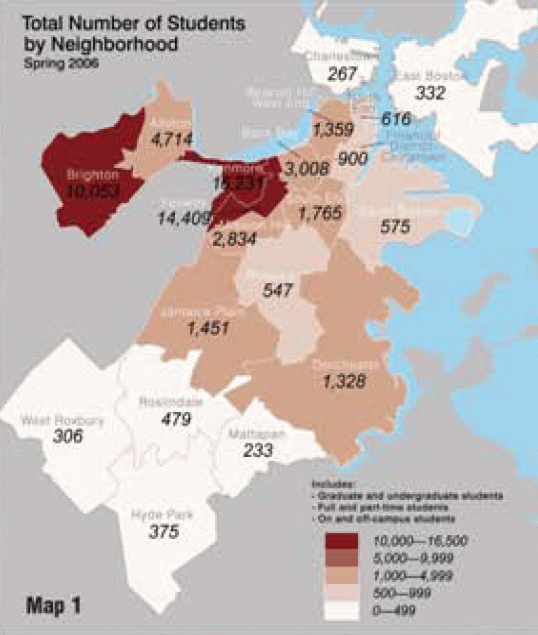
Did you know that 21% of Allston-Brighton residents are college students?

How about that 19% of all of the City of Boston's college students live in Allston-Brighton?


Or that Allston-Brighton's owner occupants only occupy their residence for eight years on average, well-below the city's average of ten years?

These were among the interesting facts presented by the BRA's planner, Carlos Montanez, as he kicked off the first meeting of the Allston-Brighton Neighborhood Planning Initiative on March 7.

The ABNPI website is at:

http://www.cityofboston.gov/bra/Planning/PlanningInitsIndividual.asp?action=ViewInit&InitID=123

which includes links to the presentation made by Mr. Montanez, as well as the summaries of the four group's discussions.

The next meeting of the ABNPI's focus group will be on Tuesday, March 27 at 6:00-9:00pm in the Jackson-Mann Community Center. This meeting will be more of a "working group" session to synthesize comments made at the previous meeting, although it is an open meeting that will include time for public comment. A future meeting on April 24th will focus on Transportation and will be more interactive for the public.