Showing posts with label off-campus. Show all posts

Tuesday, July 08, 2008

Oh, And One More Thing... Send a Check for $424k -- Er, Make That $660k

While Mayor Thomas Menino spent a couple of days last week in various interviews with reporters stating his opposition to key elements of Boston College's undergraduate housing proposals in their revised institutional master plan, he forgot to mention one thing: BC's proposed conversion of the apartment building at 2000 Commonwealth Avenue into an undergraduate dormitory would remove more than $400,000 from the city's tax rolls, because BC is a tax-exempt institution.

Today Mayor Menino continued his feud with the BC administration by insisting that BC should increase their Payment In Lieu Of Taxes (PILOT) by the $424,000 that will be removed from the tax rolls, according to the Boston Globe:
Today, Menino, through his spokeswoman, took aim at the college. "He believes BC should make that up somehow," said Menino press secretary Dorothy Joyce. "They don't do as much as their counterparts, and he'd like to see them do more."
Missing from the story is that the building is currently heavily under-assessed relative to similar, nearby comparable apartments; the city should be pushing for $660,000 in increased PILOT, not $424,000.

Mayor Menino's comments Tuesday echo earlier comments by District 9 Councilor Mark Ciommo, who called into question the wisdom of BC removing the property from the tax rolls.


Under-Assessed Property: Taxes Ought To Be $660,000 Not $424,00

Missing from the story is that the apartment building appears to be significantly under-assessed relative to a comparable apartment building in the immediate neighborhood.

The apartments at 2000 Comm Ave are typically split between 1-bedroom/3-room units with 700 square feet assessed around $165,000 (e.g., #806), and 2-BR/4-room units with 1000 sf assessed at around $240,000 (e.g., #805).

Comparable apartments at 1933 Comm Ave across the street are 1-BR/4-room units with 660 sf assessed at nearly $280,000 (e.g., #408), and 2-BR/5-room units with 1150 sf assessed at $350,000 (e.g., #403).

At $36 million, the total assessed value for the 188-unit apartment building at 2000 Comm Ave is therefore under-assessed; a more accurate assessment would be around 56% higher, or $56 million. The current property taxes for the entire building ought not to be $424,000 per year, but instead 56% higher, or $660,000 per year.

Note that 2000 Comm Ave is also a more modern building than 1933 Comm Ave and offers a range of additional, luxury amenities -- including the swimming pool in the photograph, spectacular views of the Chestnut Hill Reservoir, and others features you can see at Archstone's website. So, if anything, 2000 Comm Ave should be assessed even higher than the comparables.

When Mayor Menino is pushing for BC to increase their PILOT to account for the property tax payments on 2000 Comm Ave, the city should use $660,000/year as the baseline for negotiations -- not $424,000/year.

Why would the apartments at 2000 Comm Ave be so heavily under-assessed? I can only speculate that the developers of the building managed to get a "sweetheart" deal with the city to assess the property so low -- but, admittedly, I have no evidence whatsoever of any such agreement. It's a good question to ask the city's Assessing Department.


Is Raising PILOTs an Implicit Acceptance of the Conversion to a Dormitory?

One other problem with Mayor Menino's statement on Tuesday is that, as long as BC continues to operate the building as open market rentals, they already have to continue to pay property taxes since the property is not an "institutional use." Only if and when it switches to institutional use -- such as if it is converted into a dorm -- does the loss of property tax revenue come into play and the modified PILOT is a way to address it.

By raising the PILOT issue now, it sounds like Mayor Menino is implicitly accepting that BC will convert the building into a dorm. Doesn't the city have a say about the conversion? Doesn't BC need approval of that conversion both through the Article 80 review process (requiring approval of both the BRA Board and the Zoning Board) and through a city-issued dormitory license? If so, then the city could easily erect hurdles for BC by blocking their move through either the Article 80 review or the required dorm license.

University PILOT vary widely in their amount. Harvard University pays Cambridge, Watertown, and Boston a combined $5.1 million, while BC pays Newton and Boston a combined $315,000. Better uniformity in the PILOT would make sense, particularly since BC has demonstrated that they are not in dire straits -- having paid $173.4 million for the St. John's Seminary land in 2004-7 and $67 million for 2000 Comm Ave last month.

Tuesday, July 01, 2008

Mayor Menino Opposes BC's Tactics, Including Alumni Letter

The Boston Herald quotes Dot Joyce, spokeswoman for Mayor Thomas Menino, as saying that “The mayor is opposed to [Boston College's] tactics" in pushing for their revised institutional master plan.

In particular, Joyce expressed Mayor Menino's dislike for a letter that William Leahy, S. J., President of Boston College, sent to alumni last week asking them to contact city and elected officials in Boston to express support for the revised IMP:
This Institutional Master Plan is critical to our future, and I hope that all members of the Boston College community will take the time to review it and then assist in the approval process. In particular, I ask that those of you who are residents of Boston express your support to elected officials, especially district city councilors and the BRA.
The Herald article follows up on yesterday's story in the Banker & Tradesman in which Mayor Menino said that BC is engaged in "double speak" when describing how they propose to provide university-controlled housing for 100% of their undergraduate students. Mayor Menino objected -- pointing out that "2000 Comm Avenue is not on their campus. I’d rather see them live up to their commitment to house all of the students on campus.”

The Herald article contains a point that is confusing -- if not outright mixed up:
Joyce said the mayor’s “double-speaking” remark was only a reference to BC’s alumni letter, which didn’t mention that 2000 Commonwealth Ave. is off-campus.
The Herald correctly reports that the alumni letter did not specifically mention 2000 Comm Ave, but the Banker & Tradesman direct quotation from Mayor Menino clearly puts it in the context of 2000 Comm Ave, since he mentions it by name. I'm not sure if the Herald got it wrong, or if Joyce did.

The Herald reporter also appears to have asked some tough questions, pushing Joyce to try to get the Mayor's firm position, for or against, both BC's purchase and conversion of 2000 Comm Ave and their IMP in general. Joyce didn't bite:
Joyce stopped short of saying Menino outright opposes BC’s master plan, especially its purchase of 2000 Commonwealth Ave. - about one-third of a mile from BC’s main campus and where the college hopes one day to house hundreds of students.

BC Closes on 2000 Comm Ave for $67 Million

The Suffolk County Registry of Deeds Monday recorded the purchase by Boston College of the apartment building at 2000 Commonwealth Avenue for $67 million.


BC has previously announced that they want to turn it into an off-campus, university-controlled undergraduate dormitory housing 560 students. Mayor Thomas Menino made a statement on Monday saying that he considered the building to be off-campus, and that he would "rather see them live up to their commitment to house all of the students on campus.”

Monday, June 30, 2008

Mayor Menino Calls BC's Purchase of 2000 Comm Ave "Double Speak"

Mayor Thomas Menino has called BC's purchase of the 17-story apartment building at 2000 Commonwealth Avenue "double speak" because their plan to house 100% of their undergraduates does so by purchasing an off-campus building rather than building an on-campus dormitory.

Mayor Menino's statement today implies that he rejects BC's careful word parsing which sought to equate "100% university-controlled housing" with "100% on-campus housing."


Focus on Terminology

Today's statement was the first time Mayor Menino has spoken on the topic since the story was broken six weeks ago by GlobeSt.com that BC was pursuing purchasing the apartment building for $67 million. He told Banker & Tradesman:
“BC is double speaking here,” Menino said. “They’ve said they’re going to have beds for all of their undergraduates on campus, but 2000 Comm. Ave. is not on their campus. I’d rather see them live up to their commitment to house all of the students on campus.”
Mayor Menino has aggressively pushed for a number of years for the city's colleges and universities to house increasing numbers of their undergraduates. Prior to BC's announcement that they wanted to purchase 2000 Comm Ave, it was unclear whether he meant "on-campus housing" or "off-campus, university-controlled housing."

The statement quoted by Banker & Tradesman makes it clear that Mayor Menino wants universities to build new housing rather than purchasing and converting existing housing stock in order to address his city-wide plan for additional student housing.

BC officials have been quite careful in their use of the term "university-controlled" or "university housing," rather than "on-campus" housing. Jack Dunn, Director of Public Affairs at BC, used the term "university housing" with the Boston Globe. Thomas Keady, Jr., Vice President of Governmental and Community Affairs at BC, was quoted in the Allston-Brighton TAB as calling it "Boston College housing"; elsewhere in the TAB's article they correctly called it "university-controlled dorms." The Boston Herald heard the talking points clearly in story two on the topic, while in their first story they mistakenly thought BC was actually proposing to build 1280 new beds. (The correct answer is 720 new beds and 560 converted beds added by buying 2000 Comm Ave. The Boston Globe made the same mistake.) WBZ's two reporters were both mixed up by incorrectly using the term "on-campus" for the dormitories, as did the Boston Bulletin.

Mayor Menino has seen through the carefully-parsed wording coming out of BC. Today's statement reflects that he thinks the appropriate term is "on-campus housing" -- and that BC's plan doesn't achieve it.


Implications of Today's Statement

The Boston Globe's editorial board wrote recently that BC should actively pursue options more agreeable with the neighborhood in order to "smooth the permitting process with the city." That Mayor Menino has problems with BC's plan for using 2000 Comm Ave as an undergraduate dormitory indicates that the potential threat of denying various occupancy and/or construction permits has just increased in its probability. It was Mayor Menino's indication to the BRA on the permitting issue that killed Suffolk University's proposed dormitory on Beacon Hill in December 2006:
Suffolk needed city permits for the 22-story building, but at Menino's request, Maloney yesterday told Suffolk University vice president John A. Nucci the city's support would not be forthcoming -- which means it is all but dead.
Mayor Menino previously announced his opposition to BC's proposal to build several dormitories totalling 500 beds of housing on the former St. John's Seminary land purchased from the Archdiocese of Boston in 2004-7. BC refers to that housing as the "Brighton Dorms." He is now on record opposing two key elements of BC's proposed undergraduate housing plan.

The Brighton neighborhood and BC are currently locked in an argument over the location of undergraduate housing as part of BC's proposed 10-year institutional master plan. The most recent public meeting on the topic, held by the Boston Redevelopment Authority's BC Task Force, was a raucous affair in which the proceedings were interrupted often by protesters both over BC's planned purchase of 2000 Comm Ave and BC's desire to build the Brighton Dorms.

BC's Dunn appears not to like having a public discussion of BC's proposal to buy 2000 Comm Ave and convert it into a dormitory. Dunn told the Banker & Tradesman that he welcomes having the discussion "in private with the Mayor." The Boston Bulletin reported that the audience laughed at Dunn's comments at the June 14th public meeting.

Another public meeting on the topic is scheduled for tonight, which is an opportunity for neighborhood residents to discuss the issues of the university's expansion amongst themselves.


Residents and Non-Residents Write About About BC's Plan

The Boston Globe last week published several letters-to-the-editor on the topic. Neighborhood resident Lisa Lieberman in which she spoke of BC's plan to purchase 2000 Comm Ave:
It is disingenuous of Boston College to suggest that it is getting students out of our neighborhood when in fact it is just shuffling students from one place to another within our community.
Joseph Zadella of Cambridge sees it differently, suggesting that the 33-student building at the corner of Greycliff Road and Commonwealth Avenue has already eliminated any buffer between campus and student dormitories.

Framingham resident Craig Carlson thinks that all the disagreement is caused by "paid community activists and residents," though he didn't seem to have figured out who had all this money to pay them. While I haven't requested pay stubs from BC, my understanding is that BC officials like Keady and Dunn are the ones getting paid in this process -- not the neighborhood residents. I wonder if Carlson would mind if his letter were rewritten to state that all the disagreement is caused by "paid BC officials and employees"?

Brighton residents: is your check in the mail? Quick, look!


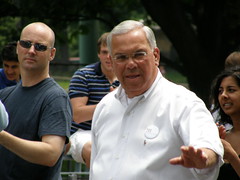
Image of Mayor Menino by Dan4th provided through a Creative Commons license.

Tuesday, June 17, 2008

Animated and Angry Crowd Confronts Boston College's Revised Master Plan

"No dorms on Brighton Campus! Change this plan, please!" [Referring to proposed dormitories on the former St. John's Seminary land purchased by Boston College in 2004-7.]

"You're taking your problem and making it our problem!" "It's not on-campus!" [Referring to BC's purchase of the apartment building at 2000 Commonwealth Avenue, which they intend to turn into an off-campus undergraduate dormitory.]

"That's blackmail!" [Referring to attempts by Jack Dunn, BC's Director of Public Affairs, to withhold more popular elements of their master plan unless the entire plan would be approved by the city and neighborhood.]

"Build them higher!" [Referring to five-story dormitories proposed to replace the two-story Mods dormitories on BC's main campus in Chestnut Hill.]

These were repeated shouts from the audience that time and again interrupted Boston College's presentation of their revised institutional master plan Monday night at the Yawkey Center on BC's campus.

Neighborhood meetings can often be total yawners, where residents argue for hours over the smallest details of setbacks, zoning variances, brick color, and window design.

Not so on Monday night. The meeting was nothing short of a raucous affair. The air was theatrically punctuated by rapid-fire flashbulbs from two news photographers.

Thirteen months ago, Thomas Keady, Jr., Vice President for Governmental and Community Affairs at BC, said at one such meeting that he didn't enjoy getting his "head kicked in." There was little question: Monday night was more than just another head-bashing.

BC officials, Boston Redevelopment Authority project managers, and BC Task Force members struggled to keep order in a room crowded with 200-250 people who kept shouting out their anger, frustration, exasperation, and profound disagreement with the undergraduate housing proposals that BC presented as their response to the Scoping Determination on their 10-year IMP issued in February by the BRA.

The university passed a significant milestone Monday by embracing the concept of providing university-owned housing for 100% of their undergraduate students.

University officials insisted that the neighborhood's price for this achievement would be accepting conversion of an off-campus apartment building into a dormitory and construction of new dormitories for the former St. John's Seminary land. Many neighborhood residents disagreed strongly with both premises, insisting that the solution lies in constructing more and/or taller dormitories on BC's main campus in Chestnut Hill.


BC Proposes 100% Undergraduate Housing -- But Some Will Be Off-Campus in the Neighborhood

Keady explained to the audience that there were two major changes to their undergraduate housing proposal.

First, he confirmed that approximately three weeks ago BC entered into a purchase and sale agreement to buy the 17-story apartment building at 2000 Commonwealth Avenue. While Keady claimed the purchase was "one of the worst-kept secrets in Allston-Brighton," many residents of nearby buildings spoke -- or shouted -- that they knew nothing about it until the last few days. "I haven't heard anything about it," said a resident of nearby 1988 Comm Ave.

The obvious reason why they hadn't heard about the purchase? The story broke a month ago online, but was not picked up by the mainstream media -- in part because BC officials refused to speak about the topic at two neighborhood meetings earlier this month.

Second, BC was now presenting a plan that would house 100% of their undergraduates in university-controlled housing -- some of which would be that new building at 2000 Comm Ave. "It's not on-campus!" came the audience replies.

It was this second point that was met with repeated, yet measured, praise from many in the task force and audience.

"The fact that this is now BC's goal is a huge achievement, because it has been the neighborhood's goal for about 15 years," said task force member Paul Berkeley.

"I applaud the 100%" target for undergraduate housing, said task force member Kevin Carragee. He gave his biggest praise to the residents, however, who kept pushing for the goal. "I want to thank the people who have been at these meetings for 15 years," he said.

Radnor Road resident Bruce Kline summarized the meeting at the end, saying that, aside from the addition of 2000 Commonwealth to their plan as a new undergraduate dormitory, the plan "is basically the same" as before.

Kline appeared accurate in his observations. In this revised plan, BC only added 110 additional beds to their main campus -- while many in the neighborhood wanted them to add between 500 (to move all the beds in the Brighton Dorms to the main campus) to 1450 (to house all their undergraduates in on-campus, rather than in off-campus, university-controlled housing).

The BRA required BC to explore two alternate studies for housing 500 additional undergraduates on their main campus, which would eliminate the need for dormitories on the former seminary land. BC's presentation offered no fundamental impediments uncovered by either study, yet rejected both in favor of a plan that was only slightly changed from the IMPNF -- and kept the Brighton Dorms in nearly the same configuration and size as before.

"I'm a little perplexed about the consideration of options," said task force member Tim Schofield. "It did sound like [the other two options] were feasible."


2000 Comm Ave: BC Official Tries Unsuccessfully to Play One Neighborhood Against Another

A significant number of residents in buildings near to 2000 Comm Ave attended Monday's meeting and expressed their displeasure with BC's pending purchase of the property.

"It's going to lower the quality of life in the neighborhood," said Lamya Shahabuddin, a board member of the building at 1933 Comm Ave. "When we bought those condos, we didn't sign up to live on campus."

Even BC Professor of Mathematics Mark Reeder, also a board member at 1933 Comm Ave, expressed his opposition to the purchase. "BC is trying to transfer their problem [to be] Brighton's problem," he said, in apparent reference to the difficulties in controlling student behavior.

One of BC's explanations for the basis of their housing plan was to create more open space on their main campus by moving some uses, such as student dormitories, further away onto the Brighton Campus -- or now at 2000 Comm Ave. "Not enough wild grass [for students] to play in?" said Reeder. "That's BC's problem, not Brighton's problem."

Keady had suggested earlier in the evening that converting the building to undergraduate dormitories was something that the neighbors of the Radnor Road, Lane Park, and Kirkwood Road area were supporting.

Lane Park resident Sandy Furman only partially backed him up. Furman said that, if faced with competing options of students in houses versus students in 2000 Comm Ave, he would choose the latter. "But it doesn't have to be that way," he said, indicating that BC had other options available, such as taller buildings on their main campus.

Shelby Marshall, Furman's Lane Park neighbor, indicated that the apartment building is already 40% occupied by BC students, which Nick Fondas, another Lane Park resident, speculated might otherwise tip over to 75-80% student-occupied within a few years. "I would rather it be a supervised than unsupervised dorm," said Marshall.

Other residents wanted nothing of Keady's attempts to pit the Radnor Road/Lane Park neighbors against those on Commonwealth Avenue. "I resent that BC would play the Radnor Road neighbors against 2000 Comm Ave," said Kirkwood Road resident Lisa Lieberman to audience applause.


"We Are Now in a Question Of How"

Task force member Kevin Carragee said these words to describe how the debate between the neighborhood, BRA, and BC was no longer focused on whether or not BC should house 100% of their undergraduate students. The discussion has now switched to where those dormitories should be located -- i.e., "how" to achieve the agreed-upon goal of full housing.

In short: location, location, location.


Repeated Neighborhood Proposals for a Tall Dormitory on Mods Site

Carragee continued with his proposed solution: "Why not go high on the Mods site?" He referred to the location of the two-story Mods dormitories, constructed as temporary housing in the 1970s -- yet eleven of those buildings would still be standing in 2019 in BC's proposed plan.

In the strangest recurring theme of the evening, Keady didn't answer Carragee's question. When asked if he was going to answer it, Keady simply replied, "No."

Shouts from the crowd requested him to answer, but more silence followed. Later questions by the audience repeatedly brought up the same question, demanding an answer -- any answer at all -- but still drew no response from Keady.

Jack Dunn, BC's Director of Public Affairs, eventually stood up out of his front-row seat, grabbed a microphone, and answered the question. "The issue for us is an issue of density," he said. "Our conclusion was that 4700 students in 40 acres [on the main campus] was the limit."

Dunn remained standing next to the podium. Every time the same question resurfaced, he repeated the same answer, and Keady stood by watching. Dunn's stock answer began to be met by laughter from the crowd.

Falkland Street resident Donal Carroll offered a comeback, noting that BC has paid its consultants probably hundreds of thousands -- if not millions -- of dollars to draw up the designs for the master plan. "If you're unable to house 12 extra individuals per acre on a 40-acre site," he said, then BC probably needs to find some different consultants, you know, to get their money's worth. Laughter ensued, drowning out Carroll's words.

One resident went to the projected map on the screen and demonstrated how small a footprint the 17-story building at 2000 Comm Ave would form if an exact, duplicate copy were constructed on the Mods site.

A version of his visual is displayed here to the right. The 2000 Comm Ave apartment building footprint is the small, gray, L-shaped building above and to the right of the proposed, new recreation center (building #19).

The implication is clear: very little green space on their main campus would be sacrificed to put 560 beds of undergraduate housing in such a building. BC could still have their wide-open main campus.


Are BC Officials Themselves Exhibiting NIMBY-ism?

In watching the meeting unfold, I couldn't help but think: if BC would agree to build such a dormitory at the Mods site on their main campus instead of the Brighton Dorms, they might very well be able to convert heavy neighborhood opposition against their housing proposals into broader support.

But, for some reason, at least one BC official on Monday night was persistently refusing to consider the option of constructing such a building on their own campus.

Several months ago, BC's Dunn resorted to name-calling by labelling neighborhood opponents of the Brighton Dorms as holding a position that amounts to "NIMBY-ism" (Not In My Back Yard).

Have the tables now turned?

When BC decided to pursue purchasing 2000 Comm Ave, they probably viewed it as a tactical victory that would curry favor from the city and quiet down neighborhood opposition to their plans in the near term.

Once BC showed their hand by expressing interest in purchasing 2000 Comm Ave -- with the intention to convert it into an undergraduate dormitory -- they stumbled into what I can only see to be a vast, strategic blunder on their part.

If such a tall building is a perfectly acceptable dormitory for their students off-campus, then they have implicitly accepted the proposition that it is an equally acceptable model for a dormitory on-campus. But BC officials are racked by inconsistency. They want the tall dormitory in the neighborhood, but they don't want an equally tall dormitory on their own campus.

Is the rejection of a tall dormitory on the main campus an act of NIMBY-ism on the part of BC officials?


The Silent Type

While Keady's silence on the issue of a tall dormitory was noticeable, somebody else's silence probably escaped the notice of most Brighton residents.

Patrick Keating, BC's Executive Vice President, who is in charge of long-range planning for the university, attended Monday's meeting of the BC Task Force. It is the first time I have ever seen him in attendance at a meeting of the task force.

I have long wondered how the neighborhood opposition to key elements in BC's undergraduate housing plan filters through the usual attendees from Governmental and Community Affairs (and Public Affairs) to the top university officials in charge of making decisions on the long-range plan, i.e., Executive VP Keating and Fr. William Leahy, S. J., President of BC. Do the intermediaries down-play residents' opposition? Do the absent executives not believe in the neighborhood opposition because they don't hear it first-hand?

Even though Keating was completely silent throughout the meeting, there was no filtering of the neighborhood's positions on the issues. Keating heard every shouted word himself.

Leahy, however, did not. He issued a press release instead, saying that the plan is:
“a manifestation of BC’s desire to be a good neighbor by taking students out of the neighborhood and providing increased stability for local residence [sic], while also addressing Boston College’s most pressing needs.”

Mainstream Media Pick Up the Story

The Boston Globe has a brief story up about BC's revised plan; a longer story is here. Monday's meeting occurred after their deadline, so it is not mentioned. WBZ radio has an audio story on the revised proposal which quotes Dunn but fails to pursue any alternative viewpoints. Boston Herald reporters have now been seen in Brighton for the first time covering the BC student housing story; they appear to have later deadlines than the Globe.


UPDATE: Allston-Brighton TAB makes reference to the mayhem. The Herald had a second story the following day which focused on the meeting. (The first article focused on BC's press release.) Expect a story from the Boston Bulletin later this week.

UPDATE: Here's the Bulletin story.


Image of shouting woman from ronsho provided through a Creative Commons license.

Friday, May 30, 2008

Councilor Ciommo on BC's Bid to Purchase Apartment Building at 2000 Comm Ave

Boston College has confirmed that they are pursuing purchasing the 16-story apartment building at 2000 Commonwealth Avenue in Brighton, according to a written statement by Jack Dunn and published reports at GlobeSt.com and the Allston-Brighton TAB. This follows news broken by GlobeSt.com last week that BC was secretively pursuing the property at a purchase price in the vicinity of $68 million.

Allston-Brighton District 9 City Councilor Mark Ciommo has now expressed the problems with the purchase. "I think the neighborhood has been clear about not taking residential stock [off the tax rolls]," he said last week in an interview.

The purchase of 2000 Comm Ave is "not something we want to encourage," Councilor Ciommo continued.

Construction of the building in 1987 was opposed by then-District 9 City Councilor Brian McLaughlin -- but supported by then-District City Councilor Thomas Menino, now Mayor of Boston.

BC previously tried unsuccessfully to purchase the property in 1993 because of strong neighborhood opposition -- and opposition of Paul Barrett, then-Director of the Boston Redevelopment Authority.

"If [purchase of the building] wasn't in the best interests of the neighborhood then, why would it be now?" said Theresa Hynes of Brighton earlier this week.


Converting Tax-Paying Housing Into a Student Dormitory

Director of Public Affairs Jack Dunn emailed GlobeSt.com to confirm that the university is interested in turning the building into an undergraduate dormitory:
Boston College’s interest in 2000 Commonwealth Ave. reflects the university’s desire to improve the quality of life for our neighbors and our students, by housing as many undergraduates as possible in university controlled residence halls.
The 190 or so units are a mix of 1- and 2-bedroom apartments. Assuming two students per bedroom means that roughly 600 students could be housed in the building.

BC's purchase of this building, followed by conversion to undergraduate dormitory use, would take approximately $400,000 off of the city's tax roll. (190 or so units averaging a bit over $2000 per unit per year.) By comparison, BC currently only pays $215,000 per year in Payments In Lieu of Taxes (PILOT) to Boston.

When asked if the potential removal of approximately $400,000 from the city's tax rolls is appropriate compared to the $215,000 in PILOT, Councilor Ciommo answered, "No."


BC Official Refuses to Meet With Neighborhood Civic Organization Over Issue

The Brighton Allston Improvement Association invited Thomas Keady, Jr., Boston College's Vice President for Governmental and Community Affairs, to meet with their group on Thursday, June 5th to discuss BC's possible purchase of the building.

Dick Marques, President of the BAIA, confirmed the invitation and that Keady declined the offer, saying that BC would instead only meet once the issue was more finalized.

Marques and Hynes interpreted Keady's refusal to attend the civic group's meeting as an attempt to meet with the neighborhood only after the deal was over and done with -- not in advance, when the neighborhood might provide input into whether or not the deal should happen in the first place.


Delays In Discussing Revised Institutional Master Plan With Residents

The BRA sent out a message two weeks ago canceling the May meeting of the BC Task Force, which caused head scratching amongst a number of neighborhood residents.

John Fitzgerald, project manager at the BRA overseeing BC's IMP filings with the city, wrote back to me:
It was rescheduled because BC has been working closely with the BRA, even as recently as last week where suggestions were made by the BRA on some options for BC. We just wanted to make sure that BC has had time to respond to our issues rather than holding a Task Force meeting where BC would not be ready to present anything concrete.
Adding two plus two together, I suspect that BC did not inform city officials about the purchase of 2000 Comm Ave until very recently, and that the city responded by asking BC to make modifications to the IMP by factoring in undergraduate housing at the new apartment building into their plans.

Councilor Ciommo confirmed that BC had been pursuing the purchase secretly, because he only found out about it by reading the story last week at the Brighton Centered Blog.


An obvious conclusion from all of this: there is now absolutely no need for a Brighton Dorm. By expressing their interest in 2000 Comm Ave as undergraduate student housing, BC is clearly stating that 16-story dormitories are an acceptable housing model for their undergraduates. The move to purchase 2000 Comm Ave directly contradicts repeated statements by Keady to the Brighton community that on-campus student behavior is poor in tall dormitory buildings.

BC can easily achieve 100% on-campus housing for their undergraduates by simply adding a few stories to dormitories already envisioned for their Main Campus, particularly at the current site of the Mods dorms. No need for any new dormitories on the former St. John's Seminary land -- or even purchasing 2000 Comm Ave -- to reach 100% on-campus housing.

Tuesday, May 20, 2008

BC Reportedly Renews Bid to Buy 2000 Comm Ave Apartment Building for $68 Million

Boston College is reportedly once again secretly trying to purchase the apartment building at 2000 Commonwealth Avenue, according to a report in GlobeSt.com today, for a price in the neighborhood $68 million.

BC previously tried unsuccessfully to purchase the building in 1992-3. Paul Barrett, then-director of the BRA, was opposed to BC buying the property and turning the building into a dormitory (archive fee). That is pretty strong opposition coming from Barrett -- particularly since he not only graduated from BC in 1978, but also captained the BC hockey team (archive fee).

The current building was constructed in 1985 by developer Jerry Rappaport over neighborhood objections due to its 16-story height being out of character for the Comm Ave corridor and nearby Chestnut Hill Reservoir. Mayor Raymond Flynn vowed to help Brighton residents to block the construction project, but the City Council intervened (archive fee) -- under the pro-developer push of District Councilors James Kelley and Thomas Menino (archive fee) -- to grant the developer a building height exemption above the allowed 70 feet. Allston-Brighton District Councilor Brian McLaughlin was one of only three votes against the exemption; Councilor Charles Yancey was another.

Rappaport sold the property in 1997 (archive fee) to Smith Property Holdings (current address in Colorado) for $27.5 million.

Before the current building was constructed, four construction workers were killed in 1971 (archive fee) on the same site when the roof fell in and the building, 75% completed, collapsed.


Off-Campus Student Dormitory

In recent years, much of the building has been occupied by undergraduate students of Boston College, with one BC official mentioning an approximately 40% student occupancy rate. Online reports of the student behavior in the building are highly negative, such as, "If you like to party all night and don't plan on sleeping for your entire stay here then move on in. Otherwise, stay away."

Despite such stories, Father William Leahy, S. J., President of BC, has stated that he believes the students in tall, off-campus apartment buildings, like 2000 Comm Ave, "rarely encounter the same kind of problems" (archive fee) as found in 1- or 2-family houses occupied by students. His argument appears to be unsupported. Yet BC has repeatedly insisted that on-campus students actually behave worse in tall dormitory buildings, and therefore BC has pushed for dormitories not to exceed four stories.

If BC were to purchase 2000 Comm Ave -- thereby likely turning it into on-campus undergraduate housing -- would they chop off all the stories above the fourth floor to ensure that their students occupying the building would behave well? Or were their arguments all along simply a ruse?


Via UniversalHub.

Tuesday, April 22, 2008

TAB Scoops Heights On Undergraduate Student's Lawsuit

An editor at the Northeastern News, the student newspaper of Northeastern University, wrote in The Salt Mine that The Heights, the Boston College student newspaper, got scooped on a story that should've been a slam dunk for The Heights to cover.

Who scooped them? The Allston-Brighton TAB, a community newspaper.

At issue? The undergraduate who is part of the lawsuit against the city over the new zoning amendment that limits off-campus undergraduate student apartments to four students or fewer. Her name is Jessica Luccio, and she is a sophomore at BC. It only made sense for a newspaper to run an interview with her to find out why she joined the lawsuit. As of today, a search at the website of The Heights still produces no hit for the name "Luccio".

The NU News editor argued that there were two days for The Heights to file their story after the Boston Herald first named Luccio as part of the lawsuit -- albeit without identifying the university in which she is enrolled. (UniversalHub and Brighton Centered both noted soon after the Herald article that Luccio is an undergraduate at BC, I might add.)

Most of the main-stream media -- and non-MSM bloggers -- don't cover on-campus issues because that is the beat that ought to be covered best by student newspapers. I think there will be some red faces over in Chestnut Hill this week.

What were the stories that The Heights considered more important to run in their April 17th issue? One story was the debut of two flat-screen TVs in the dining hall. Apparently, students voted in February 2007 that these flat-screen TVs were more important than "a push for united social change, reshuffling the [Undergraduate Government at Boston College's] structure to improve efficiency, extending the UGBC's role beyond programming to improve student life, and [having the UGBC serve] as a more representative liaison between the students and the administration."


Image from Mike Wade through Creative Commons license.

Monday, April 14, 2008

Four Landlords Plus One Student Make Five -- And File Suit Against the City

The Boston Herald reports that four landlords and one student have filed a lawsuit against the city's new zoning amendment restricting rental properties to four or fewer undergraduate students per unit:
Battling City Hall are four landlords, Mark Rosenberg, Anthony Dimeo, Lazarus Pavlidis and Lloyd Rosenthal, who all bought homes in Allston and Brighton over the past two decades with plans to rent them out to students...

Jessica Luccio, who lives with eight other students in a rental in the city, also has joined in the suit. She argues that, under the new rules, she faces an unfair restriction on who she can rent an apartment with in the city.
And... why didn't the other seven students join the suit?


Earlier:
Amateur legal analysis of some legal arguments opposing the zoning amendment. Boston Zoning Commission passes the amendment following a long, boisterous public hearing. BRA Board does the same, without so much boisterousness. Background on the zoning amendment.

Update: Adam Gaffin reports that the student who joined the lawsuit, Jessica Luccio, is a student at Boston College, based on her Facebook profile. She also has a webpage on the BC server. She is in the class of 2010, hence currently a sophomore -- and therefore in need of housing for the fall, since BC does not, in general, provide housing for juniors.

Another Update: More will be coming in the future about some of the landlords who are part of the lawsuit. Some of them are well-known -- if not notorious -- in Brighton.

Wednesday, April 09, 2008

Legal Objections to the Four Student Apartment Zoning Ordinance: "Is That All You've Got?"

Opponents of the recently enacted zoning amendment limiting off-campus undergraduate students to four or fewer per apartment appear to be preparing a legal challenge, according to the TAB newspapers.

What might be the legal arguments at the basis of their challenge?

An online op-ed by Dr. Richard Cravatts, advertising and publications manager at law firm Nixon Peabody LLP, at the American Thinker website presents a series of potential arguments against the zoning amendment. I suspect that the arguments he makes will be similar to many arguments that will appear in a lawsuit seeking to overturn the zoning amendment. He works for a law firm, while I'm not a lawyer at all, so it makes perfect sense for me to be presumptuous by analyzing his legal arguments. I am admittedly surprised by how poor those legal arguments against the zoning amendment appear to be.

1. A zoning ordinance that has as one of it objectives to limit the amount of rent an owner could potentially realize in an unregulated market, thus reducing his profits and the value of his property, has been seen by some courts, as it has with rent control, as a "taking" of private property by the government for "public use, without just compensation," a violation of the Fifth Amendment.
At no time have I heard the proponents state that the zoning amendment has anything to do with rent control; instead, it is the opponents who claim that the amendment amounts to a backdoor version of rent control. Councilor Michael Ross and other supporters justified the amendment on the basis of over-crowding and quality-of-life issues. While some have claimed that the outcome of the zoning amendment could be to make such units more affordable to families, a plausible argument could even be made that the zoning amendment will actually drive up rental prices, because it will increase the demand, as measured in number of units, while not increasing the supply of units.

Opponents of the zoning amendment also frequently argue that it will increase the price per person for student rentals -- landlords continue to charge the same amount per unit, in order to pay off their costs, thereby charging more per occupant when there are fewer occupants -- which is contrary to the position that landlords will now be earning less per unit. Many students remark that they pay more for on-campus housing, yet still prefer to live on-campus, indicating that there is more money available to many students per person to pay for off-campus housing than they currently pay.

If the lawsuit simultaneously argues both that the zoning amendment amounts to rent control and that students will have to pay more for apartments as a result of it, then expect any decent defense lawyer to tear apart the argument by showing the inherent contradiction.

If the TAB article is correct, then a form of this argument (#1) will be the primary basis for the lawsuit. Skip Schlomming of the Small Property Owners Association told the TAB, "They want to use a landlord on the verge of retiring so if he gets targeted, that’s just his retirement." Such a landlord's legal standing would be his financial harm due to the decreased occupancy.

2. Landlords legally cannot proscribe or police the private behavior of tenants -- nor should they have to -- even if it was permitted by housing law.
The zoning amendment as I understand it does not include any provision for policing the private behavior of tenants; its enforcement plan doesn't yet exist, but will presumably be written by the city's Inspectional Services Division. Indications are that enforcement action would be initiated by a complaint, and that the enforcement would target the landlord, not the tenant.

Standard leases state the names of all people allowed to occupy the unit; if other people not listed on the lease occupy the unit, then the tenant is in violation of the contract, and the landlord can just throw them out. If the landlord, however, signs one or more leases for a unit that include, in writing, more than four undergraduate student occupants, then the landlord is violating the new zoning amendment. In neither case is the landlord "[policing] the private behavior of tenants" -- he is only required not to sign leases to more than four students.

Something I expect to occur is that some students may now sign leases that do not list all the occupants. If they do so, they may become liable for paying the fines and also subject to eviction. It's one thing to like to watch Jeopardy, but quite another to be living in a state of continual jeopardy that could suddenly throw you out onto the street in the middle of the winter. Since ISD enforcement is likely to be triggered by complaints, students engaged in such illegal living arrangements would definitely not want to be throwing noisy parties with underage drinking.

3. The courts have also repeatedly asserted that tenants, when they live in units that conform to zoning regulations, are entitled to an expectation of privacy from government intrusion, something they seemingly would be denied if Boston officials can prevent them from living together merely because they happen to be college students.
Cravatts' sole legal argument here invokes the dissent in the U. S. Supreme Court's 1974 Belle Terre v. Boraas case; a lower court hearing a lawsuit against the zoning amendment would be unlikely to reject the majority decision in favor of the dissent, since this would likely not survive an appeal.

4. While the Boston ordinance specifically prevents more than four college students, and only students from living together in a unit, it will allow families, even extended families, to occupy the same units that will now be unavailable to students.
On a factual basis, the defense would cede this point. The reason is that students are not legally a protected housing class, regardless of whether or not some people consider this unfair. Cravatts' once again uses only the Belle Terre dissent as a legal argument that would be unlikely to carry the day.

5. There are other measures to address the social problem of rowdy student behavior which are more practical to implement and less intrusive than regulations which have tended to harm, rather than ameliorate, housing markets
.
Whether or not this is true it does not invalidate the zoning amendment. Cravatts is making a political argument rather than a legal one. Government has every right to choose among competing options to address a problem, as long as they are all legal.


One more argument was made by attorney Stephen Greenbaum in the TAB article:
6. “The city would have to ascertain students’ personal academic status in order to determine the legality of their living arrangements,” said Greenbaum. “Students are under no obligation to disclose that information.”
Greenbaum's argument is that the law is not enforceable on a practical level, because students living off-campus will simply refuse to say whether or not they are students. Yes, that may very well happen, and the apartment would not get cited. But if the students deliberately lied to an ISD officer that might open up more legal jeopardy if ISD could determine their enrollment status through independent means.

Boston College Police, for example, jointly patrol off-campus with Boston Police Department details, and regularly are supported in their work by BC employees who identify whether or not a given apartment is occupied by BC students. BC students having a noisy party may prefer to be identified as being students to go through the student disciplinary system rather than initiating a criminal record.


I must say that I am quite unimpressed with these legal arguments against the zoning amendment. I honestly thought that there would be stronger legal arguments than these -- they amount to a Hail Mary pass, not a slam dunk. As The Decider asked Brother George, "Is that all you've got?"

More discussion on this topic is at the AllstonBrighton2006 google group.

Wednesday, March 12, 2008

Boston Zoning Commission Passes Rule Limiting Student Off-Campus Apartments to Four Occupants

The Boston Zoning Commission unanimously passed an amendment to the zoning code that allows only four or fewer off-campus undergraduate students to share a single apartment. The amendment clarifies the definition of a "family" under the city's zoning code after a recent court case and subsequent consent decree.

The hearing room was packed both by supporters and opponents of the proposal, according to several people who attended. [Read their reports below.] The Boston Globe story posted on boston.com includes pictures of a long line of people waiting to speak in the hearing room. The meeting was long, beginning promptly at 9:00 am and continuing until 12:45 pm.

There were some indications that organizations of local realtors, small property owners, and students may have been planning to attend the hearing en masse. Supporters of the amendment were apparently offered a cute button to wear during the event.

The Boston City Council unanimously passed the original petition in December 2007, while the Board of the Boston Redevelopment Authority passed the zoning amendment in February 2008. The Zoning Commission approval was the last hurdle for it to pass.

Mayor Thomas Menino recently wrote a letter in support of the zoning rule change in advance of the Zoning Commission's consideration of the proposal.

WHDH has an online story that includes an image of Boston College's campus. Does WHDH realize that the zoning rule applies to off-campus housing, not on-campus housing?


Summary of the Arguments Supporting and Opposing the Amendment

One Brighton resident who attended the meeting, Sandy Furman, spoke in support of the amendment. He wrote this description of the main arguments of those both supporting and opposing the zoning amendment. (Furman did not take notes at the meeting, but wrote this summary from memory later in the day -- he hopes he remembered it all accurately.)
Interestingly, the proposed amendment had the support of Mayor Menino, a unanimous City Council, and a unanimous BRA Board.

The meeting room was packed, standing room only, with a line out the door into the corridor. I am arithmetically challenged, but I'd say there were well over a hundred people present, perhaps several hundred. The atmosphere was highly charged, with strong emotions on display from both sides. Tensions were also high.

Councilor Ross began with a PowerPoint presentation:

  • After the Sang Vo case, which had been brought by Greater Boston Legal Services and resolved with a consent decree, it became open season for landlords to buy up Victorians, two family and three family houses, and convert them into student apartments, at exorbitant rates.

  • This was done especially in the neighborhood he represents, Mission Hill, but also in other neighborhoods such as Allston and Brighton.

  • This development caused massive increases in the values of these homes, with commensurate increases in property taxes for all who live nearby.

  • Quality of life issues such as noise, litter, public urinating, etc., became larger problems for the communities.

  • Families and young professionals found themselves displaced at worst and unable to afford housing at best.

  • Most (he said all) major cities around the country have some kind of restriction on the number of people who reside in houses/apartments.

  • Some of them discriminate explicitly against students. (“Discriminate” is my wording, not his.)

  • His conclusion is that this plan, to redefine family in the zoning code so as to exclude five or more undergraduate students from any unit, is legal.

  • The plan is not a panacea that solves all problems, but it is an important step towards saving and, in some cases, taking back our neighborhoods.

  • By limiting housing units to no more than four students, the average rental of those units would fall from $5000-6000 per month to approximately $3000 per month, which he views as affordable.

  • Dispersing students more broadly rather than concentrating them in clusters or "ghettos" benefits the embattled neighborhoods while having a minimal impact on the other neighborhoods that might inherit some students.

After he finished speaking there was a parade of proponents of the amendment. This included elected officials – Councilor Sam Yoon, other City Councilors, a representative from the Mayor's office, a representative from the BRA, and numerous residents, including Alex Selvig, Shelby Marshall, and myself. Most of the speakers were from the Mission Hill neighborhood.

We mostly echoed Ross's comments, while adding personal stories.


I, for example, described the rapid turnover of the Foster Street, Kirkwood Road, Radnor Road, Gerald Road, Greycliff Road, and Lane Park area in the few years since the enactment of the Sang Vo consent decree, and that I was weary of being told that "this is a college town, man". I also pointed out that I personally am prepared to risk that the value of my home might be adversely affected by this proposal, if it will save the neighborhood.

Then the barrage kicked in from the opponents.

There were at least as many opponents, probably more. They appeared well organized. They included a Northeastern University economics professor who claims to live in Mission Hill, some students from Northeastern University, a real estate lawyer, and numerous property owners -- including an 82-year-old sympathetic woman -- several of whom claim to live in the community.

For them it was all about rights to property and profit. (Do you detect a bit of bias here?) Half or more of those speaking in opposition identified themselves as being involved in real estate: owners, sales, and/or rentals.

Their arguments included the following:

  • The proposal is nothing more than a back door attempt at rent control, something for which Councilor Ross has been fighting his entire career.

  • The proposal unfairly discriminates against a class of people, i.e., undergraduate students.

  • We, as residents, should appreciate the wonderful things that the institutions in general, and the students in particular, bring to our neighborhoods.

  • The proposal is misguided because it unfairly (as well as unlawfully) penalizes property owners, most of whom (all of whom if the speakers can be believed) are responsible, and should not be held responsible for the bad behavior of a few bad apples.

  • The problems, such as they (minimally are), can and should be solved by enhanced enforcement of existing laws and regulations -- police, ISD, the universities themselves.

  • If the change is enacted, then it will be impossible to enforce given both the very limited resources of ISD and the privacy issues.

  • If taxes do in fact go down, the ripple effect on city services such as schools, let alone ISD, will be severe.

  • Rents will not go down because the parents of these students will pay whatever they have to.

  • The "Starbuck's Crowd" will come into the neighborhood and pay rents equal to the student housing rental rates. The result is that there won't be any restoration of families or young working people to the neighborhoods. (I guess real families don't drink Starbuck's -- which is why, for example, in Brighton Center we obviously cannot sustain Starbuck's, Café Nation, and Athans).

  • The restriction will increase the problem by spreading students further out into more houses and more neighborhoods -- bringing the problems, such as they are, to other neighborhoods.

  • A landlord known to reside in Newton, far away from BC, who owns several properties, spoke of the wonderful improvements he made in his house, and the great tenants the students make.

I must say, the "Starbuck's Crowd" argument is downright odd because it contradicts two of the other arguments. If a non-student class of people -- this "Starbuck's Crowd" -- would really move into the apartments currently housing excessive numbers of students and pay the same price the students are currently paying, then the zoning amendment will neither result in rent control nor cause property owners to suffer financially. Someone needs to go back to the talking points.

I have not heard that anyone from the Greater Boston Real Estate Board, a trade association, spoke in opposition to the amendment. The Boston Herald noted that "some real estate groups are rallying their members against the proposal," yet only quotes GBREB as "[contending that] the proposal is legally flawed and won’t stand up to a challenge in court." Their GBREB website makes no mention of the issue.


Another Brighton Resident Summarizes the Meeting

Another Brighton resident, Shelby Marshall, spoke at the meeting in support the zoning amendment. He summarized the meeting:
"Councilor Ross did a wonderful job laying out the arguments for the amendment. He has really done his homework. Quite a few officials spoke strongly, and then lots of community members spoke. Many were from Mission Hill, and a few people from the Boston College neighborhood... took our turns, too.

The opposition came down to three basic arguments: they'll lose money, it won't work, and it's discriminatory. Oh, yes, and to make sure they don't lose money, they'll raise their rents so that the few students who remain will pay more. And, by the way, the government's job is to raise taxes, not to regulate the market. So higher rents, higher house prices, and higher tax rates are good.

The landlords who spoke... swore that they and every other investor they know takes wonderful care of their houses (which they buy in awful condition and fix up, by the way), better than many of the neighbors; don't let students party in their houses; and believe that student behavior should be regulated -- something they would love to discuss with neighbors, colleges, and city authorities."

Hmmmm... I detect just the slightest bit of sarcasm there.

Simple examination of the police blotter demonstrates that students are partying in the houses, and that many landlords are not regulating the student behavior. As for the condition of the party houses, I can't imagine anyone in the "Starbuck's Crowd" wanting to move into one of them after they have been packed with students for years -- unless the units undergo substantial renovation after the students move out.


UPDATE: The full Boston Globe story has now appeared. It includes the "Starbuck's Crowd" quotation. The enforcement mechanism, according to Councilor Ross last month and, now, an official with the city's Inspectional Services Department, will enforce the zoning change in response to complaints, not proactively:
Enforcement of the law would be driven by neighborhood complaints, city officials said.

"As with other zoning violations, the Inspectional Services Department will develop an enforcement strategy to respond to any property owners reported or found to be in violation of the code," Dorothy Joyce, the mayor's press secretary, said in a written statement. "We will work with local colleges and universities to educate students and property owners about the new zoning. As [with] all zoning, we expect all property owners to adhere to the letter of the law."

Officials have not determined the specifics of enforcement, including possible fines.

The text of the zoning amendment is quite brief, merely changing the definition of what constitutes a "family" under the zoning code. No enforcement procedure or penalties was part of the amendment, but will instead be developed by the city after the Mayor signs the amendment.


UPDATE: The Allston-Brighton TAB has also come out with their story which quotes Councilor Stephen Murphy repeatedly. Councilor Murphy claims that the idea for the zoning change came from conversations dating to 1998 between him and late Allston-Brighton District 9 City Councilor Brian Honan:
"The late Councilor Brian Honan and I talked about this in 1998 before [Michael] Ross got on to the body. It’s been an issue predominantly in student neighborhoods for a number of years."
Councilor Honan died unexpectedly in 2002.

The TAB did not ask Councilor Murphy the obvious question about why he and Councilor Honan would have been talking about this zoning change back in 1998. The city had zoning language in place in 1998 limiting apartment occupancy to four or fewer unrelated people, which led to the Boston court case and subsequent consent decree in 2003 invalidating that zoning language. It was the 2003 court case that allowed property owners to pack students into apartments legally for the last five years. Before 2003, students could be packed into the apartments illegally -- and from now forward they could be packed into apartments illegally, too -- meaning that the problem in 1998 was one of enforcement, not of the zoning language in place at the time.

I take this to mean that Councilor Murphy was actually referring to 1998 conversations about what to do about illegal apartment-packing, not that he and the late Councilor Honan were talking in 1998 about instituting a zoning change like the one adopted yesterday.

Tuesday, March 11, 2008

Mayor Menino Supports Zoning Rule to Limit Rentals to Four or Fewer Students

Mayor Thomas Menino now supports the proposal to limit undergraduate student rentals to four or fewer students, according to the Boston Herald:
Menino has submitted a letter backing the proposal, which would amend the city’s zoning code to prohibit landlords from renting out a single unit to more than four students. Ross also has letters and pledges of support from a dozen neighborhood groups, and even a top downtown developer.
The Zoning Board will be meeting Wednesday morning to consider the proposal. Their approval is the last step in implementing the zoning rule change.

The Boston Herald news story, however, is way off in understanding the magnitude of the student apartment-packing:
The expansions are putting the squeeze on the city’s real estate market, with landlords cashing in by renting out apartments for $3,000 to $4,000 a month to half a dozen or more students at a time.
Actually, some of the apartments have as many as 10-12 students, thereby netting twice that in monthly rent. When such over-renting appears in a two-family house, such as 62-64 Kirkwood Road in Brighton, the rental value could easily be quadruple the Herald's number -- and be accompanied by a series of ISD code violations in the process. No family renter can compete with these high prices that landlords can collect from over-packed student renters.

The Allston-Brighton TAB editorial page has not taken a position on the proposed zoning change, while the Boston Herald editorial page took a position in January against it as did the Boston College student newspaper, The Heights.

A number of local institutions of higher education are in support of the proposal, according to District Councilor Michael Ross. The TAB editorial notes that Jack Dunn, Director of Public Affairs at Boston College, "supports" the idea, although this does not appear to be the same as strong institutional backing from BC.

The Greater Boston Real Estate Board opposes the proposal and thinks it violates the law -- even though, as Councilor Ross has noted, many other cities and towns in Massachusetts, such as neighboring Newton, have passed nearly identical ordinances.

The TAB covered a meeting last month of the Allston Civic Association on the topic.

The Zoning Board will be meeting tomorrow (Wednesday) at 9:00 am to consider the proposal. The City Council passed the petition unanimously in December 2007, and the Board of the Boston Redevelopment Authority passed an amended version of the ordinance last month that would specify that the rule applies only to undergraduate students, not graduate students.

Boston Zoning Board
Public Meeting
Room 900, 9th Floor, City Hall
9:00 am
Agenda: Proposal to limit student rental units to four or more people unrelated by blood or marriage/family status.

Contact the Zoning Commission directly by writing to the Chairman and Members of the Zoning Commission, 1010 Massachusetts Avenue, Boston, MA 02118.

Tuesday, February 26, 2008

BRA Board Votes to Limit Apartments to Four or Fewer Students

In an unannounced appearance at the conclusion of the Allston Brighton Green Gathering, Councilor Michael Ross of Mission Hill delivered the news that the BRA Board voted earlier in the day in favor of limiting apartment occupancy in Boston to four or fewer students.

Councilor Ross submitted the petition to change the definition of a "family" under the city's Zoning Code that would exclude groups of "five or more students enrolled at or attending a post-secondary educational institution" from being able to live together in a single housing unit. The city's previous definition of "family" was overruled by a 2003 court decision and subsequent consent decree, which meant that landlords could rent to larger groups of students during the past five years than previously allowed.

The Boston City Council has already unanimously approved Councilor Ross's petition. The next and final step for approval will be an appearance before the city's Zoning Board on March 12th. Councilor Ross said that opponents to his proposal -- I'm guessing that these include the Small Property Owners of America -- have put out the call to appear in large numbers at the upcoming Zoning Board meeting.

The most surprising detail was that many of the city's institutions of higher education have come out in favor of his proposal. After the event, Councilor Ross stated Northeastern University, Wentworth Institute of Technology, Massachusetts College of Art, Massachusetts College of Pharmacy, the School of the Museum of Fine Arts, and Suffolk University were all backing his proposal. He also noted that several other prominent institutions were considering supporting the proposal, including Simmons College, Boston University, and Boston College.

Councilor Ross also noted that the Greater Boston Legal Services, who had brought the court challenge to the previous definition of a "family" under the Zoning Code, were now supporting Ross's petition.

The Allston-Brighton TAB already filed their story about how the BRA Board is soon to vote on the issue. I think they've got a day or two to add to their story before deadline... Their story provides interesting background from last week's meeting of the Allston Civic Association (ACA):
Many other cities and towns regulate the number of occupants a housing unit may have.
At the Green Gathering, Councilor Ross noted that Newton had similar problems with over-crowded, off-campus student housing and pass an ordinance much like Ross's proposal. The Newton ordinance, he said, was successfully defended in court.

The TAB article continued:
Ross said some neighborhoods, including Brighton, have an overabundance of students. Students will move to areas with more space for them as a result of the proposal.

Enforcement of the law would be complaint-driven; for example, if a neighbor reports a lot of occupants in a house with nightly parties to the Inspectional Services Department.

Ross said 99 percent of the people who support the proposal are from the community, whereas 99 percent of those who oppose it work in real estate. The ACA supports it.

A-B City Councilor Mark Ciommo said, “A-B is unique because we have so many students living off-campus, and I believe this amendment would help reduce problems with overcrowding and quality of life in these neighborhoods.” He also said it would alleviate problems associated with absentee landlords.
The meeting of the Zoning Board will be on March 12, 2008, at 9:00 am, in Room 900 on the 9th Floor of Boston's City Hall.

Wednesday, February 20, 2008

Local Impacts of Proposed City Ordinance on Student Off-Campus Dwellings

The Boston City Council is considering an ordinance that would petition the Boston Zoning Commission and the Board of the Boston Redevelopment Authority to ban more than four off-campus students from living together in a single apartment. The proposed ordinance will be presented and discussed at Wednesday night's meeting of the Allston Civic Association.

A recent court case and subsequent consent decree defined what kind of living arrangements constitute an illegal boarding-house, which, in effect, loosened up the restrictions. As long as unrelated residents of an apartment shared common space, such as kitchen and bathrooms, do not have locks on individual bedroom doors, and don't individually rent from the owner, then the occupants are considered a "family" unit that can legally rent an apartment together. Off-campus student housing in Allston-Brighton often lawfully exceeds four students per apartment. "Club Kirkwood" is one notable example.

Can students be separately categorized in an ordinance such as this one? Likely yes, according to a government housing specialist contacted recently, because students do not consitute a protected housing class under federal or state law. If Ross's proposed ordinance were to restrict housing on the basis of race, however, it would be illegal, because ethnicity is a protected housing class. (On a related, albeit not identical, issue, Boston College administration officials have recently proposed instituting a ban on their undergraduates from living in 1- and 2-family houses in three zip-codes in Allston-Brighton and Newton, a policy which BC officials have stated publicly several times has been checked for its legality.)

District 8 City Councilor Michael Ross wrote in a January 25, 2008 letter to John Palmieri, the Director of the BRA:
Since [2003] the current definition of family remains unresolved, causing an ambiguity in the law and its enforcement. As a result, unscrupulous landlords have taken advantage of this limbo by packing upwards of ten students into college apartments that once housed families. These actions have subsequently raised rents to a level where virtually no one can afford to live within certain neighborhoods of the city. The proposed change to the zoning code will require that landlords cap the number of students living within one dwelling to four, thereby restoring a semblance of control to what has become an escalating crisis.
BC's student newspaper, The Heights, ran a news story on the issue and also an editorial opposing the proposed ordinance. The editorial says that the proposed ordinance treats students "unfairly" and is "counter-productive to the constituency it seeks to placate" -- i.e., "neighbor's concerns about loud parties and poorly-kept residences."

As the aforementioned example of Club Kirkwood indicated, however, the problems of the over-crowded housing are code violations and dangerous conditions. I wrote back in October 2007:
As Bill Mills noted at the October 16th meeting of the BC Task Force, they allegedly found smoke detectors had been removed from the ceilings, missing CO detectors, underage drinking, and so on. A sting operation was planned for inspectors from the city's Inspectional Services Department, which identified other problems -- such as residents illegally housed in the basement, others housed in parts of the attic that don't meet height requirements, and locks on the bedroom doors (that might have constituted an illegal boarding house).
The news story in The Heights makes a series of unattributed statements, some of which appear to be factually incorrect. An example:
The effect [of the ordinance on student-occupied off-campus housing] is not wholly seen in the Brighton area that surrounds BC, mainly because most of the houses are owned by the people living in them.
The owner-occupied housing rate was only 19.3% in Allston-Brighton in the 2000 U. S. Census; in Brighton alone, the rate was 23.6%. Of owner-occupied housing in Allston-Brighton, only 26% of the units had more than 0.5 persons per room, while 49% of renter-occupied housing units did. The conclusion from the census data: most of Allston-Brighton's housing stock is renter-occupied, and the rental units are, on average, more packed with occupants than the owner-occupied units. It is hard to know where The Heights gathered its facts since so many of the story's statements, such as the one above, have no attribution.

Small Property Owners of America opposes the proposed ordinance, providing a series of arguments against it: displacement and high rents; de facto rent control and devaluation; housing shortage and higher rents; and college and university concerns.


Councilors Ross and Ciommo to Attend ACA Meeting on Proposed Ordinance

Councilors Michael Ross and Mark Ciommo will be appearing at a meeting Wednesday night of the Allston Civic Association in order to discuss the proposed ordinance.

Councilor Ross submitted the original petition in December 2007. His office is spearheading the effort to pass the ordinance. In a community-wide letter sent out recently by staff member Johanna Sena, she anticipates that "this issue will be coming before the BRA Board for their approval at the end of February and before the Zoning Commission in early March."

The text of the ordinance proposes a change in the definition of "family" under the Boston Zoning Code, so that it would be defined as:
'Family' one person or two or more persons related by blood, marriage, adoption or other analogous family union occupying a dwelling unit and living as a single, nonprofit housekeeping unit, provided that a group of five (5) or more students enrolled at or attending a post-secondary educational institution shall not be deemed to constitute a family. A group residence, limited... shall be deemed a family.

The meeting of the Allston Civic Association will be:

Wednesday, February 20, 2008
Honan-Allston Library
300 North Harvard Street
Allston, MA 02134

Other items on the agenda are listing at Harry Mattison's blog.

Some questions I would like to see addressed in the meeting:
  • How will the city prevent the landlords from obtaining zoning variances in order to chop up the housing into smaller and smaller units to keep each unit's occupancy below five?
  • What is that anticipated increase in expense for off-campus housing for various neighborhoods of the city, e.g., Brighton, where occupancy would suddenly switch from, say, ten tenants to four?
  • What are the universities' plans for dealing with the added increase in off-campus housing that will result? In particular, what would Boston College possibly do to provide on-campus housing for its students with greatest financial need who might not be able to deal with the rental increase?
  • If half the Radnor/Kirkwood/Upper Foster area off-campus students, for example, were suddenly required to find alternative housing, where do real estate professionals believe that they would be most likely to move in the current housing market?
  • What fraction of the impacted rental units are suitable for family housing, and what fraction are excessively-sized such that they are beyond the needs and/or means of most families?

UPDATE: UniversalHub has a series of comments posted about this topic.