Showing posts with label transportation. Show all posts

Sunday, June 01, 2008

ABCDC Annual Meeting Tuesday To Focus on Transportation Issues

The Allston Brighton Community Development Corporation is holding its annual meeting Tuesday night at 6:00 pm at the Veronica Smith Senior Center.

This year's meeting focuses on transportation issues, with a keynote address by Fred Salvucci, who was Massachusetts Secretary of Transportation under Governor Michael Dukakis. Historical context will be given by historian Bill Marchione, President of the Brighton Allston Historical Society.

The last two decades have seen an explosion in problems in transportation and traffic in Allston-Brighton (March 11, 2006 "Transportation Visioning" from the ABCDC's Allston Brighton Community Planning Initiative):
  • Allston-Brighton resident permit parking increased by 88% between 1990 and 2000;
  • Auto ownership per household increased around 30% during the same time period;
  • Traffic volumes have doubled in the last three decades on Everett Street and Market Street, and increased by around 50% on Cambridge Street and North Beacon Street;
  • MBTA ridership has been up 25% since 1988 but without an increase in service;
  • Bus #66 is one of the busiest lines in the city, and frequently cannot meet its schedule -- and the MBTA Green/B line is often even slower than parallel traffic; and
  • A-B has had no bicycle lanes, although the first, limited lanes (near Boston University) are scheduled to be completed this summer.
The challenges are only becoming bigger with Harvard University's massive expansion into, and development of, North Allston. Harvard's January 2007 Institutional Master Plan Notification Form project an additional 16,755 commuter round-trips per day to their North Allston campus, which has the potential to overwhelm bus service on MBTA routes #66 and 86 -- not to mention the roadways and intersections.

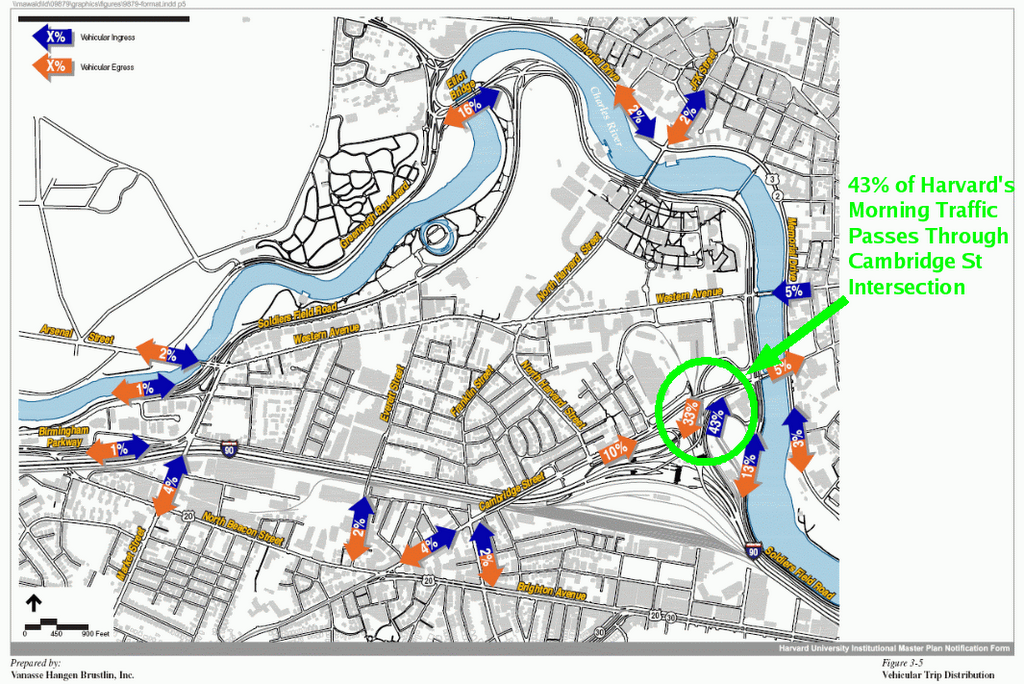
Worst hit may be the parking lot more affectionately known as the intersection of Cambridge Street and Storrow Drive (at the River Street Bridge), which will have a traffic increase of 21% due to Harvard's new development.

Those existing transportation problems and the potentially exacerbated problem posed by Harvard's development are the context for Tuesday's annual meeting of the ABCDC.


Keynote Speakers
Fred Salvucci: Former Massachusetts Secretary of Transportation, Senior Lecturer and Research Associate at MIT's Center for Transportation & Logistics.
Bill Marchione: Author and local historian

Veronica Smith Senior Center
20 Chestnut Hill Avenue, Brighton, MA 02135
6:00 pm: Refreshments, socializing, and exhibits
7:00 pm: Program

For more information: 617-787-3874; info@allstonbrightoncdc.org; http://www.allstonbrightoncdc.org

Image of a Model T Ford by Mitchel25J provided through a Creative Commons license.

Thursday, January 17, 2008

Letter to BC Task Force: Traffic, Transportation, and Parking

At Wednesday night's meeting of the BC Task Force on the topic of traffic/transportation/parking in Boston College's Institutional Master Plan Notification Form, I presented the following letter to the task force for their consideration.

Much of the information in the letter grew out of a series of community meetings of the BC Neighbors Forum during 2007 which I facilitated. It is not a "position paper" (nor a public comment for the scoping determination) per se, but instead my attempt at summarizing the various concerns that were raised at those meetings -- and add a few more.


TO: Jeanne Woods, Chair, BC Task Force
DATE: January 16, 2008
RE: Traffic, Transportation, and Parking in Boston College's IMPNF

Dear Ms. Woods,

In this letter, I outline a series of issues needing discussion in the traffic, transportation, and parking proposals in Boston College's Institutional Master Plan Notification Form of December 5, 2007. Most of these issues have been raised by Brighton residents in previous meetings of the BC Neighbors Forum.

1. Need for Independent Peer Review of Traffic, Transportation, and Parking Studies (and Their Assumptions). Members of the public and the BC Task Force are neither experts nor engineers in the field of traffic and transportation. BC's traffic, transportation, and parking studies should therefore be subjected to an independent peer review in order to examine their assumptions, data, models, analysis, and conclusions.

Such peer review is standard practice in the field of traffic engineering. Allowing municipalities to charge for it is provided in state law (MGL 44, section 53G). Many neighboring municipalities charge developers for independent, third-party review (e.g., Somerville, Plymouth, Hopkinton, Salem, Winchester, Stoneham, etc.).

a)BC should pay the costs of the independent peer review (Harvard is already doing so through as part of their review with the Massachusetts Environmental Protection Act Office);
b)The BC Task Force, or another suitable community organization (such as the ABCDC), should act as both the fiscal agent and client for the peer review (this is already being done by the Citizens Advisory Committee in the Special Review Procedure for the Harvard case);
c)The peer review should examine the assumptions [see #6 below], data, models, analysis, and conclusions of BC's consultant's traffic study, including breaking down the traffic analysis by individual element [see #2 below];
d)The peer review should also examine errors in BC's 2000 traffic study, and certify that those errors have been corrected [see #5 below];
e)BC's consultants should share data in electronic format with the peer reviewer(s); and
f)The peer review should be conducted, and its results shared with the community, well in advance of BC submitting their next filing to the BRA (e.g., DPIR) so that the results can be studied and any remaining problems identified.

2. Traffic Analysis Should be Done for Individual Elements of Their Proposals. BC's traffic and transportation proposals for the intersection of Lake St and Comm Ave are:

a)Moving MBTA station. BC has proposed to move the MBTA station from its current location northwest of the intersection of Lake Street and Commonwealth Avenue to the center of Commonwealth Avenue east of Lake Street.
b)Creating new intersection east of Lake Street. BC has proposed to create a new intersection that crosses Commonwealth Avenue and the MBTA B line tracks at a location east of Lake Street (and east of the proposed new MBTA station).
c)Re-routing St. Thomas More Road. BC has proposed to re-route St. Thomas More Road, a city street on state-owned land, further to the east (to link up with the intersection in b) above).

The traffic and transportation impacts of these three elements must be analyzed both individually and in every possible combination in order to determine which elements improve the traffic flow – and which do not. Elements not contributing to traffic improvement should be removed from the IMP. For example, if moving the MBTA station all by itself creates all the improvement in the level-of-service (LOS) for the intersection of Lake Street and Commonwealth Avenue, then there is no public need to re-route St. Thomas More Road.

3. Stone Walls Along Commonwealth Avenue Should Not Be Removed to Provide Space for MBTA Center Platforms. If it is built, in order to provide for a wider center-platform MBTA station, the stone walls located along both the north and south sides of Commonwealth Avenue should not be modified from their current state. This may entail the trade-off of loss of a small number of on-street parking spaces along Commonwealth Avenue. Since BC is strongly advocating the new MBTA station, they should provide substitute parking spaces nearby.

4. MBTA Car Barn Land and/or Air Rights. BC and the MBTA should communicate to the neighborhood immediately if any kind of discussions have occurred regarding purchase and/or lease of land and/or air rights for the MBTA car barn parcel northeast of Lake St and Comm Ave.

5. Failures of the Traffic Assumptions, Models, and Analysis in BC's 2000 IMP Must be Fully Documented and Corrected. The traffic models in BC's approved IMP from the year 2000 contain the following information for the intersection of Lake Street and Commonwealth Avenue:

a)The intersection's actual "Level-of-Service" (LOS) in 2000 was rated a “C” overall (2000 IMP, App. B, Table 12);
b)The LOS no-build prediction for 2005 was a “D” (Table 14);
c)The LOS build prediction for 2005 was a a “D” (Table 24);
d)The LOS no-build prediction for 2010 was a “D” (Table 16); and
e)The LOS build prediction for 2010 was a “D” (Table 26).

As we know from BC's March 2007 presentation to the BC Task Force, the actual LOS for 2007 is “F” for this intersection. Note that the shrinkage of the Archdiocese of Boston, unanticipated in 2000, should have, if anything, decreased the traffic in that intersection; the opposite appears to have occurred.

The traffic assumptions, models, and/or analysis in BC's IMP of 2000 were therefore demonstrably flawed. These flaws must be identified, explained to the community, and corrected in their current traffic analysis. Their current traffic model must be capable of using the traffic data of 2000 in order to correctly predict the actual traffic data of 2007. I note that these glaring and systematic errors in their 2000 traffic study points to the need for independent peer review.

6. Assumptions for Traffic, Transportation, and Parking Must be Justified and/or Corrected. BC's 10-year master plan calls for an increase in their faculty of 100. Such an increase in the number of faculty usually bring an associated increase in the number of professional research staff, post-doctoral researchers and fellows, technicians, graduate students, secretaries, grant administrators, and the support staff (custodial, food service, stock rooms, etc.).

BC claims in their IMPNF that their increase of 100 faculty members would be accompanied by 342 new graduate students – but only an increase of 12 in all other categories of employees combined!!! (Table 6-3) Their 2000 IMP estimated an increase of 11 new faculty and 93 staff (2000 IMP, App. B, p.55). The ratio of increased faculty-to-staff has changed by a factor of 70 between 2000 and 2007!!! The 2007 numbers are highly suspect.
Jeanne Levesque, BC Director of Government Relations, has noted (private communication) that 23 of the 100 new faculty members will be in the natural sciences. These science faculty members will bring in a substantial number of new post-doctoral researchers, technicians, scientific staff, and so on.

Full disclosure of the ratio of faculty to all employees in BC's natural sciences departments (physics, biology, chemistry, etc.) should be required (it was requested verbally from BC), and the increase in total faculty, staff, and students should be independently reviewed.

Anecdotal evidence can be found at the website for some individual faculty members' labs, which indicate that there are often around eight employees per faculty member's lab group. Inspection of Harvard University's Department of Molecular and Cell Biology, and Harvard Medical School's Department of Cell Biology, indicates that there are 12.6 employees in addition to each member of the faculty. Whether we adopt a ratio of eight (BC anecdotal evidence) or 12.6 (Harvard examples), just the 23 new natural sciences faculty members will bring with them an additional 184 to 290 employees in the other (staff) categories.

These additional employees must be accounted for transparently and included in BC's traffic, transportation, and parking plans. In so doing, BC will likely have to increase the number of parking spaces to be built on-campus as part of their IMP. For example, an increase in 290 staff employees (compared to an increase of 12 in the IMPNF) would require an additional 222 parking spaces (using 80% auto mode share for faculty and staff).

7. Inadequate Parking Spaces in Master Plan. Even with BC's estimated increase of only 100 faculty, 12 staff, and 342 graduate students (Table 6-3), the master plan does not construct enough new parking spaces to accommodate those new employees.

Faculty and staff currently have a 80% auto mode share (Table 6-4), while students have an auto mode share of 26% (Table 6-4). [Note: BC needs to separate students into undergraduate and graduate students for tabulating mode share and other statistical data.] Using these mode share numbers, BC's estimated increase in employees requires an increase in 179 new parking spaces, but their master plan only increases parking spaces by 36.

The needed increase in the number of parking spaces should be scoped and included in the IMP. Furthermore, the location of these parking spaces is highly problematical: effectively, BC is moving 150 spaces from the main Chestnut Hill Campus to the Newton Campus, while their faculty and staff increase (80% of whom drive!) are likely to be concentrated in the Chestnut Hill Campus. The location of new parking spaces should follow the location of the new BC students and faculty. Modified locations for the new and/or substitute parking spaces should be scoped.

8. Substantial Improvement Is Needed to BC's Transportation Demand Management Program. Boston College's TDM program appears to have shown only limited success, in that 80% of their faculty and staff drive to work everyday (2007 IMPNF Table 6-4). In 2000, however, BC reported that 70% of their faculty and staff drove to work alone (2000 IMP, Appendix B, Table 9).

In the absence of an effective Transportation Demand Management Program, Boston College regressed in getting their faculty and staff to use alternate transportation methods. A vastly improved and aggressive TDM program, with clear targets and penalties, should be a requirement of their IMP.

Example: BC Should Subsidized MBTA Passes. It is astonishing that BC does not subsidize public transportation passes for their faculty or staff. One easy and effective way to reduce the auto mode share is to subsidize monthly T passes, for example, by 50% – and by allowing them to be purchased before payroll taxes are deducted.

9. New Cut-Through Route Will Divert Traffic Onto Foster Street. Currently, traffic from northbound St. Thomas More Road or eastbound Commonwealth Avenue cannot easily access Foster Street northbound without taking a U-turn on Commonwealth Avenue. (The intersection of Foster Street and Commonwealth Avenue does not extend across the MBTA B line tracks.) Opening up the new intersection at the entrance to the Brighton Campus will provide for a new cut-through route to Foster Street. Such additional traffic diverted onto Foster Street will overburden a narrow street already the subject of regular vehicle damage and speeding. The recent effects of the street closure next to the Brooks Pharmacy on Market Street created a 1 km backup along Foster Street, indicating how the street is critically burdened already.

The methods to prevent this cut-through route are: (1) locked gate [near Clements Hall] blocking through traffic, or (2) closed entrances to Brighton Campus [fully manned 24/7] requiring permit access for parking. Without either of these solutions, BC's proposal will create a new traffic route that would defeat the original layout of the streets emphasizing, e.g., Chestnut Hill Avenue for through traffic. BC should scope both options in their master plan and justify the final option.

10. Street Parking Study Should Be Performed to Determine Impact of Illegal Parking by BC Community on City Streets. BC does not provide on-campus parking for most of its undergraduates, leading to many parking off-campus illegally on city streets without resident parking stickers. Other commuters to campus avoid on-campus parking fees – or because they do not qualify for on-campus parking – by parking illegally on city streets.

BC should be required to to a thorough, wide-ranging, and complete street parking survey of the entire surrounding neighborhood within, say, 0.25 mile of any BC property. This survey should be done at a series of times at each location – e.g., midday; late-night on weeknights; and late-night on week-ends. The results should be compared to known locations for BC off-campus student rentals and on-campus buildings (e.g., academic, administrative, athletics, and housing). Cars should be identified by visible, legal parking stickers, any BC identification characteristics, state of license plate registration, etc. The availability of street parking throughout the impacted neighborhoods should also be fully documented.

All impacts of BC community using street parking must be addressed in the DPIR with a clear path towards resolution (and penalties for failing to meet targets) for all of those impacts. BC needs to be proactive to prevent such illegal parking by members of their community, rather than simply saying that it is the city's job to enforce those laws.

Sincerely,

Michael Pahre
76 Foster Street
Brighton, MA 02135
pahre@comcast.net
617-216-1447
Tuesday, January 15, 2008

BC Task Force Meeting Wednesday 1/16 at 6:30 pm

BC Task Force Meeting
Wednesday, January 16, 2008, 6:30-8:30 pm
Brighton Marine Health Center, 77 Warren Street, 3rd floor, Brighton MA 02135

For more information, contact: John Fitzgerald, Project Manager, BRA, 617-918-4267, John.Fitzgerald.bra@cityofboston.gov

Public comments on IMPNF: Due February 5, 2008 to the BRA.

Note: The BC Task Force has requested that attendees, if possible, provide them with written comments at their meetings. It doesn't have to be a formally-written letter, etc., but anything to help them assemble information in addition to verbal comments at the meetings. Address letters to Jean Woods, Chair, BC Task Force. You can also email them to the task force at bctaskforce@yahoo.com

BC's master plan website with electronic version of their project notification form


Agenda: Transportation, Traffic, and Parking Issues in BC's 10-year institutional master plan

See Chapter 6 of the 12/5/07 IMPNF.

Intersection changes. Boston College has proposed a three-fold modification to the intersection of Commonwealth Avenue, Lake Street, and St. Thomas More Road:
  1. Move the MBTA T station ("Boston College") from northeast of the intersection to a center station east of the intersection;
  2. Construct a new intersection on Commonwealth Avenue east of the intersection for a new entrance into the Brighton Campus (former St. John's Seminary land); and
  3. Re-route St. Thomas More Road further to the east so that it lines up with the new intersection in #2.
While BC's presentation to the April meeting of the BC Task Force dealt with #2 and 3, MBTA officials backed out of attending that meeting at the last minute. BC's presentation on December 4th stated that that MBTA supports #1, but we have not heard directly from the MBTA itself as to what that means. Who pays for #1 will also be an important detail.

Will these changes to the intersection improve its level-of-service? At the April 2007, BC's consultants said yes, but the jury is still out on this until their assumptions, data, analysis, and conclusions are subject to an independent peer review. In at least one previous case, BC's consultants have made poor predictions about traffic level-of-service.

Parking spaces. The master plan includes removal of many parking spaces (particularly surface lot spaces) and construction of many others (both underground spaces and parking garage structures) for a net increase of 36 spaces. BC's employees will increase by 100 faculty, 12 staff, and 342 graduate students over the next 10 years, but 36 new (net) parking spaces is more than 140 short of accomodating these new employees assuming current auto mode share rates.

Furthermore, BC's expansion in the natural sciences, in particular, appears to neglect all of the additional employees associated with the laboratory sciences -- post-doctoral fellows and researchers, lab technicians, etc. -- which would lead to a substantially higher number for the increase in staff than 12. (See previous story for extrapolation based on Harvard GSAS and Harvard Medical School figures; BC has not provided similar numbers related to their current demographics in the natural sciences or other fields in which they plan to expand their faculty.) Such additional staff would be accompanied by additional need for parking spaces not included in the master plan.

Transportation Demand Management (TDM) program. While BC has included some elements of a TDM program (e.g., zipcars), there are other elements that are surprisingly not included: BC neither does not subsidizes MBTA passes nor charges employees (faculty, staff, and students) for parking on-campus. Both subsidized T passes and charging for parking are standard practices for institutions of higher education in Boston and surrounding areas.

[NOTE: Comment posted below contradicts this, saying that both students and faculty now pay for parking. The IMPNF states no such charges, except for the case of graduate students who pay to park at the Orkney Road site (page 6-8). The IMPNF only states that "are required to register their vehicles and obtain a parking permit to park on campus." Inspection of this website at BC indicates the parking fees for faculty and staff.]

Tuesday, December 18, 2007

Update: Market Street Looks Fully Re-Opened Tonight

This evening around 10 pm, Market Street southbound had some cars travelling on it. Maybe this means that it will remain open in the morning.

The MBTA is no longer showing service advisories for bus #86.

Hopefully, Wednesday morning we won't have gridlock for a six-block radius around Brighton Center like we've had Monday and Tuesday. At one point on Tuesday morning, one detour route, southbound Foster Street, was literally backed up bumper-to-bumper all the way from Commonwealth Avenue to Washington Street.

The massive traffic jams and gridlock experienced in the Brighton Center area these last two days is one indication of how the transportation infrastructure around here has been stretched to its limit. One little road closure (southbound for two blocks of Market Street) has caused a ripple effect on the traffic patterns all around the neighborhood up to a mile away.

Time to bring back those streetcars to discourage people from driving on Washington Street.


Earlier: Brighton Rite-Aid (nee Brooks) Pharmacy roof collapses.
Bus #86 re-routed.
Southbound Market Street remained closed until completion of work to shore up walls from further collapse.

Monday, September 17, 2007

Harvard Sends Allston a Big New Year's Present: Professessional Technical Assistance

In tune with the Jewish New Year's holiday Rosh Hashanah, Harvard announced in a press release, made along with Massachusetts Environmental Protection Act Office, that they have agreed to a "Special Review Procedure" to deal with each and every project Harvard will propose to build as part of their Allston development. Harry Mattison announced this tonight on his allston02134 blog following the meeting of the Harvard Allston Task Force.

The press release gives a sketchy description of this Special Review Procedure:
The Special Review Procedure for the Harvard-Allston project requires Interim Updates every three years. It also requires every project-specific filing to go through an extensive public comment process.

For the purpose of that public comment process, the Special Review Procedure establishes a Citizens Advisory Committee, consisting of the City of Boston’s Allston-Brighton Task Force [i.e., Harvard Allston Task Force], which serves as an advisory group to the Boston Redevelopment Authority for its review of the university’s institutional master planning process, and several additional members to be named by the Secretary.

In addition, Harvard has agreed to provide financial resources to allow the CAC to retain professional expertise for the purpose of reviewing technical planning documents on issues pertaining to transportation, energy, and air quality produced through the Special Review Procedure, giving the CAC the ability to comment on proposed development that could affect the quality of life in the Allston neighborhood.
This sounds to me like Harvard has pledged to fund independent peer review of transportation, energy, and air quality, and that the Citizens Advisory Committee (the Harvard Allston Task Force plus a couple more people to be named by the Secretary of Energy and Environmental Affairs) will be the "client" for the work.

While the details need to be filled out, and the process worked out, this appears to be a big gift, presumably made along with some horse-trading with the Secretary. The Secretary announced earlier today that he is planning to approve Harvard's request for a Phase One Waiver to avoid completing a full environmental review of the science complex project.

Over here in Brighton, we have a similar need for technical expertise in order to analyze the transportation and environmental elements of Boston College's upcoming Institutional Master Plan. Let us hope that BC can follow Harvard's generous lead, and provide a similar present before the Gregorian New Year.

Friday, May 18, 2007

BC Neighbors Forum: Public Meeting Monday, May 21 at 7:00pm

Boston College Neighbors Forum: Public Meeting

Monday, May 21, 7:00 pm
Edison Middle School

60 Glenmont Street


Area residents are invited to attend a community meeting to analyze and discuss the details of the Boston College development plans. The meeting will take place on Monday, May 21st, 7:00 pm, at the Edison Middle School, 60 Glenmont Road, Brighton.

The Boston College Neighbors Forum is an unaffiliated, independent grassroots discussion group. The goal of the meeting is to build a consensus in the community on issues of common concern, and to eventually prepare formal community feedback to BC and the City of Boston.

The May 21 meeting will focus on BC plans for transportation-related issues, including re-routing St. Thomas More Road and moving the MBTA station. Proposed buildings along Commonwealth Avenue will also be discussed.

Public participation is strongly encouraged and all residents will be afforded an opportunity to speak as time permits. Possible topics for future meetings will be discussed.

For more information, Michael Pahre at 617-216-1447 or pahre@comcast.net; or visit the GoogleGroup at
http://groups.google.com/group/BC_Neighbors_Forum .

Thursday, April 26, 2007

What BC Left Out of Their Traffic/Transportation Presentation

Officials of Boston College, and their associates, presented various details of their master plan on "traffic and transportation" to the April 17, 2007 meeting of the BC Task Force.

The following topics were not addressed at all:
  1. Details of moved BC T station. (MBTA planners not ready to present the details.)
  2. No information on employee / student "mode share", i.e., the percentages who:
    • drive a car to work
    • take city bus
    • take BC shuttle bus
    • take subway
    • bicycle
    • walk.
  3. What is their plan to reduce the one person / one car "mode share"?
  4. How many cars (parking) and people (transportation) would be moving from the main campus to the Brighton Campus? BC has made many statements of no net increase in numbers of people***, but their plans clearly move people from easily accessible sites on the main campus to less accessible sites on the Brigton Campus.
  5. Bicycles:
    • Harvard has made clear that their plan for Allston encourages bicycle use. BC avoided the topic altogether.
    • Would any bicycle lanes on streets be introduced? Where?
    • Would there be any bicycle paths on their main campus?
    • Will the development in the Brighton Campus include any bike-friendly paths or lanes?
    • How to connect bicycle routes between each of BC's campuses?
    • Increasing bicycle parking locations, showers, etc., to encourage bicycle commuting.
    • Do they even have a complete inventory of their bicycle parking spaces (racks) and shower facilities?
  6. Students and cars: Zip cars on-campus could reduce demand for on-campus student parking and off-campus illegal parking.
  7. Shuttle buses: How many will service the new Brighton Campus? Will shuttle bus system be opened to the public? How will expansion of parking spaces in Newton Campus be accomodated by increased bus support to the Main Campus / Brighton Campus? What will shuttle bus routes to Brighton Campus follow -- will they turn around, or continue on through to Foster Street? (Buses on Foster Street? It's conceivable.)
Can you think of any more that they left out?

Follow the conversation into the BC Neighbors Forum...


*** NB: This topic will be addressed in a future posting... they may have left a lot of people out!

Saturday, March 31, 2007

Harvard's Cambridge Street Mess

According to Harry Mattison's report from the most recent subcommittee meeting of the Harvard Allston Task Force, the Harvard planners seem to be addressing only the issue of Stadium Way -- not of the more pressing traffic and transportation problems.

I present the following hypothesis: the success or failure of Harvard's traffic plan for Allston will hinge on how they deal with the intersection where Cambridge Street reaches the Charles River (IMPNF, Figure 3-5, annotated):

Harvard's own numbers, estimated using a model constructed in collaboration with the Boston Transportation Department, shows that 43% of their morning automobile traffic will exit the Mass Pike's A-B tolls and enter this intersection. (IMPNF, Table 3-5)

Q: How many cars will this be at the end of their 20-year master plan?
A: 8,145 * 0.43 [morning] + 7,775 * 0.33 [evening] = 6,068 cars per day (IMPNF, Table 3-4; IMPNF, Figure 3-5)

Q: How many cars currently pass through that intersection daily?
A: 28,464 (HUAM PNF, Table 3-1)

Q: What percentage increase in traffic will Harvard's Allston development cause on this intersection?
A: 6,068 / 28,464 = 21%

That intersection is already far, far too crowded. No, it suffers from gridlock. Until Harvard and/or the City fix the intersection, nothing else will really matter.