Showing posts with label Banker and Tradesman. Show all posts

Wednesday, July 02, 2008

Third Time's A Charm: Mayor Menino Blasts BC's Undergraduate Housing Plan For Third Straight Day

Three days, three stories. A three-day news cycle. Mayor Thomas Menino is extremely unhappy with Boston College, their institutional master plan, and the "arrogance" of the university's leaders.

Monday, Banker & Tradesman reported that Mayor Menino called BC's plan to house all their undergraduates "double speak" -- because they would do so partly with off-campus, not on-campus, housing. Tuesday, the Boston Herald refers to his dislike for BC's tactics in trying to win approval for their IMP, particularly the email and/or letter that they sent to alumni asking those in Boston to contact city and elected officials to express their opinions on the IMP.

And now, in Wednesday's edition of the Boston Globe (advance version on boston.com), Mayor Menino blasts the overall process that BC has followed in dealing with the neighborhood and city officials:
More broadly, Menino deplored BC's tactics in advancing their proposals, saying the college has not heeded doubts expressed by the neighborhood and the city.

"Confrontation doesn't work," he said. "I'm saying to them, 'Let's work together and stop pitting people against each other.' There has to be a balance between the interests of the city and the college."

While Mayor Menino expressed similar dislike for BC's tactics in Tuesday's Herald article, he went a step further in Wednesday's Globe article by expressing outright opposition to two of BC's proposals: conversion of the recently-purchased apartment building at 2000 Commonwealth Avenue into an off-campus undergraduate dormitory and construction of undergraduate "Brighton Dorms" on the former St. John's Seminary land purchased by BC from the Archdiocese of Boston in 2004-7:
In a wide-ranging and sharply worded criticism of the plan, Menino said that he squarely opposes the college's recent proposal to convert a high-rise apartment building about one-third of a mile from the Jesuit university's main Chestnut Hill campus into a dormitory.

Menino also faulted BC's plans to build new dorms on property it purchased from the Roman Catholic Archdiocese of Boston, and disputed the college's contention that it cannot fit more students on its traditional campus.

"I want them to build on the campus they have right now, not buy up property and turn it into a dormitory," he said in an interview.
At Monday night's public meeting of the BC Neighbors Forum, there was some discussion about the extent of the Mayor's opposition to either or both of BC's housing proposals. His direct quotation as it appeared in the Banker & Tradesman story did not express outright opposition to either proposal, but instead he said that he would "rather see them live up to their commitment to house all of the students on campus.” Maybe only a preference -- possibly even a strong preference -- but not clear opposition.

The Globe story put such word parsing to bed. Mayor Menino opposes both, unequivocally. And, on top of that, he wants BC to find space on their main campus in order to locate the new dorms adjacent to their current dorms.


A Tale of Two Letters

Tuesday I wrote of a June 24, 2008 letter written by Fr. William Leahy, S. J., President of Boston College, to BC alumni. The letter appears to have been sent to an Atlanta alumnus, who wrote about it on his "Eagle in Atlanta" blog on June 26th. The letter reads, in part:
In particular, I ask that those of you who are residents of Boston express your support to elected officials, especially district city councilors and the BRA.
That language makes it clear that the letter is addressed to some alumni who live outside of Boston, but that the request for an expression of support was only made to those recipients who are also residents of Boston.

Wednesday's Globe story refers to a June 27, 2008 letter:
Menino took particular exception to a recent effort by BC administrators to lobby city officials in support of the plan. In a June 27 letter, president William P. Leahy wrote that it would be "most beneficial to have expressions of support from Boston College alumni and employees who live in the city of Boston."
Those words quoted by the Globe in the June 27th letter do not appear in the June 24th letter, hence they appear to be two different letters -- not a separate mailing of the same letter nor a mixed-up date in the Globe story. (UPDATE: a reader provided a copy of the June 27th letter, which indicates it is wholly distinct from the June 24th one. The text is not only different, but the June 27th letter also includes a long list of contact names, addresses, phone numbers, and email addresses for municipal officials as well as city and state elected officials.)

When Jack Dunn, Director of Public Affairs at BC, told the Globe that "Leahy's letter was sent only to BC employees and graduates who live in Allston-Brighton, as well as a small number of graduates who live in other parts of the city," it is more likely that he was referring only to the June 27th letter -- while presumably selectively avoiding discussing the June 24th letter (which appears to have been distributed more widely).


Boston Herald Weighs In, But Misses the Story

The Boston Herald came in with another article Wednesday, "Mayor: BC off track with dorm plan," in which they report that Mayor Menino "stopped short of saying BC needs to back out of the apartment-building deal" which closed last Monday. "They've purchased it... I'll always work with BC," said Mayor Menino.

The Herald's reporting did not note, however, whether or not the Mayor supports BC's proposal to convert their newly-purchased apartment building into an undergraduate dormitory -- a glaring omission.

Wednesday's Globe story filled in the gaps by noting his opposition to the dormitory conversion plan, not the purchase itself. "I want them to build on the campus they have right now, not buy up property and turn it into a dormitory," he said.


Image of Boston Globe by ckirkman provided through a Creative Commons license.

Tuesday, July 01, 2008

Mayor Menino Opposes BC's Tactics, Including Alumni Letter

The Boston Herald quotes Dot Joyce, spokeswoman for Mayor Thomas Menino, as saying that “The mayor is opposed to [Boston College's] tactics" in pushing for their revised institutional master plan.

In particular, Joyce expressed Mayor Menino's dislike for a letter that William Leahy, S. J., President of Boston College, sent to alumni last week asking them to contact city and elected officials in Boston to express support for the revised IMP:
This Institutional Master Plan is critical to our future, and I hope that all members of the Boston College community will take the time to review it and then assist in the approval process. In particular, I ask that those of you who are residents of Boston express your support to elected officials, especially district city councilors and the BRA.
The Herald article follows up on yesterday's story in the Banker & Tradesman in which Mayor Menino said that BC is engaged in "double speak" when describing how they propose to provide university-controlled housing for 100% of their undergraduate students. Mayor Menino objected -- pointing out that "2000 Comm Avenue is not on their campus. I’d rather see them live up to their commitment to house all of the students on campus.”

The Herald article contains a point that is confusing -- if not outright mixed up:
Joyce said the mayor’s “double-speaking” remark was only a reference to BC’s alumni letter, which didn’t mention that 2000 Commonwealth Ave. is off-campus.
The Herald correctly reports that the alumni letter did not specifically mention 2000 Comm Ave, but the Banker & Tradesman direct quotation from Mayor Menino clearly puts it in the context of 2000 Comm Ave, since he mentions it by name. I'm not sure if the Herald got it wrong, or if Joyce did.

The Herald reporter also appears to have asked some tough questions, pushing Joyce to try to get the Mayor's firm position, for or against, both BC's purchase and conversion of 2000 Comm Ave and their IMP in general. Joyce didn't bite:
Joyce stopped short of saying Menino outright opposes BC’s master plan, especially its purchase of 2000 Commonwealth Ave. - about one-third of a mile from BC’s main campus and where the college hopes one day to house hundreds of students.

Monday, June 30, 2008

Mayor Menino Calls BC's Purchase of 2000 Comm Ave "Double Speak"

Mayor Thomas Menino has called BC's purchase of the 17-story apartment building at 2000 Commonwealth Avenue "double speak" because their plan to house 100% of their undergraduates does so by purchasing an off-campus building rather than building an on-campus dormitory.

Mayor Menino's statement today implies that he rejects BC's careful word parsing which sought to equate "100% university-controlled housing" with "100% on-campus housing."


Focus on Terminology

Today's statement was the first time Mayor Menino has spoken on the topic since the story was broken six weeks ago by GlobeSt.com that BC was pursuing purchasing the apartment building for $67 million. He told Banker & Tradesman:
“BC is double speaking here,” Menino said. “They’ve said they’re going to have beds for all of their undergraduates on campus, but 2000 Comm. Ave. is not on their campus. I’d rather see them live up to their commitment to house all of the students on campus.”
Mayor Menino has aggressively pushed for a number of years for the city's colleges and universities to house increasing numbers of their undergraduates. Prior to BC's announcement that they wanted to purchase 2000 Comm Ave, it was unclear whether he meant "on-campus housing" or "off-campus, university-controlled housing."

The statement quoted by Banker & Tradesman makes it clear that Mayor Menino wants universities to build new housing rather than purchasing and converting existing housing stock in order to address his city-wide plan for additional student housing.

BC officials have been quite careful in their use of the term "university-controlled" or "university housing," rather than "on-campus" housing. Jack Dunn, Director of Public Affairs at BC, used the term "university housing" with the Boston Globe. Thomas Keady, Jr., Vice President of Governmental and Community Affairs at BC, was quoted in the Allston-Brighton TAB as calling it "Boston College housing"; elsewhere in the TAB's article they correctly called it "university-controlled dorms." The Boston Herald heard the talking points clearly in story two on the topic, while in their first story they mistakenly thought BC was actually proposing to build 1280 new beds. (The correct answer is 720 new beds and 560 converted beds added by buying 2000 Comm Ave. The Boston Globe made the same mistake.) WBZ's two reporters were both mixed up by incorrectly using the term "on-campus" for the dormitories, as did the Boston Bulletin.

Mayor Menino has seen through the carefully-parsed wording coming out of BC. Today's statement reflects that he thinks the appropriate term is "on-campus housing" -- and that BC's plan doesn't achieve it.


Implications of Today's Statement

The Boston Globe's editorial board wrote recently that BC should actively pursue options more agreeable with the neighborhood in order to "smooth the permitting process with the city." That Mayor Menino has problems with BC's plan for using 2000 Comm Ave as an undergraduate dormitory indicates that the potential threat of denying various occupancy and/or construction permits has just increased in its probability. It was Mayor Menino's indication to the BRA on the permitting issue that killed Suffolk University's proposed dormitory on Beacon Hill in December 2006:
Suffolk needed city permits for the 22-story building, but at Menino's request, Maloney yesterday told Suffolk University vice president John A. Nucci the city's support would not be forthcoming -- which means it is all but dead.
Mayor Menino previously announced his opposition to BC's proposal to build several dormitories totalling 500 beds of housing on the former St. John's Seminary land purchased from the Archdiocese of Boston in 2004-7. BC refers to that housing as the "Brighton Dorms." He is now on record opposing two key elements of BC's proposed undergraduate housing plan.

The Brighton neighborhood and BC are currently locked in an argument over the location of undergraduate housing as part of BC's proposed 10-year institutional master plan. The most recent public meeting on the topic, held by the Boston Redevelopment Authority's BC Task Force, was a raucous affair in which the proceedings were interrupted often by protesters both over BC's planned purchase of 2000 Comm Ave and BC's desire to build the Brighton Dorms.

BC's Dunn appears not to like having a public discussion of BC's proposal to buy 2000 Comm Ave and convert it into a dormitory. Dunn told the Banker & Tradesman that he welcomes having the discussion "in private with the Mayor." The Boston Bulletin reported that the audience laughed at Dunn's comments at the June 14th public meeting.

Another public meeting on the topic is scheduled for tonight, which is an opportunity for neighborhood residents to discuss the issues of the university's expansion amongst themselves.


Residents and Non-Residents Write About About BC's Plan

The Boston Globe last week published several letters-to-the-editor on the topic. Neighborhood resident Lisa Lieberman in which she spoke of BC's plan to purchase 2000 Comm Ave:
It is disingenuous of Boston College to suggest that it is getting students out of our neighborhood when in fact it is just shuffling students from one place to another within our community.
Joseph Zadella of Cambridge sees it differently, suggesting that the 33-student building at the corner of Greycliff Road and Commonwealth Avenue has already eliminated any buffer between campus and student dormitories.

Framingham resident Craig Carlson thinks that all the disagreement is caused by "paid community activists and residents," though he didn't seem to have figured out who had all this money to pay them. While I haven't requested pay stubs from BC, my understanding is that BC officials like Keady and Dunn are the ones getting paid in this process -- not the neighborhood residents. I wonder if Carlson would mind if his letter were rewritten to state that all the disagreement is caused by "paid BC officials and employees"?

Brighton residents: is your check in the mail? Quick, look!


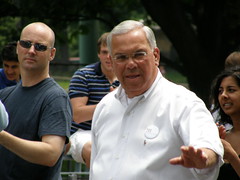
Image of Mayor Menino by Dan4th provided through a Creative Commons license.