Showing posts with label boston herald. Show all posts

Friday, April 16, 2010

PILOT Numbers Behind McGrory's Metro Column on BC

The Boston Globe's Brian McGrory has done his best to channel Howie Carr in today's metro op-ed column about how Boston College should be paying more in Payments in Lieu of Taxes (PILOT) to the City of Boston.

The problem with McGrory's argument that BC should contribute more PILOT to the city is that he didn't give a handle on what might be a reasonable expectation for those payments, particularly since only some of BC's property is located within Boston's city limits.

By looking at what BC might be expected to contribute in PILOT under the proposal recently made by the city's PILOT reform commission, BC ought to be contributing at least $1.6 million more to the city than they are currently paying through PILOT and real estate taxes.

Here's how I come by that number: Boston College's existing Chestnut Hill campus (just that part within the Boston city limits) are currently assessed at a valuation of around $480 million, according to the city's website. Add to that the 16-story apartment building at 2000 Commonwealth Avenue they purchased in 2008 and the former St. John's Seminary land they purchased from the Archdiocese of Boston for $177.4 million in a series of transactions between 2004 and 2007. Added together, those properties lying within Boston have a current value in the ballpark of $722 million, no small change.

The current property tax rates in Boston -- the amount that BC would be paying if they were not a tax-exempt institution -- are $12 (residential) or $29 (commercial) per year per $1000 of valuation for residential property. Since BC's primary financial activities are in education and research, not rental income, most of the land would fall under the commercial rate; I'll assume 75% commercial, 25% residential, or $25 per $1000 of valuation.

If BC were to pay full taxes on their property at that $25 rate it would total around $18.05 million per year. The city's commission that is looking at PILOT reform is recommending that tax-exempt institutions, like universities, voluntarily contribute PILOT at a rate of 25% of the tax rate -- corresponding here to $4.5 million -- of which the institution could elect to pay half in payments-in-kind (e.g., community benefits). The 25% figure is based on a calculation of the cost of city services the institution requires as part of its operation, such as the emergency response to many campus incidents (including Tuesday's ammonia leak at BC's Conte Forum).

Applying the commission's recommendations implies that BC should be contributing a minimum of $2.3 million cash in PILOT to the city, while BC is currently, according to McGrory, paying only $0.3 million in PILOT and $0.4 million in real estate taxes for taxed property. (Nearly all of the valuation for the taxed property is 2000 Commonwealth Avenue; since I include it in the PILOT calculation above, it is appropriate to consider it alongside BC's current PILOT.)

So BC should be paying at least $2.3 million in cash to the city, while they are currently paying only $0.7 million, a shortfall of at least $1.6 million. Based on the commission's recommendations, McGrory has a point that BC is underpaying the city for required city services.


McGrory's tone has evinced a torrent of outraged (and outrageous) comments -- channeling the tone of Howie Carr fans who comment at the Boston Herald's website -- nearly all from people defending BC from what they view as his unfair attacks on their alma mater. Read at your peril.


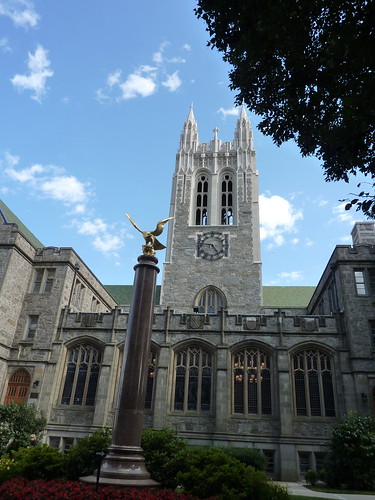
Image of BC's campus:

Monday, November 02, 2009

Unsubstantiated Allegations About Unsubstantiated Allegations

Readers of this week's Allston-Brighton TAB who flip to the editorial page will find a series of endorsements for the municipal election that will be held Tuesday: incumbent Thomas Menino for mayor; incumbents John Connolly and Stephen Murphy, as well as challengers Tito Jackson and Felix G. Arroyo, for City Councilor-At-Large; and incumbent Mark Ciommo for District 9 City Councilor.

In crafting the endorsement of Ciommo's bid, however, the editorial page of the A- B TAB engaged in a bit of mudslinging -- about challenger Alex Selvig's mudslinging:
Ciommo has been on the receiving end of a campaign of mudslinging. We took seriously the accusations that were hurled in his direction by opponent Alex Selvig and some of his followers. Many of the charges have turned out to be distortions and unproven accusations. [emphasis added]
As a frequent reader of the A-B TAB, I was startled to read that the newspaper had unearthed multiple distortions and multiple unproven accusations made by Selvig, because I have not seen any such news analysis printed or online in their newspaper. Nor were any examples given in the editorial itself.

The TAB's allegations about Selvig's "distortions" and "unproven accusations" might be accurate; as far as I can tell, however, they have not substantiated any of these allegations on their pages.

The campaign between Ciommo and Selvig has been lively and, yes, there have been some cases where both candidates -- though noticably more by Selvig -- have stretched the facts a bit to make their point. But to my eye it has mostly been the typical kind of stretching that goes on in political campaigns. Selvig did go negative with a mailing earlier this month, and another one that arrived today. But once again, inspection of the TAB's stories don't substantiate how Selvig's allegations in these negative mailings are "distortions" or "unproven accusations."

A-B TAB editor Wayne Braverman did not respond to an emailed request Friday for examples of stories they have run that would detail their allegations about Selvig. The closest examples I could find, in a news story in last week's paper, look like pretty ordinary and tame campaigning -- by both Selvig, who accurately pointed out a $200 contribution to Ciommo's campaign, and by Ciommo, who incorrectly identified the source of most of Selvig's campaign funds. (The funds were loaned to his campaign by Selvig, not by Elite Rowing -- which would illegal under the state's campaign finance law.)

Until I hear something more concrete, I will chalk up as unfair the TAB's unsubstantiated allegations about Selvig making unsubstantiated allegations.


Other Endorsements in District 9 Race

For an endorsement in the District 9 race that is better reasoned, read the Boston Phoenix:
Also deserving is first-term District 9 incumbent Mark Ciommo, who has a solid understanding of issues facing Allston-Brighton — particularly campus expansion — and took on the difficult role, for a freshman councilor, of mastering the city’s complex budget. As chair of the Ways and Means Committee, he managed to hold serious, informative budget sessions in the middle of a fiscal crisis and a mayoral-election year.
The Boston Bulletin also endorsed Ciommo:
Ciommo is a quiet man in the middle of very loud neighborhood debates.

The audible angst in Allston and Brighton is seen as necessary by residents who feel that their neighborhoods are under siege by massive development projects and the impacts that come from the hundreds and hundreds of college students who are their transient neighbors...

We agree with those who think Ciommo needs to be more vocal in his stands on crucial issues. It would be nice to see him act less like a diplomat and more of a fighter on issues like police patrols, ISD enforcement, rats and improving schools. We urge him to make good on this endorsement by taking his work on the council to a higher level.
Note that the Boston Herald did not endorse in this race, and neither did the Boston Globe.


Image of Sometimes I yell at myself by spunkinator, provided through a Creative Commons license.

Monday, September 14, 2009

Delete-Delete-Gate

More questions were raised by a follow-up story in the Boston Globe that described the procedures that Michael Kineavy, chief of policy and planning in the administration of Mayor Thomas Menino, used to delete nearly all his emails over one particular six-month period, in apparent violation of the state's Public Records Law:
[Boston Corporate Counsel Bill] Sinnott said that all e-mails are supposed to be backed up in the city’s computer systems, but a glitch, which he said the city was fixing, allowed users to delete messages and then empty a “deleted items folder,’’ thus circumventing the nightly backup process...

Kineavy told [city officials] that he deletes all his e-mail on a daily basis and does not allow his e-mail to be saved on city backup computers, according to officials.
Note how Kineavy was not just deleting emails in his email application's inbox -- he was also going into the "deleted items folder" (or the "trash folder") to delete those backed-up versions of the emails.

And, on top of that, Kineavy was so systematic that he managed to delete all but 18 emails over that six month period so that they would not appear in the automated, nightly backups made of city hall computers. That deletion record is impressive: Kineavy must have had an incredible attention to detail, because he deleted both his inbox and his trash folder regularly and thoroughly at the end of each day before he left work for home, otherwise one or the other would have appeared in the backups.

I dub this scandal "Delete-Delete-Gate," since the issue is not just Kineavy deleting emails but then deleting them from his trash folder so that they would not be archived in city hall backups.

The Boston Herald is playing second fiddle catch-up on the story, missing how Kineavy also deleted "deleted items folder" content:
In an effort to tidy his inbox, Kineavy was deleting his e-mails every day before he left work, unaware that those e-mails were gone for good, the city insists. Until the Globe’s request, the city archive system didn’t copy records until well after the end of business each day.
Peculiarly, WBUR's Morning Edition today reported that city officials say that the deletion of emails was "unintentional."

Calling delete and then delete again unintentional? That explanation does not pass the sniff test. I smell a stinker here.


Image of "Miscalculation" by .::HIMU:: provided through a Creative Commons license.

Wednesday, July 02, 2008

Third Time's A Charm: Mayor Menino Blasts BC's Undergraduate Housing Plan For Third Straight Day

Three days, three stories. A three-day news cycle. Mayor Thomas Menino is extremely unhappy with Boston College, their institutional master plan, and the "arrogance" of the university's leaders.

Monday, Banker & Tradesman reported that Mayor Menino called BC's plan to house all their undergraduates "double speak" -- because they would do so partly with off-campus, not on-campus, housing. Tuesday, the Boston Herald refers to his dislike for BC's tactics in trying to win approval for their IMP, particularly the email and/or letter that they sent to alumni asking those in Boston to contact city and elected officials to express their opinions on the IMP.

And now, in Wednesday's edition of the Boston Globe (advance version on boston.com), Mayor Menino blasts the overall process that BC has followed in dealing with the neighborhood and city officials:
More broadly, Menino deplored BC's tactics in advancing their proposals, saying the college has not heeded doubts expressed by the neighborhood and the city.

"Confrontation doesn't work," he said. "I'm saying to them, 'Let's work together and stop pitting people against each other.' There has to be a balance between the interests of the city and the college."

While Mayor Menino expressed similar dislike for BC's tactics in Tuesday's Herald article, he went a step further in Wednesday's Globe article by expressing outright opposition to two of BC's proposals: conversion of the recently-purchased apartment building at 2000 Commonwealth Avenue into an off-campus undergraduate dormitory and construction of undergraduate "Brighton Dorms" on the former St. John's Seminary land purchased by BC from the Archdiocese of Boston in 2004-7:
In a wide-ranging and sharply worded criticism of the plan, Menino said that he squarely opposes the college's recent proposal to convert a high-rise apartment building about one-third of a mile from the Jesuit university's main Chestnut Hill campus into a dormitory.

Menino also faulted BC's plans to build new dorms on property it purchased from the Roman Catholic Archdiocese of Boston, and disputed the college's contention that it cannot fit more students on its traditional campus.

"I want them to build on the campus they have right now, not buy up property and turn it into a dormitory," he said in an interview.
At Monday night's public meeting of the BC Neighbors Forum, there was some discussion about the extent of the Mayor's opposition to either or both of BC's housing proposals. His direct quotation as it appeared in the Banker & Tradesman story did not express outright opposition to either proposal, but instead he said that he would "rather see them live up to their commitment to house all of the students on campus.” Maybe only a preference -- possibly even a strong preference -- but not clear opposition.

The Globe story put such word parsing to bed. Mayor Menino opposes both, unequivocally. And, on top of that, he wants BC to find space on their main campus in order to locate the new dorms adjacent to their current dorms.


A Tale of Two Letters

Tuesday I wrote of a June 24, 2008 letter written by Fr. William Leahy, S. J., President of Boston College, to BC alumni. The letter appears to have been sent to an Atlanta alumnus, who wrote about it on his "Eagle in Atlanta" blog on June 26th. The letter reads, in part:
In particular, I ask that those of you who are residents of Boston express your support to elected officials, especially district city councilors and the BRA.
That language makes it clear that the letter is addressed to some alumni who live outside of Boston, but that the request for an expression of support was only made to those recipients who are also residents of Boston.

Wednesday's Globe story refers to a June 27, 2008 letter:
Menino took particular exception to a recent effort by BC administrators to lobby city officials in support of the plan. In a June 27 letter, president William P. Leahy wrote that it would be "most beneficial to have expressions of support from Boston College alumni and employees who live in the city of Boston."
Those words quoted by the Globe in the June 27th letter do not appear in the June 24th letter, hence they appear to be two different letters -- not a separate mailing of the same letter nor a mixed-up date in the Globe story. (UPDATE: a reader provided a copy of the June 27th letter, which indicates it is wholly distinct from the June 24th one. The text is not only different, but the June 27th letter also includes a long list of contact names, addresses, phone numbers, and email addresses for municipal officials as well as city and state elected officials.)

When Jack Dunn, Director of Public Affairs at BC, told the Globe that "Leahy's letter was sent only to BC employees and graduates who live in Allston-Brighton, as well as a small number of graduates who live in other parts of the city," it is more likely that he was referring only to the June 27th letter -- while presumably selectively avoiding discussing the June 24th letter (which appears to have been distributed more widely).


Boston Herald Weighs In, But Misses the Story

The Boston Herald came in with another article Wednesday, "Mayor: BC off track with dorm plan," in which they report that Mayor Menino "stopped short of saying BC needs to back out of the apartment-building deal" which closed last Monday. "They've purchased it... I'll always work with BC," said Mayor Menino.

The Herald's reporting did not note, however, whether or not the Mayor supports BC's proposal to convert their newly-purchased apartment building into an undergraduate dormitory -- a glaring omission.

Wednesday's Globe story filled in the gaps by noting his opposition to the dormitory conversion plan, not the purchase itself. "I want them to build on the campus they have right now, not buy up property and turn it into a dormitory," he said.


Image of Boston Globe by ckirkman provided through a Creative Commons license.

Tuesday, July 01, 2008

Mayor Menino Opposes BC's Tactics, Including Alumni Letter

The Boston Herald quotes Dot Joyce, spokeswoman for Mayor Thomas Menino, as saying that “The mayor is opposed to [Boston College's] tactics" in pushing for their revised institutional master plan.

In particular, Joyce expressed Mayor Menino's dislike for a letter that William Leahy, S. J., President of Boston College, sent to alumni last week asking them to contact city and elected officials in Boston to express support for the revised IMP:
This Institutional Master Plan is critical to our future, and I hope that all members of the Boston College community will take the time to review it and then assist in the approval process. In particular, I ask that those of you who are residents of Boston express your support to elected officials, especially district city councilors and the BRA.
The Herald article follows up on yesterday's story in the Banker & Tradesman in which Mayor Menino said that BC is engaged in "double speak" when describing how they propose to provide university-controlled housing for 100% of their undergraduate students. Mayor Menino objected -- pointing out that "2000 Comm Avenue is not on their campus. I’d rather see them live up to their commitment to house all of the students on campus.”

The Herald article contains a point that is confusing -- if not outright mixed up:
Joyce said the mayor’s “double-speaking” remark was only a reference to BC’s alumni letter, which didn’t mention that 2000 Commonwealth Ave. is off-campus.
The Herald correctly reports that the alumni letter did not specifically mention 2000 Comm Ave, but the Banker & Tradesman direct quotation from Mayor Menino clearly puts it in the context of 2000 Comm Ave, since he mentions it by name. I'm not sure if the Herald got it wrong, or if Joyce did.

The Herald reporter also appears to have asked some tough questions, pushing Joyce to try to get the Mayor's firm position, for or against, both BC's purchase and conversion of 2000 Comm Ave and their IMP in general. Joyce didn't bite:
Joyce stopped short of saying Menino outright opposes BC’s master plan, especially its purchase of 2000 Commonwealth Ave. - about one-third of a mile from BC’s main campus and where the college hopes one day to house hundreds of students.

Thursday, June 19, 2008

Editorials on BC's Revised Housing Proposal

The Boston Globe's editorial page is pushing for Boston College to build denser housing on the Mods site as part of their revised institutional master plan -- and as a potential compromise with the neighborhood:
There should be room to resolve such issues within the 10-year construction schedule of dorms, new academic buildings, and recreation facilities — as long as BC remains flexible. One such opportunity is on the northeast section of the lower campus, where BC wants to replace 22 dreary modular housing units with a 175-student dorm and a swath of greenspace. Enlarging the dorm and moving up the schedule for its construction could postpone the need to build dorms on the contested former archdiocese site. Such compromises would also smooth the permitting process with the city.
The Boston Herald's editorial board, however, thinks BC's plan is fine just the way it is, quoting Eva Webster from the Boston Globe's news story to support their argument.

The Allston-Brighton TAB editorial sides with the Globe, arguing that BC should consider taller dorms on its main campus to minimize housing near residential areas, but is more positive about BC's purchase of 2000 Commonwealth Avenue.

Earlier: Boston Globe editorial in December 2007 that BC has not made a "convincing case" for the Brighton Dorms on the former St. John's Seminary land; adding a few stories to proposed dormitories on their main campus and "maximizing the use of land now occupied by outmoded modular housing units" were suggested.

Also:
Mayor Thomas Menino told the Globe's editorial board in January that he wants to see the dorms built south of Commonwealth Avenue. (The Brighton Dorms would be north of Comm Ave.)

Saturday, May 03, 2008

Boston Civic Summit Brings Together Community Organizers

The first Boston Civic Summit took place Saturday at the Boston Convention and Exhibition Center in South Boston, providing a chance for civic leaders -- and foot soldiers -- from across the city to network with each other and craft a vision of how Boston could look a decade from now.

City Council President Maureen Feeney explained how the idea for the event grew out of a meeting months ago over coffee at Gerard's Restaurant in Dorchester with BCEC Executive Director Jim Rooney. They were looking at "ways to revitalize civic life in Boston," and seized upon a meeting of civic leaders as a way to draw people together from many different neighborhoods in the city.

Roughly 400 people from across the city met for seven hours to talk about community organizing strategies, improving communications with the media, fundraising, and their vision for the city's future.


"Don't Just Tell us What's Wrong"

Mayor Thomas Menino breezed in -- and out -- of the convention center probably feeling a little bit unwelcome. The event was conceived and organized without his input, faced his early opposition, and only provided him five minutes to speak to the crowd.

The event's program (as of one week ago) didn't list him on the program as a speaker; later in the week (and in the published program) he had a five-minute slot at the end of lunch; and only today did he manage to move his speaking slot up to a time right before event's keynote speaker. That the Boston Civic Summit wouldn't look to the Mayor as a keynote speaker speaks to the chasm between between the city's civic leaders and the municipal government's leaders; Boston Herald muckracker Howie Carr says that Mayor Menino privately calls the activists "agitators." The Mayor's Office of Neighborhood Services only provided perfunctory visible support to the program -- sending out an announcement of the event to Allston-Brighton residents on April 29th, four days after registration for the event was supposedly closed on the 25th. Gee, thanks for the shout out, I guess.

Anticipating trouble might be brewing at the event, Mayor Menino tried to head it off at the pass: "Voice your concerns. Ask tough questions. Don't just tell us what's wrong."

But describing what was wrong with city government was apparently what happened at the first session of "Managing Community Development / Zoning". I was at a parallel session at the time, but word on the street was that the zoning discussion dove right into institutional expansion and animated BRA-bashing, leading to former Councilor Larry DiCara -- who led the session -- being instructed to keep the discussion in the subsequent session on the zoning process rather than the failings of the BRA. Which he did.

How could a discussion of zoning and community development avoid talking about the elephant in the room, namely the issues of institutional expansion and the BRA's role as possible facilitator? Because she said so, that's why. Councilor Feeney reportedly told one participant that this whole summit was supposed to be about civic involvement rather than reforming city government. A number of summit participants, however, didn't understand how one didn't involve the other.

It was without any apparent sense of irony that Mayor Menino noted how opposition in the early 1970s to the proposed Southwest Expressway faced down the "bureaucrats [who] tried to divide us." He obviously recognizes how civic engagement directly relates to government, although it must be tough now to be on the side of the equation.


"Rugged Idealism"

Keynote speaker Alan Khazei, the Founder of City Year, spoke about how he sees the United States being founded on the ideas of "rugged idealism," rather than the term "rugged individualism" that everyone is taught in high school history class.

Khazei gaves examples of the Boston Tea Party, the work of abolitionists in the 19th century, the suffrage movement of the late-19th and early-20th centuries, Rosa Parks and the Montgomery bus boycott -- and the Boston Ten-Point Coalition, which focuses on "the issues affecting Black and Latino youth, especially those at risk for violence, drug abuse, and other destructive behavior."

"Idealism works," said Khazei. "It has the power to change lives." He concluded with a rejection of Ronald Reagan's argument in the 1980 presidential campaign that people should ask, "Are you better off?" Instead, Khazei thinks that people should focus on the question, "Are we better off?"


Aging Population of Community Activists


The wireless tools used by AmericaSpeaks in the "Town Hall" session enabled instant identification of the demographics of the civic leaders of the city -- and the comparison with the city as a whole.

Community activists here have lived in Boston far longer (50% have lived in the city more than 30 years, compared to 10% of Boston residents), are more predominantly white (73% of activists vs. 50% of Boston residents), and are heavily skewed towards older residents (67% are age 45 or older, compared to 38% of Boston residents) than the population at large.

The worrisome message that grows out of these demographics is that those civically-engaged residents are aging but not being replaced by younger activists.

The only silver lining was identified by speaker Dr. Thomas Sander of Harvard's Kennedy School of Government, who referred to recent research showing that people who were in college at the time of the events of 9/11 are turning out to be more politically active than their immediate predecessors.

But Sanders pointed to a steady decrease in the average rate of membership in large organizations since 1970 -- bringing activism rates, at least as measured by involvement in large organizations, down to a rate not seen since the Great Depression of the 1930s.


Top Issues Facing Boston

Participants identified education (61%), economic development (43%), public safety (37%), and housing (33%) as the most important issues facing Boston. Yet economic development (26%) and housing (15%) were low on the list of issues that they felt they could impact most through their civic participation, being trumped by education (65%), public safety (52%), and the environment (41%).

Political leaders often speak of economic development as key to the city's future, and point to the companies and institutions as drivers of the economic engine. The need for affordable housing is often repeated on the campaign trail, too. That the civic leaders of the city feel so powerless to affect change on these two issues is telling as to a disconnect between government and the people.


Vision for Revitalized Civic Engagement

The participants in the town hall session arrived at a common vision for how Boston might appear twelve years from now, should their civic activities produce meaningful change:
Participants envisioned thriving civic engagement in Boston in 2020 and discused how we would know we have achieved our vision. The group identified the following concrete, measurable things that would indicate we have reached our vision of revitalized civic engagement in our city:
  • Boston has a 100% high school graduation rate and Boston Public Schools are as good as schools in the suburbs;
  • Neighborhoods are green and sustainable (more green development, clean public spaces, decreased reliance on cars);
  • The digital divide has been eliminated, partially through free wi-fi throughout the city and city services are more easily accessed through the web;
  • Lower crime rate, "zero murder rate every year"
  • Young people fully involved in civic programs;
  • City government is more transparent (fully utilizing new technologies, participation is more fully encouraged); and
  • City government is more representative -- both ethnically and of the neighborhoods.
It takes little imagination to suggest that these issues will be front-and-center in the 2009 mayoral election campaign.


Image of old man by Pulpolux, and image of BCEC by silver marquis, through a Creative Commons license.

Saturday, April 26, 2008

DCR Confused About Another Bridge

The state Department of Conservation and Recreation has a problem about the Longfellow Bridge: they don't agree with their own consultant's report about its current condition, according to a report in the Boston Globe. The DCR also wants to hold up reporting of the bridge's inspection until after repairs can be made, and a newer inspection made:
An independent inspection of the Longfellow Bridge found the span to be in worse condition than the state had previously determined, but officials dispute the findings and refused to release the report to the public for several months...

But [Commissioner Richard K. Sullivan Jr.] said he wants Jacobs to conduct a follow-up inspection and issue a final report this summer, after the repairs are complete.

"I believe there's general agreement that, when those repairs are done and Jacobs does the reinspection, the rating will be better, and there will be an agreement at that time," said Sullivan.

Last summer, the DCR told the Boston Herald that the BU Bridge was not structurally deficient (archive fee):
“It may need work, but it can still take the statutory loads,” said Wendy Fox, spokeswoman for the state Department of Conservation and Recreation, which owns the bridge connecting Boston and Cambridge. “The point is, it’s not on the list because it’s not considered to be structurally deficient.” [italics added]
despite that the bridge was listed as structurally deficient in the federal National Bridge Inventory database -- as well as the Boston Herald's compilation based on the federal database. Oh, and you can see the holes through the bridge's surface from below.

Few people would likely disagree that the DCR (and its predecessor agencies) has a poor record in maintaining their infrastructure, although some blame could easily be pointed at the State Legislature and/or Governor for failure to allocate sufficient funding. But the DCR should do a better job at recognizing and reporting the condition of the infrastructure under their control, rather than making public misstatements or engaging in peculiar reporting practices. The public statements of DCR officials about the current condition of their bridges is straining their credibility.


Longfellow Bridge image by lstrong2k through Creative Commons license.

Tuesday, April 22, 2008

TAB Scoops Heights On Undergraduate Student's Lawsuit

An editor at the Northeastern News, the student newspaper of Northeastern University, wrote in The Salt Mine that The Heights, the Boston College student newspaper, got scooped on a story that should've been a slam dunk for The Heights to cover.

Who scooped them? The Allston-Brighton TAB, a community newspaper.

At issue? The undergraduate who is part of the lawsuit against the city over the new zoning amendment that limits off-campus undergraduate student apartments to four students or fewer. Her name is Jessica Luccio, and she is a sophomore at BC. It only made sense for a newspaper to run an interview with her to find out why she joined the lawsuit. As of today, a search at the website of The Heights still produces no hit for the name "Luccio".

The NU News editor argued that there were two days for The Heights to file their story after the Boston Herald first named Luccio as part of the lawsuit -- albeit without identifying the university in which she is enrolled. (UniversalHub and Brighton Centered both noted soon after the Herald article that Luccio is an undergraduate at BC, I might add.)

Most of the main-stream media -- and non-MSM bloggers -- don't cover on-campus issues because that is the beat that ought to be covered best by student newspapers. I think there will be some red faces over in Chestnut Hill this week.

What were the stories that The Heights considered more important to run in their April 17th issue? One story was the debut of two flat-screen TVs in the dining hall. Apparently, students voted in February 2007 that these flat-screen TVs were more important than "a push for united social change, reshuffling the [Undergraduate Government at Boston College's] structure to improve efficiency, extending the UGBC's role beyond programming to improve student life, and [having the UGBC serve] as a more representative liaison between the students and the administration."


Image from Mike Wade through Creative Commons license.

Saturday, February 16, 2008

MBTA Routinely and Secretly Cancelled Bus and Subway Trips For Years, And Admits Lying About It

The Boston Herald channeled The Onion today while reporting a true story that is literally jaw-dropping: for years, the MBTA has been routinely and secretly cancelling bus and subway trips that are on their schedules, and admits to lying to the public about the practice:
Top MBTA officials acknowledge that for years the agency has been secretly cutting thousands of bus and train trips from published schedules to lower costs - a practice that has left legions of customers waiting for rides that arrived late or not at all.

T General Manager Daniel Grabauskas told the Herald he has moved swiftly to end what he called “hidden service cuts” on bus and subway lines throughout the system. But he said customers have been lied to for years so the T could claim to operate at a level of service it was not delivering.

“We were not telling the truth to our customers before when we were not delivering the service that was scheduled,” Grabasukas said in an interview. “But we began to remedy that when I came on two years ago, and I know we’ve improved service.”...

“I had one very (senior-level) person say to me, ‘We knew we were dropping bus trips, so we’d go to the communities where we were dropping trips out of garages - and we would lie to people,’ ” Grabauskas said.
Grabauskas appears to be channeling the Straight-Talk Express now that John McCain has thrown himself under the bus.

For everyone who stands at a bus stop in foul weather waiting for a scheduled bus that never seemed to show up, you may now know the reason. For those who called the MBTA customer service number to try and figure out where the bus was -- or if a bus was actually running the scheduled route -- and got the run-around from the customer service agent or the garage's dispatcher, you may now know the reason.

You just can't make this stuff up.

For those who may not remember, MBTA General Manager Grabauskas doesn't ride the T himself because "it tends not to be convenient to me."

Via UniversalHub, which includes links to other bloggers' amazement and outrage at the MBTA General Manager's admission.

New Bike Lanes On Comm Ave Near BU

Part of Commonwealth Avenue due east of Allston will soon be getting bike lanes, according to an announcement Thursday by the City of Boston.  The proposed bike lanes were part of Mayor Thomas Menino's State of the City speech on January 15, 2008.

The new lanes should be painted by summertime.

Mayor Menino has shown renewed interest in expanding the city's bicycle infrastructure since he took up bicycling himself last summer.  (No word on how often he has been keeping on the bike over the snowy winter.  I hope he has, because it's a great way to learn first-hand about mediocre snow removal and how quickly potholes can form during wintertime.)

The Boston Herald reports:
The city’s Boston Bikes department announced Thursday that the strip of Commonwealth Avenue between Kenmore Square and the BU Bridge will have 5-foot-wide bike lanes available in each direction by this summer.

The bike lanes will reallocate space on the street and sidewalks as part of a planned reconstruction of Commonwealth through the Boston University campus.

“That project ends at the bridge, so that’s why the bike lanes won’t be extended further, at least not (as) part of this project,” said David Watson, executive director of bicycling advocacy group MassBike...

That could mean eventually extending the bike lanes past the BU Bridge and into Allston, a college neighborhood full of cyclists and the scene of a bike fatality last spring when 23-year-old Kelly Wallace was struck by a motorist.

“The bulk of students (who commute) live in Allston,” said BU grad Diane Akerman, 24, of Somerville. “Whether they go to BU, Emerson or Berklee, they need to get down Comm. Ave.”...

But he expressed concern that the planned bike lane will sandwich riders between traffic and parked cars.

“It often winds up even more dangerous due to the chance of getting (struck by a car door), and motorists swerving across cyclists to snag a just-noticed parking spot,” Braiotta said.

Sunday, January 27, 2008

Knife Fight Between Two Employees at IHOP

There was a knife fight early Saturday evening between two employees of the International House of Pancakes at 1850 Soldiers Field Road in Brighton.

The Boston Herald couldn't resist using some colorful imagery:
A knife duel between two workers at a Brighton greasy spoon turned the eatery into the International House of Pain.

The fracas broke out about 5 p.m. yesterday inside the International House of Pancakes on Soldiers Field Road, just as early dinner guests were sitting down to enjoy the food chain’s all-you-can-eat pancakes. But in short order, the clinking of coffee cups was replaced by the sounds of battle.
One employee was badly hurt, but is expected to survive; another had more minor wounds to the hand and has been booked, according to the Herald. WBZ-TV and the Herald have differing accounts on the second employee: WBZ reports that the hand injury was suffered by a third employee who tried to intervene in the incident. What's right? WBZ looks closer to the truth, according to the Boston Police Department report.  (EDIT 1/28/08:  The Boston Globe appears to get it right, too.)

The Herald also notes that "employees were separated in different rooms while detectives checked the restaurant’s licenses near the front door." Were detectives looking for the requisite license allowing knife fights?

Wednesday, December 05, 2007

Links and Media Coverage of BC's Announcement of Institutional Master Plan

Last night, Boston College announced their new institutional master plan, and today they filed it with the city of Boston.

BC Documents:
BC press release about master plan (PDF, 3 pages)
BC press release about strategic plan (PDF, 2 pages)
10-Year Master Plan Map (PDF, 1 page, low-resolution)
Strategic Plan website, "Towers of Excellence"
Institutional Master Plan online (PDF, 19 separate files)
BC main website, which currently links all mainstream media coverage of their master plan

Media Coverage:
Boston Globe:  "Grand expansion at BC:  $1.6b plan calls for faculty increase, massive construction"
Boston Herald:  "Eagles let fly $1.6B plan:  BC to grow out, add 100 profs"
BC's The Heights (student newspaper):  "BC unveils $1.6 billion strategic plan"
Associated Press:  "Boston College Seeks $1.6B Expansion"

From the Boston Globe:
Boston College plans to spend $1.6 billion over the next decade to expand and rebuild its Chestnut Hill campus, bolster its faculty by 15 percent, and create a dozen academic institutes in a far-reaching effort to vault the Jesuit college into the top echelon of the nation's universities...

"There will be extensive construction on campus for at least the next seven to 10 years," Leahy said. He added the college would stagger construction and would borrow substantially to finance the project, but would not tap its $1.7 billion endowment or raise tuition beyond normal increases.
From the Boston Herald:
To support the initiative, President William Leahy said BC is eyeing what will likely be its largest capital campaign ever.

The college will likely have to raise as much as $1 billion to make the expansion possible.

BC’s largest fund-raising campaign to date netted $440 million and ended in 2003.
From The Heights:
Culminating years of studies and planning, the unprecedented 10-year plan will hire 100 new faculty members, establish new academic institutes, and increase the annual budget of academic departments by $43.5 million...

A significant portion of the construction costs will also be financed through acquisition of debt, which is the typical protocol for University construction projects. To date, BC carries $630 million in debt...

Meetings with the [BC] Task Force have been a source of debate between the University and the local residents, who have expressed their concerns with bringing students closer to an otherwise quiet neighborhood. "We know there will be concerns on this development on this space which has been like a park for the neighborhood, and we have been meeting with them for a year and a half and have made necessary changes to the plan," Leahy said. Those changes include moving student housing farther away from Lake Street, which will use the natural barrier of the surrounding trees and gradient change to keep students and noise insulated within campus.


Wednesday, November 28, 2007

Brighton High School Football to the Super Bowl

It wasn't many years ago when the Brighton High School football team had seasons where they fought to avoid a winless record. No longer. In Tuesday evening's semi-final game, the Bengals defeated Manchester Essex 28-7 to gain a berth in the Division 4 Superbowl game on Saturday at Stonehill College.

The Boston Herald and Boston Globe both come through with more coverage of Brighton High School football than they gave to Allston-Brighton District 9 City Council elections. The A-B TAB chimes in, too... albeit with historically more balanced coverage.

Tuesday, November 20, 2007

Bulk Mailing Permits: Not Much Evidence There

The Boston Herald has been focusing on the apparent link between Councilor-At-Large-elect John Connolly's campaign mailings and the anonymous attack mailings sent the week before the election that he has denied sending -- but which share the same bulk mailing permit number (out of North Reading) as at least some other bulk mailings sent by the Connolly campaign.

How unique is such a match for the bulk mailing permit?

I've been shoving some of the mailings I received during the campaign into a yellow envelope, so this gives me the opportunity to pull them out to inspect the bulk mailing permit numbers. I got two other packrats in town to help out. We all braved the silverfish while reporting for this story. The numbers in parentheses gives the number of unique mailings the three of us received from that candidate. (There might be some duplicates among us.)

#231 (No. Reading, MA or zipcode 01864): Alex Selvig (6); Mark Ciommo (1); Rosie Hanlon (2)
#315 (Brockton, MA): Greg Glennon (3)
#396 (Boston, MA): Steven Tolman/Kevin Honan/Michael Moran [not campaign literature] (1); Steve Murphy (1)
#755 (Boston, MA): Mark Ciommo (4)
#52955 (Boston, MA): Steve Murphy (4)
#54162 (Boston, MA): Tim Schofield (1); John Connolly (5)
#54302 (Boston, MA): Sam Yoon (1)

I'm not sure if permit #231 is the same one out of North Reading on the anonymous mailing the Herald referred to, but it looks like a reasonable inference.

Does the bulk mailing "evidence" mean that Selvig, Ciommo, and/or Hanlon are the real culprits who sent the anonymous mailing(s) with the North Reading bulk mailing permits? Or that the bulk mailing permit line of evidence just isn't a unique piece of evidence all by itself? I'll bet on the latter.

The Herald's linking of Connolly to the remaining anonymous mailings via the evidence of bulk mailing permit numbers is not a unique match: many mailings from various campaigns may use the same permit numbers. Instead, the Herald's reporting should be focusing on the other factors that they are really using to assess a possible link between Connolly and the mailings: motive, means, and opportunity. That's where the discussion should be focused.

Student Death on Allston's Glenville Avenue

The mainstream media has been covering this story, hence I'll just provide a summary and links here.

Early Saturday morning, November 17th, there was a large fight at 14 Glenville Avenue in Allston, MA 02134. Police officers responded and found a 21-year-old photography major at the Art Institute of Boston, Shawn Dow, lying in a back alley. He later died. He apparently fell off of the roof of the building. The coroner later determined that he died from the fall itself, but no police or coroner statement has been made about what caused him to fall off the roof (accidental or intentional); this last element of the story is yet to be resolved.

BPDnews 11/17/07: death investigation
Boston Globe 11/18/07: police interviews indicate faller from building and brawl inside building were separate incidents
BPDnews 11/18/07: deceased identified as Shawn Dow, 21, of Peabody
Blog comment from "pierce" 11/18/07: Dow had "footprints all over his chest" (note: unconfirmed report, taken from a now-removed, second-hand EMT report of a not-fully-specified fatal party fight. EMT report probably removed for legal reasons.)
Boston Herald 11/18/07: broken bottles litter building's stairwell, bannister poles missing
Boston Globe 11/19/07: story on Dow, friends, and family
Boston Herald 11/19/07: Dow's mother suspects foul play causing Dow's fall, since police photo of Dow's face, she says, looks like "someone hit him"
BPDnews 11/19/07: death is not listed as a "homicide" as of this date
Allston-Brighton TAB 11/19/07: Conway Cahill-Brodeur Funeral Home in Peabody is handling funeral arrangements; Art Institute planning a memorial service
Salem News 11/19/07: interviews with family, friends in Peabody area
BPDnews 11/19/07: cause of death consistent with a fall, as opposed to injuries sustained as the result of assault; interviewed 20+ witnesses which don't place Dow at the scene of the brawl
boston.com report on the same 11/19/07
BU's Daily Free Press 11/20/07: anonymous witness says that Dow had severe injuries to his face, despite being found near-dead on his back after falling from the roof. Brawl reported to have included breaking bottles over people's heads.
Salem News 11/20/07: "Witnesses quoted in some media reports said Dow had been beaten in a fight."
Allston-Brighton TAB 11/20/07: details on the wake, funeral, and burial of Dow

Boston Police "Citizens Alert" 11/20/07: "On Nov. 17th 2007 the Boston Police responded to a large fight at 14 Glenville Avenue where a party was being held and found a male lying on the asphalt in the rear alley of 14 Glenville Ave. Autopsy reports indicate that this male sustained injuries consistent with falling off the roof. Anyone with any information relative to this incident is advised to call the Boston Police @ 617-343-4256 and speak to the Detectives."

Boston Police are looking for tips in the investigation: Crime Stoppers at 1-800-494-TIPS where anonymous tips can be placed.


On an unrelated note: three young men were arrested on gun charges in the area of Tremont Street and West Newston Street on Friday night, November 16th.

Another unrelated note: the two Brighton bank robberies on Friday, November 16th, were accompanied by two others in the Boston area. Some of the suspects have physical features that do not match each other. Since this year has seen 118 bank robberies in Massachusetts thus far, it is unusual to see four on the same day.

Saturday, November 03, 2007

City Council Candidate Connolly Sent Anonymous Mailings Attacking Councilor Murphy

People all over town have begun receiving two different, but related, anonymous mailings about the Boston City Councilor-At-Large race which expresses negative comments about Councilor Stephen Murphy, who is running for re-election. The nature of the negative comments are given in a humorous way using a shopping cart and a deliveryman.

I received my first phone call about it on Thursday, November 1st. The first blogged report of one of these mailings was later that day from Adam Rosi-Kessel (via UniversalHub):
Today’s mailing attacked Stephen Murphy for repeatedly trying (and failing) to win some other office or get some other job than City Councilor. The return address was 31 Milk Street, which is the address of many different businesses.
One non-business at 31 Milk Street is a U.S. Post Office.

Murphy-attack-mailing #1 has a front cover the photo of packages in a shopping cart zooming down a store aisle: "Steve Murphy is always shopping for another job. Trouble is, he isn't very good at the one he has." Murphy-attack-mailing #2 shows a deliveryman with a stack of cartons: "Steve Murphy spends a lot of time shopping for a new job. But when it comes to the job he has, he isn't carrying the load." Both were mailed 9-5/8" x 8" glossy card stock. Both are stamped, rather than using a permit which would allow you to easily track down the sender.

The Boston Herald picked up the story in the November 2nd edition, quoting one flyer as saying:
“You know it’s election time when Steve Murphy is out looking for a different job that [sic] the one he already has,” states the flier. “On Nov. 6th, tell Steve Murphy that if he doesn’t want the job he has, you’ll elect someone who will.”
The Herald noticed that the printer "bug" on a Murphy-attack mailing matched that of other mailings from challenger John Connolly. Here is the "bug" on a previous Connolly mailing sent to me:


where the fine print on the right-hand-side reads "GCIU 274C". It stands for Graphic Communications International Union, where the tag "274C" identifies the printer as Standard Modern Company of Brockton, MA. A Brighton resident who received both of the Murphy-attack mailings informed me that both carry the same "GCIU 274C" bug as this previous Connolly mailing. The Herald considered this identical "bug" as evidence sufficient to write a story:
The mailing has a Milk Street return address and was printed by a Brockton company that produced another flier [sic] for John Connolly, one of Murphy’s opponents in Tuesday’s election. Connolly and his aides did not return repeated calls.
Nowhere on Connolly's campaign finance reports is there an expenditure referring to either a Brockton printer or the name Standard Modern Company. Other candidates for public office in Massachusetts, such as Christy Mihos, Governor Deval Patrick, Joanna Gonsalves, and Thomas Reilly, have recently listed this company in their expenditure on campaign finance reports; none of them appear to be directly linked with Connolly.

Adam Gaffin of UniversalHub further discussed the similarity between the attack mailing and a previous Connolly flyer by comparing the shape of the "Boston Globe" cutouts on the two: amazingly similar scissors work, although it is quite possible the the creator of both flyers downloaded a graphic from the same source. He also notes that the mailing addressee name, "The Gaffin Household," is identical between the two, and that both are the same size and card stock.


New Evidence Linking Attack-Mailings to John Connolly

I asked a Boston resident with direct expertise in writing software for campaign mailings to inspect the attack mailings and a previous Connolly flyer to determine if they were similar. His experience in the field provides a nuts-and-bolts approach to the technical aspects of such campaign mailings.

He confirmed most of the above points raised by the Herald and Gaffin: similar size and card stock; similarly structured name for the addressee; and same GCIU bug.

He also found one much more compelling similarity between the attack mailing and the Connolly mailing: the computer entry line, sandwiched between the addressee's name and the postnet code, was a direct match in one case. The computer line likely originates from the sender's computer database of addresses.

In particular, the "Shopping Cart" attack flyer has the same prefix characters "S125 P6" as a flyer previously sent to the same addressee by Connolly. These numbers appear on the line above the address with the ECRLOT number (which is the Enhanced Carrier Route, Line of Travel) code. The whole line is like this: "S125 P6 *********************ECRLOT**C006."

The "Delivery Man" attack flyer has a slightly different pattern for the beginning of the database entry line, "S166 P7"; these prefix characters are nonetheless very similar to the "Shopping Cart" flyer ("S" followed by three digits, then "P" followed by one digit) and very different from the database lines coming from other candidates' mailings.

Locally in A-B, Greg Glennon has had flyers printed by the same shop carrying the "274C" bug. The computer database entry line for two identical mailings sent to me and my wife by Glennon show a different line from the Murphy attack mailing, "****************ECRLOT**C033 S22 P1"; another one sent a while ago reads, "*******AUTO**5-DIGIT 02135 T3 P1". Clearly, all recent mailings sent out by Standard Modern Company do not carry the same ECRLOT line.

All told, the mounting evidence -- particularly the exact match of the ECRLOT line -- appears quite strong in pointing towards Connolly's campaign having sent out these two flyers as anonymous attacks on Councilor Murphy.


Connolly Campaign Admits Involvement

Connolly's campaign did not return calls and emails seeking comment on whether or not they were behind the mailings attacking Councilor Murphy. (I had set a deadline in my request for comment for 4:00 pm, after which I would go to press.) As noted above, they also did not return repeated phone calls from the Herald on Thursday seeking comment.

As I was "going to press" Saturday afternoon, the Connolly campaign issued a statement to the Herald and UniversalHub that they are responsible for the mailing. (The Herald's website indicates they published it around 3:00 pm.) The Connolly campaign issued no apology, nor did they explain why they went to great lengths (anonymously sent, USPS return address, stamps instead of permit for postage) to hide their involvement; instead, they defended the nature of the statements made in the mailings attacking Murphy.


Motivation?

What was Connolly's motivation in sending out these attack mailings? The obvious reason is that Councilor Murphy finished took the fourth and final Councilor-At-Large seat in the 2005 election, while Connolly finished out of the money in fifth place. Some pundits think that Councilor Murphy is therefore the most vulnerable sitting Councilor to being unseated by Connolly.

A deeper reason might be that Connolly sees the close synergy between him and Councilor Murphy: the two share more than just Irish surnames. Despite recent arguments to the contrary, they both appear to share some positions that are more socially conservative than the other competitors (particularly Councilors Felix Arroyo and Sam Yoon). Connolly and Councilor Murphy are pro-casino, anti-Planning Department, vocal proponents of more police officers, etc. If Connolly wants to unseat Councilor Murphy, he has to figure out a way to differentiate the two of them. Reminding voters how Councilor Murphy keeps running for other offices is one way to do it.


Connolly Campaign Enters Slow Burn Phase of Bad Public Relations

The inability of the Connolly campaign to get out early, on Thursday, in front of the story puts them into a repeated news cycle problem that will likely get worse before it gets better. Early on, they should have been returning phone calls and emails from the media and issuing strong statements of admission or denials; instead, they didn't return phone calls or emails, and only issued a statement after two days. Good PR officials time-and-again recommend getting out in front of a story quickly in order to limit damage.

Their failure to apologize for the anonymous nature of the attack mailings was another big blunder by their campaign. If I made a statement like that to my wife after making a big mistake, then I would be sleeping on the couch for a long time... if I were so lucky not to have the locks changed first. Does politics mean never having to say you're sorry? Obvious answer: no.

A series of comments posted on the Herald site, plus Gaffin's personal opinion, suggest that many voters who believed Connolly to be connected with this attack mailing will not vote for him on Tuesday. One Brighton poltical insider, who up until now has supported Connolly, responded negatively towards Connolly with a Bronx cheer when confronted by the increasingly likely possibility that Connolly is responsible for the attack mailings. The damage is mounting; we'll see if their statement, continuing the attack on Murphy rather than apologizing, can stem the tide. I doubt it.

It would be a sad outcome for Connolly if, after running such an effective campaign all year, he then gets clubbed in the end by making a lousy decision to send out these attack mailings a few days before the election. Nobody would be raising a stink about this if the attack mailings had carried his name on them. But politics is all about standing up for your actions, and Connolly took quite a while to take responsibility. I predict he will undergo a slow burn over the next couple of days -- and he might also be greeted by an unsurprising and unfavorable result on Tuesday night as a result of both his delay in taking responsibility and his refusal to apologize.


I don't normally link to attack-meisters like Howie Carr, columnist of the Boston Herald. But he ran a column in today's Herald containing relevant information (amidst Carr-like foaming rants) that was filed before Connolly's statement was released; the Herald website promises another column from Carr tomorrow. (EDIT: it can be found here.) Remember that the Herald editorial board endorsed Connolly, as did the Globe; it will be interesting to watch if either editorial page comments on Connolly's stupid mailings, or even retract their endorsements. I doubt it.

When all those newspapers, plus the Allston-Brighton TAB and sort-of the Boston Phoenix, endorsed Connolly for all the new and fresh ideas that he might bring to the City Council, was this what they meant? If so, the constables guarding City Hall might not be sufficient to contain the fighting that will break out inside among the Councilors themselves.
Tuesday, October 30, 2007

Boston Herald Endorses Glennon, Connolly, Flaherty, and Murphy for City Council

On the same day as the Boston Globe announced its endorsements for Mark Ciommo and John Connolly for Boston City Council, the Boston Herald has come out with their own endorsements: Greg Glennon for Allston-Brighton District 9 City Councilor and John Connolly, Councilor Michael Flaherty, and Councilor Stephen Murphy for City Councilor-At-Large.

The complete Herald endorsement of Glennon reads:
For the open seat in the Brighton-Allston district (District 9), the Herald endorses Greg Glennon, an assistant district attorney in Suffolk County and former legislative counsel. Glennon is a solid supporter of public charter schools, and just as solid an opponent of rent control under whatever guise it makes its next appearance.
Glennon's support for charter schools can be heard in the audio to the October 23rd debate (audio link "public schools").

Glennon has made a very strong point in this election campaign that he will not give his personal views on subjects, like abortion (audio link "audience questions"), that are not issues before the City Council. "Public charter schools" are chartered by the Commonwealth of Massachusetts's Board of Education, operate completely independent of the Boston Public Schools (or any other school district), and are therefore outside the purview of the Boston City Council -- that independence is the whole point of charter schools, both to their supporters and their opponents! It is ironic that the Herald would raise charter schools as one of the only two issues they identified as forming the basis for their endorsement since it's not a City Council issue and Glennon has avoided addressing some non-Council issues. Couldn't the Herald have mentioned if Glennon matched their views on affordable housing, taxes, institutional expansion, quality-of-life, etc.?


The Herald took a different tack from the Globe by endorsing three (not one) candidates for Boston City Councilor-At-Large. The Herald glowingly cites Councilor Flaherty for his "loyal opposition" to the administration of Mayor Thomas Menino. They find in Councilor Murphy a strong proponent of public safety issues, particularly favoring putting more police on the streets. The Herald also likes Connolly's position on more police officers, while also praising his support for more neighborhood watch groups.

The Herald's endorsements of Connolly and Councilors Flaherty and Murphy, but not of Councilors Arroyo and Yoon, plays right along with the contradictions I raised in the Ward 21 Democratic Committee endorsements of Connolly and Councilors Felix Arroyo and Sam Yoon. I questioned how the Ward 21 committee could endorse both Connolly and Councilor Arroyo when they differed in their positions on so many issues. The Herald endorsements underline my categorizing by effectively lumping the candidates into separate groups of Connolly-Flaherty-Murphy (endorsed) vs. Arroyo-Yoon (not endorsed). You might call it "Team Irish" vs. "Team Unity."

Monday, October 01, 2007

Not Covering the Election

The Northeastern University student newspaper, The Northeastern News, ran an Op-Ed today by Derek Hawkins on how little information there is about the Boston City Council preliminary municipal election last week and municipal election next month:
There's a rumor around the city that there's going to be a City Council election this fall. Just a rumor, though. Only the bloggers are talking about it. If you've been reading the Globe or The Herald, you probably wouldn't have heard...

The reality is we're about six weeks away from a full election of the City Council and no one, besides a handful of local bloggers and activists, seems to care -- not even the city's major newspapers.
Well, actually five weeks and a day, but who's counting?  Hawkin is clearly a reader of the blogs, picking up this thread running from David Bernstein in the Boston Phoenix's Talking Politics blog, Adam Gaffin on Universal Hub, me on Brighton Centered (here and here), and a comment I made on a start-up blog, Municipally Wasted.

He gets the story right, or at least in agreement with my opinion:  the city-wide Mainstream Media newspapers have barely covered the campaign and election, while coverage here in Allston-Brighton has instead been led by the online press (Brighton Centered Blog and Allston Brighton Community Blog) and the local paper (Allston-Brighton TAB).

He quoted me (from my comment posted on Municipally Wasted) as saying that this election "may be the most thoroughly documented race in the city's history," which was specifically a reference to the voter materials made available in the weeks and months leading up to the election:  transcripts and audio from three candidate forums; candidate responses to two questionnaires; campaign finance reports posted online; candidate public comments and positions on two proposed development projects; and interviews.

But my comment could easily be generalized to include reported coverage and analysis of the race:  online presence and its effectiveness; campaign finance analysis; articles analyzing the performances at two forums; background on various other issues; and so on.  I think the public is lucky to get 10-25% of that kind of coverage in past races.  If anyone can name a Boston City Council race that has been as well-covered as this one in District 9, then please tell me.

Thursday, September 27, 2007

Boston Herald Bursts Into Covering the A-B City Council Race

The Boston Globe's news desk broke their silence yesterday, deciding to cover the Allston-Brighton District 9 City Council race with a one paragraph story -- after the preliminary election was over.

The Boston Herald has now burst onto the coverage scene with an in-depth, one sentence story a day later.