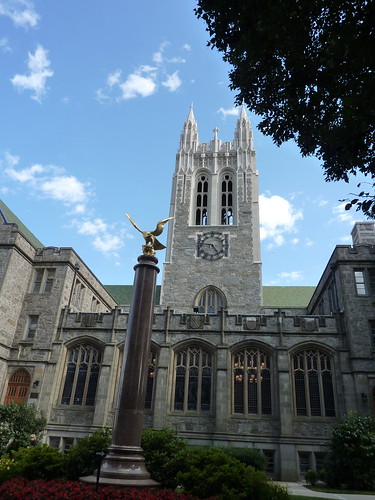
 The Boston Globe's Brian McGrory has done his best to channel Howie Carr in today's metro op-ed column about how Boston College should be paying more in Payments in Lieu of Taxes (PILOT) to the City of Boston.
The problem with McGrory's argument that BC should contribute more PILOT to the city is that he didn't give a handle on what might be a reasonable expectation for those payments, particularly since only some of BC's property is located within Boston's city limits.
By looking at what BC might be expected to contribute in PILOT under the proposal recently made by the city's PILOT reform commission, BC ought to be contributing at least $1.6 million more to the city than they are currently paying through PILOT and real estate taxes.
Here's how I come by that number: Boston College's existing Chestnut Hill campus (just that part within the Boston city limits) are currently assessed at a valuation of around $480 million, according to the city's website. Add to that the 16-story apartment building at 2000 Commonwealth Avenue they purchased in 2008 and the former St. John's Seminary land they purchased from the Archdiocese of Boston for $177.4 million in a series of transactions between 2004 and 2007. Added together, those properties lying within Boston have a current value in the ballpark of $722 million, no small change.
The current property tax rates in Boston -- the amount that BC would be paying if they were not a tax-exempt institution -- are $12 (residential) or $29 (commercial) per year per $1000 of valuation for residential property. Since BC's primary financial activities are in education and research, not rental income, most of the land would fall under the commercial rate; I'll assume 75% commercial, 25% residential, or $25 per $1000 of valuation.
If BC were to pay full taxes on their property at that $25 rate it would total around $18.05 million per year. The city's commission that is looking at PILOT reform is recommending that tax-exempt institutions, like universities, voluntarily contribute PILOT at a rate of 25% of the tax rate -- corresponding here to $4.5 million -- of which the institution could elect to pay half in payments-in-kind (e.g., community benefits). The 25% figure is based on a calculation of the cost of city services the institution requires as part of its operation, such as the emergency response to many campus incidents (including Tuesday's ammonia leak at BC's Conte Forum).
Applying the commission's recommendations implies that BC should be contributing a minimum of $2.3 million cash in PILOT to the city, while BC is currently, according to McGrory, paying only $0.3 million in PILOT and $0.4 million in real estate taxes for taxed property. (Nearly all of the valuation for the taxed property is 2000 Commonwealth Avenue; since I include it in the PILOT calculation above, it is appropriate to consider it alongside BC's current PILOT.)
So BC should be paying at least $2.3 million in cash to the city, while they are currently paying only $0.7 million, a shortfall of at least $1.6 million. Based on the commission's recommendations, McGrory has a point that BC is underpaying the city for required city services.
McGrory's tone has evinced a torrent of outraged (and outrageous) comments -- channeling the tone of Howie Carr fans who comment at the Boston Herald's website -- nearly all from people defending BC from what they view as his unfair attacks on their alma mater. Read at your peril.
Image of BC's campus:


