Thursday, February 10, 2011

Fantastic! A Fox This Morning in Brighton Back Yard

Startling but lovely sight this morning to see a fox trotting into my Brighton back yard. He wandered around a bit, hopped over the fence into the neighbors yard, stretched out and scratched. A chorus of crows surrounded him in the trees, and he left soon after.

Methinks he was looking for rabbits, a few of which live on this block. I've tracked them recently in the fresh snow.

Friday, November 12, 2010

Bike Lane on Brighton's Lake Street

City workers were seen painting bike lane -- and shared bike lane -- markings on Brighton's Lake Street last Saturday morning. The stripes were painted from the beginning of Lake Street at Commonwealth Avenue down to the bottom of the steep hill at Lake Shore Road, approximately a half mile.

The striped pavement looks to be approximately: 0.1 mile of exclusive bike lane; 0.25 mile of shared bike line on the right hand side of the street; and 0.15 mile of exclusive bike lane.

The street was recently re-paved, which meant that a number of potholes larger than a newborn baby were filled in. Several dangerously protruding manhole covers are also now level with the asphalt, although one bad one still remains at a location halfway down the hill.

For those who know the one-way street: it is fairly steep downhill such that a cyclist can easily speed over 40 mph unless braking steadily the whole way. In the past, I have had to ride in the center of the lane, blocking vehicular traffic -- weaving left-and-right because of the horrendous condition of the road surface. The resurfacing and bike lane are welcome improvements.

Thursday, August 26, 2010

MWRA Workers at Chestnut Hill Reservoir

Word is that MWRA workers have been over at the Chestnut Hill Reservoir -- including a boat and a truck -- who look to be preparing for the reservoir to be used as part of the city's water supply should the water main in Weston need to be closed off for repairs.

Earlier today the Boston Globe reported that the city's main water line had sprung a leak in Weston at a location only 75 feet away from the major leak that disrupted the city's water service back in May.

The Boston Globe's story notes that the MWRA is preparing unspecified backup plans:
"Right now, there are no service interruptions of any kind, but we are making ready our backup plans just in case," said Ria Convery, an MWRA spokesman.
In May the CHR was used as part of the backup water supply. The MWRA activity over there today suggests that it may be called into service again soon.

Friday, July 30, 2010

Judge Rules BC Task Force a Government Body -- At Least For Now

The City of Boston was dealt several setbacks recently in a lawsuit against them over the city's approval of the Boston College institutional master plan.

In the case of Galvin et al. vs. Boston Zoning Commission et al., Superior Court Justice Charles Spurlock [right] issued a preliminary ruling on June 29th that there are "sufficient facts to support an inference" that the BC Task Force, an official advisory body of the Boston Redevelopment Authority (or, in the judge's words, "a subcommittee of the BRA"), is a government body, and hence subject to the state's Open Meeting Law. The ruling was issued in response to a series of pre-trial motions by lawyers on both sides of the case.

The ruling is significant in that it is consistent with the ruling of Suffolk County District Attorney Dan Conley in June 2007 that the BC Task Force and the Harvard Allston Task Force are government bodies that are subject to the state's OML, a ruling that the city continues to dispute.

Two Brighton residents, Patrick Galvin and Mark Alford, filed their lawsuit against the city in July 2009 in response to the city's approval of BC's IMP. The BRA Board voted in January 2009 to approve the IMP; the Boston Zoning Commission approved it, with modification, in June 2009; and Mayor Thomas Menino subsequently signed it.

Justice Spurlock's order, while not a final ruling in the case, indicates that the task force will continue to be a defendant in the lawsuit. To date the task force has not, to my knowledge, responded at all to the complaints nor have they been represented in front of the court by legal counsel.

Implicit in the judge's ruling is that the lawsuit will go forward into additional phases, such as discovery and, potentially, trial. This alone suggests that there may be a protracted legal battle over BC's IMP that could impact the university's ambitious expansion plans.

This preliminary ruling by Justice Spurlock appears to be a major headache for the city, since its lawyers argued strongly to try and keep the task force out of the lawsuit. Now not only is the task force in this lawsuit as a defendant, but the judge has made an initial ruling that would appear to imply that all of the BRA's task forces are subject to the state's OML -- and, by extension, the state's Public Records Laws and ethics laws.

Let's hope the task force members -- now confirmed by the preliminary ruling to be part-time, unpaid municipal employees -- are doing a better job at retaining their emails than some other city employees who have recently been in the news.


Other Rulings by Judge

The judge also turned down two separate motions by the defendants that would send the case to Land Court and expedite it.

While not noted in the ruling, the judge appears to have allowed Boston College earlier this spring to join the lawsuit as a defendant without objection from the plaintiffs (as expressed in a December 2009 hearing). BC's lawyers have been filing motions repeatedly with the court -- including the Land Court and expedition motions -- actions that are normally allowed only for parties to the case.

The plaintiffs did not, however, win on every issue. The judge: ruled that their allegation of OML violations were filed too late according to the statutory 21-day limit; rejected their attempt to make a claim for violations of civil rights and their rights under the Equal Protection Clause; said that he would not consider possible criminal violations of the state's ethics laws, since those should be brought in front of the district attorney instead; that the individual members of the task force could not be named separately as co-defendants in the lawsuit, appearing to lift their individual liability (while not ruling on the government body's collective liability); and that the task force itself did not impact the rights of the plaintiffs, because the task force was only an advisory body to the BRA.

I suspect that that last ruling will be hotly contested in the case, and that we haven't heard the last of it.

The ethics issue, too, promises to be complicated as the case moves forward. While ruling that this civil action is not the appropriate venue for a criminal allegations of conflict-of-interest against individual members of the BC Task Force, the judge also stated case law that ethics civil violations are administrative matters that are rectified by processes within governmental agencies. But if the BRA Board and BZC relied upon recommendations from their advisory panel (the task force) that were allegedly biased due to financial conflicts-of-interest, then nothing in the ruling appears to prevent the plaintiff's arguments from going forward in seeking to invalidate approval of BC's IMP in a tainted process.

Spurlock was assigned to the case earlier this year after the previous judge, Christine Roach, recused herself after repeatedly suggesting her potential conflicts to the lawyers.


Update: The Boston Bulletin has a story on the ruling.

Saturday, May 01, 2010

Catastrophic Failure of Boston's Water Main -- In 1859

While today's catastrophic failure of the water main supplying drinking water to Boston may seem unprecedented, it's not.

The city's water main also had a major failure once before -- in 1859. Allston-Brighton historian William Marchione wrote in Allston-Brighton in Transition: From Cattle Town to Streetcar Suburb:
In 1859 a major break occurred in the aqueduct at the point where it passed across the Charles River at the westerly end of Needham. Since the capacity of the four small storage reservoirs ringing the city was quite limited, it became necessary to thut off water service to Boston for all but domestic uses while repairs were being made. Had a major fire broken out at this point, the fast-growing metropolis might have found itself without water, with devastating consequences. This emergency prompted the Cochituate Water Board to recommend the construction of a much larger storage reservoir just outside of Boston.
That new reservoir would be the Chestnut Hill Reservoir, the site of which was selected in 1864 and construction began in 1865. Its location was straddling the border between Brighton -- then an independent town not part of Boston -- and Newton. The purpose of the new reservoir was to provide a much larger backup water supply in case of catastrophe.

The reservoir consisted of two basins; the larger one still exists, while the smaller one was granted to Boston College, which, over time, filled it in to make way for an expansion of its campus (the "Chestnut Hill Lower Campus"). The main water pipe, however, continues to pass underground at the same location on the BC campus.

The reservoir is no longer used as part of the water supply system for Boston, but is reserved as a backup in case of emergency. Such as today.

Chestnut Hill Reservoir at Half Capacity Before the Emergency?

Earlier this year I repeatedly noticed that the water level of the Chestnut Hill Reservoir has been much lower than it usually is at this time of year.

I estimated by around six (or so) feet lower than normal. William Marchione, in his book Allston-Brighton in Transition, gives the size of the Bradlee Basin as 125 acre (5.4 million square feet or 1.56 mile circumference) and a storage capacity of 550 million gallons. Using the conversion of one gallon to 7.5 cubic feet, I estimate the reservoir's "standard depth" as 13.3 feet. That means current water level of 7.3 feet, instead of the usual 13.3 feet.

So the Chestnut Hill Reservoir this spring might only have been just over 50% capacity? Ouch. That extra water would have come in handy right about now.

I wonder if the people at the Massachusetts Water Resources Authority and Department of Conservation and Recreation might now be kicking themselves for letting the reservoir's level get so low earlier this year.

Thursday, April 22, 2010

Do Library Supporters Have the Right Target in Their Sights?

The Trustees of the Boston Public Library voted earlier this month to close four of the 26 branch public libraries in the city, including the Faneuil Branch Library in Brighton's Oak Square.

Library supporters are outraged and looking to reverse that decision -- whether through additional state funding, with an attached rider that would require all the branches to remain open, or additional city funding.

Those who want the branches to remain open have top two targets for their criticism: BPL President Amy Ryan, who drew up the closing plan, and Boston Mayor Thomas Menino, who voiced his strong support for it.

Are they targeting the right people?

The answer to this question lies first in figuring out why BPL is in a funding crunch.

Menino spokesperson Dot Joyce noted that the city this year "level-funded libraries."

Budget documents on the BPL website show that the City of Boston has decreased its payments much less: from $31.2 million in FY09 to $29.7 million in FY10 and $29.4 million in FY11. That's a decrease of $1.8 million over two years, or a cut of 6%. (Note that Joyce is not quite correct in saying that the city has "level-funded libraries.")

Now let's look at the state funding side of the BPL budget.

Brighton state Representative Michael Moran is especially outraged at Menino and has co-sponsored a bill in the state House of Representatives that would restore some state funding.

Note that verb: "restore."

In the same time period that the city has cut its funding to BPL by a little bit, the state has cut heavily its own contribution to BPL: from $8.9 million in FY09 to $4.0 million in FY10 and $2.4 million in FY11. That's a decrease of $6.5 million over two years, or a cut of 73% in state funding for BPL.

The funding shortfall in BPL's budget can nearly all be traced to a decline in state funding, not a decline in city funding.

Should Brighton protesters target Mayor Menino to tell him to restore funding for the libraries to keep the Faneuil Branch Library open? That strategy appears misguided, since it is not the city that has drastically cut their funding for the libraries.

Instead, Brighton residents might find their outrage better directed at members of the state legislature who voted to decrease state spending on BPL by 73% over the past two years.

Since state representatives Moran and Kevin Honan both voted for the budget bill that included decreased funding for BPL in the FY10, shouldn't the outraged residents of Brighton be holding them accountable? (Senator Steven Tolman probably also voted for the same cuts, but I can't find a roll call vote from 6/19/09.)

Shouldn't the the outraged citizens of Brighton be demanding that Reps. Moran and Honan and Sen. Tolman restore the state's funding to BPL from $2.4 million to the FY09 level of $8.9 million?

Methinks the public's anger towards Menino is misplaced on this issue since it is the state legislature who created BPL's funding sinkhole.

And members of the public who are angry at the possible closing of the Faneuil Branch Library should hold Moran, Honan, and Tolman responsible for their June 19, 2009 votes on the FY10 budget.

Friday, April 16, 2010

PILOT Numbers Behind McGrory's Metro Column on BC

The Boston Globe's Brian McGrory has done his best to channel Howie Carr in today's metro op-ed column about how Boston College should be paying more in Payments in Lieu of Taxes (PILOT) to the City of Boston.

The problem with McGrory's argument that BC should contribute more PILOT to the city is that he didn't give a handle on what might be a reasonable expectation for those payments, particularly since only some of BC's property is located within Boston's city limits.

By looking at what BC might be expected to contribute in PILOT under the proposal recently made by the city's PILOT reform commission, BC ought to be contributing at least $1.6 million more to the city than they are currently paying through PILOT and real estate taxes.

Here's how I come by that number: Boston College's existing Chestnut Hill campus (just that part within the Boston city limits) are currently assessed at a valuation of around $480 million, according to the city's website. Add to that the 16-story apartment building at 2000 Commonwealth Avenue they purchased in 2008 and the former St. John's Seminary land they purchased from the Archdiocese of Boston for $177.4 million in a series of transactions between 2004 and 2007. Added together, those properties lying within Boston have a current value in the ballpark of $722 million, no small change.

The current property tax rates in Boston -- the amount that BC would be paying if they were not a tax-exempt institution -- are $12 (residential) or $29 (commercial) per year per $1000 of valuation for residential property. Since BC's primary financial activities are in education and research, not rental income, most of the land would fall under the commercial rate; I'll assume 75% commercial, 25% residential, or $25 per $1000 of valuation.

If BC were to pay full taxes on their property at that $25 rate it would total around $18.05 million per year. The city's commission that is looking at PILOT reform is recommending that tax-exempt institutions, like universities, voluntarily contribute PILOT at a rate of 25% of the tax rate -- corresponding here to $4.5 million -- of which the institution could elect to pay half in payments-in-kind (e.g., community benefits). The 25% figure is based on a calculation of the cost of city services the institution requires as part of its operation, such as the emergency response to many campus incidents (including Tuesday's ammonia leak at BC's Conte Forum).

Applying the commission's recommendations implies that BC should be contributing a minimum of $2.3 million cash in PILOT to the city, while BC is currently, according to McGrory, paying only $0.3 million in PILOT and $0.4 million in real estate taxes for taxed property. (Nearly all of the valuation for the taxed property is 2000 Commonwealth Avenue; since I include it in the PILOT calculation above, it is appropriate to consider it alongside BC's current PILOT.)

So BC should be paying at least $2.3 million in cash to the city, while they are currently paying only $0.7 million, a shortfall of at least $1.6 million. Based on the commission's recommendations, McGrory has a point that BC is underpaying the city for required city services.


McGrory's tone has evinced a torrent of outraged (and outrageous) comments -- channeling the tone of Howie Carr fans who comment at the Boston Herald's website -- nearly all from people defending BC from what they view as his unfair attacks on their alma mater. Read at your peril.


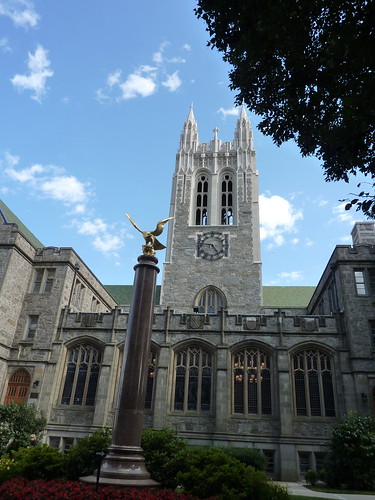
Image of BC's campus:

Thursday, April 15, 2010

Sheep in the State House

I woke up to the news that seemed in the tank all week: the state House of Representatives voted, overwhelmingly, in favor of legalizing casino gambling and installing slot machines at the state's race tracks.

This follows a completely opposite vote in the same legislative body a couple of years ago, when the same legislative body was against legalizing gambling.

What changed?

The legislators are still using the same "studies" written by the casino industry and its lobbyists, not independent analysis. In fact, this time around they asked only for a "benefits" study, not a "cost-benefits" analysis. Good lord. At least figure out what it is you're getting into before you vote for it.

The legislators are using the same arguments that casinos would create lots of new jobs -- vastly inflated numbers that don't make sense, and are made with the crazy methodology that is "standard" among all kinds of developers (where one hour of subcontracted work qualifies as an entire "job," rather than expressed in FTEs). The unemployment rate might be higher today than it was a couple of years ago, but I predict that the unemployment rate will have dropped significantly by the time that the first shovel goes in the ground.

The legislators are faced with the same arguments that gambling destroys people's lives, such as the nine-year-old boy who had to watch loan sharks repeatedly slam a meat cleaver in-between his father's fingers.

It's the same arguments. In fact, it's virtually all the same representatives voting again, since most of their seats aren't challenged.

What changed?

The speaker of the house, that's who. State Representative Robert DeLeo, whose father we learned this week used to work in the gambling industry at the race tracks, is now the speaker, having replaced disgraced former speaker and former State Representative Salvatore DiMasi.

The old leadership told the representatives a couple of years ago to vote against legalizing gambling, and they did it. The new leadership told the representatives this week to vote for legalizing gambling, and they did it.

A large number of the members of the state house of representatives appear to have no principles behind their voting records; they are just following their speaker like a flock of sheep.

Their benefits for cowing behind DeLeo? Continued leadership positions in the house and the extra pay that comes with it.

Since these legislators appear to operate under no principle other than following their leader, then what does this mean about their votes a few years back to kill efforts to ban gay marriage? Were those votes not based on principle? Will they gladly reverse their votes when a new speaker takes over who wants to get rid of gay marriage?

Gay marriage advocates watch out.

Do I sound cynical? Angry?

Maybe. It's because I learned that our state's representatives ain't got no... you know.


In Allston-Brighton, Representative Michael Moran and Kevin Honan both voted yes in favor of the casino bill. Both voted against the casino bill in 2008.

Image of sheep:

Monday, March 15, 2010

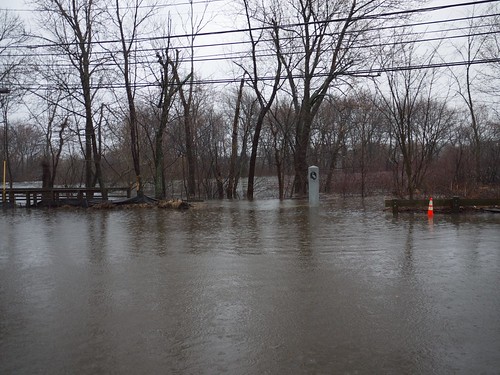
Charles River Bike Path Flooded in Watertown

In the past month, while out for runs in the mornings on the bike paths along the Charles River, I noticed that the water level had been getting quite low.

No longer.

The Aguageddon -- make that the H2OMG -- looks to be flooding the bike path along the Charles River on the north side in Watertown.

I know where I'm not going for a run Tuesday morning.


Image of flooded Charles River:

Tuesday, March 09, 2010

Which Allston-Brighton Public Library is Most Likely to be Closed?

The Trustees of the Boston Public Library are compiling data in order to determine up to ten branch libraries to close in order to address a budget shortfall of $3.6 million.

Three of the 26 branch libraries are located in Allston-Brighton; statistically speaking, one of those three is therefore facing closure.

Which one?

On one level, it would be politically disastrous to close the Honan-Allston Public Library in North Allston, since it is named after the deceased brother of current State Representative Kevin Honan. The Brighton Branch Library near Brighton Center would seem an unlikely target, too, since it is currently undergoing renovations -- if it were to close, the money already spent would be tossed down the toilet.

That leaves the Faneuil Branch Library in Oak Square [pictured at right].

How do the data on the branch libraries compare to this superficial assessment? The trustees have stated that they will be guided in their decision-making by data about each of the branch libraries, in addition to other important qualities such as connection to other community centers:
Library administrators will rank the 26 neighborhood branches by foot traffic, computer use, and how many Web surfers use laptops to log on to Wi-Fi networks. They will count how many programs are offered at each location and tally the number of people who attend storytime and English classes.
Below are a few sets of data on the Allston-Brighton branch libraries that were taken from a compilation on the BPL website. Statistics date from fiscal year 2007, which allows for a direct comparison among the branches (since the Brighton branch was closed for renovations in early 2009). I am impressed by the methodological data collection that BPL has undertaken, and the ease with which a member of the public can access the information from the internet. If only all government agencies were like this!

Based on these indicators -- many of which the BPL trustees said they would be using in arriving at their decision -- it would appear that the Faneuil branch library is the most likely to be closed. In fact, the Faneuil branch ranked last in all but one indicator.

The Presentation School Foundation has already initiated a campaign in order to drum up support for the Fanueil library and lobby the city to keep it open. Based on these data, however, the PSF's work is cut out for them.


Most Recent Renovation or Construction (i.e., Most Modern Facilities)
  1. Brighton: built 1969, renovated 2010
  2. Honan Allston: built 2001
  3. Faneuil: built 1931
Size of Collection (in volumes):
  1. Brighton: 76,900
  2. Honan Allston: 74,000
  3. Faneuil: 47,200
Size of Facility (in square feet of floor space):
  1. Brighton: 22,400
  2. Honan Allston: 20,000
  3. Faneuil: 7,600
Items Circulated:
  1. Brighton: 120,710
  2. Honan Allston: 118,117
  3. Faneuil: 93,043
Number of Volumes Used by the Public:
  1. Honan Allston: 14,540
  2. Brighton: 9,841
  3. Faneuil: 2,902
Meeting Room?
  1. Brighton, Honan Allston: yes
  2. Faneuil: no
On-Site Parking Spaces:
  1. Honan Allston: 20
  2. Brighton: shared lot (with courthouse)
  3. Faneuil: none
Public Computers:
  1. Honan Allston: 17
  2. Brighton: 14
  3. Faneuil: 12
Number of Visitors:
  1. Honan Allston: 82,895
  2. Brighton: 77,857
  3. Faneuil: 61,568
Number of Class Visits:
  1. Honan Allston: 101
  2. Brighton: 58
  3. Faneuil: 53
Number of Library-Sponsored Programs Within Boston Public Schools:
  1. Honan Allston: 25
  2. Brighton: 4
  3. Faneuil: none
Number of Students Requesting Library Assistance:
  1. Brighton: 701
  2. Honan Allston: 254
  3. Faneuil: 198
Use of Meeting Rooms by Public Organizations:
  1. Honan Allston: 98
  2. Faneuil: 83
  3. Brighton: 27
Number of People Seeking "Orientation and Instruction":
  1. Honan Allston: 1,736
  2. Brighton: 981
  3. Faneuil: 720
Number of People Receiving "Literacy Training and Assistance":
  1. Brighton: 199
  2. Honan Allston: 116
  3. Faneuil: 10
One statistic appears inaccurate to me: the number of class visits at the Brighton branch. The reason is that nearby Winship Elementary School has no on-site library, yet during a visit to the school earlier this year I was told that they have a regular program to visit the Brighton branch library as a substitute. Four classroom visits per year therefore appears inaccurate.

Another issue that is bound to be raised is that the Faneuil branch would be a nearby resource for a future community center at the former Presentation School in Oak Square; that future connection will not be reflected in assessments of past connections.

A final issue which appears contradictory is that the Faneuil branch had its meeting rooms used more often by public organizations than the Brighton branch, yet BPL documentation lists the Faneuil branch as having no meeting rooms. (I assume that the "meeting room" that is being referred to in the Faneuil branch is the small stage in the children's book wing -- which cannot be used separately from the rest of the room.)

Lacking from these indicators is a measurement of the number of "community centers" connected to each branch library. How exactly this term is defined may determine which branch comes out on top.

Another indicator missing from these is how "central" the branch is to the neighborhood or the public. That's a hard thing to quantify, although it probably already appears in the statistics for the numbers of visitors (gate count) and the circulation statistics.

Finally, the number of children's events (book readings, magic shows, etc.) is not summarized in the information on the BPL website. Based on my experience, I suspect that the Brighton branch will come last in this category -- but there should be a more quantitative measure available on it, too.


Let me add my own architectural category:

Most Interesting Architecture:
  1. Honan Allston: Beautiful building inside and out. A real treat to visit.
  2. Faneuil: Cool Art Deco exterior (only building of that style in Allston-Brighton). Awful and cramped interior that makes you forget its beautiful exterior.
  3. Brighton: Horrendous Stalin-esque exterior (which, in 1969, replaced a beautiful building!). Unknown interior (until renovations are complete).

Friday, March 05, 2010

Lowe's Unfamiliar With Massachusetts Culture

Lowe's may want to build a new home improvement store in Brighton Landing at the former Barry Controls building, but at a neighborhood meeting Thursday night Lowe's made it sound like the company doesn't understand Massachusetts culture.

One audience member asked, "Would you consider putting a Dunkin' Donuts in?"

Lowe's site development manager Larry LePere responded that he had actually raised the issue with Lowe's management before in other projects, but was always struck down by his bosses -- such that he got the message not to raise the issue again.

LePere didn't mention, however, that the nearest Dunkin' Donuts (aka Dunking Doughnuts) is far, far away from the proposed development site -- two blocks away, that is, at the corner of North Beacon Street and Market Street. You know, the one that used to have the 1957 sign [upper right] that was torn down nearly two years ago.


Image of former Dunkin' Donuts sign in Brighton:

Monday, March 01, 2010

Will Lowe's Continue to Misrepresent Traffic on Market Street?

Lowe's is scheduled on Thursday night to present to the Brighton Allston Improvement Association their revised plans for construction of a home improvement store in Brighton Landing. Lowe's is currently locked in a struggle with New Balance over competing development plans for those parcels.

Mayor Thomas Menino rejected Lowe's first proposal for the store in 2007 because of the traffic problems it would create.

A year-and-a-half ago Lowe's presented the first revision in their plans in which they first promised to spend $1.2 million to improve traffic signals on Market Street and North Beacon Street. If those improvements were found to reduce vehicle travel times, Lowe's representatives proposed that they should be permitted to construct their store.

In Lowe's traffic study, however, they substantially misrepresented the existing traffic situation on Market Street, stating travel times that are approximately three times longer than actual measured times. Lowe's characterization of travel times on Market Street are, simply put, way off.

Will Lowe's on Thursday continue to misrepresent the existing traffic conditions on Market Street?

In 2008 Lowe's representatives told the BAIA:
Lowe's traffic engineering consultants claim that it currently takes 14.4 minutes to travel along Market Street from Washington Street to Lincoln Street during morning rush hour, and the reverse trip during evening rush hour takes 17.6 minutes. They also claim that travel on North Beacon Street from Market Street to Union Square takes 10.2 minutes eastbound during morning rush hour or 15.0 minutes westbound during evening rush hour.
Their consultants were stating the travel times estimated from computer modeling of Market Street traffic patterns, not those actually measured in a vehicle on the street.

So what does the experimental physicist in me want to do? Measure the actual travel times. During morning and evening rush hour the past couple of weeks I made a series of timings of the travel time from crossing Washington Street to the time crossing Lincoln Street (or vice-versa). Morning timings were taken in a car and evening timings were taken from MBTA bus #86, which should be even slower than normal traffic because of the added time of allowing passengers to get on and off. [See the bottom of the post for more details on the measurements.]

Actual travel times: between four and seven minutes.

Predicted travel times from Lowe's computer models: between 14.4 and 17.6 minutes.

The results show that Lowe's predictions of travel times are three-and-a-half times too large for northbound travel on Market Street during morning rush hour, and two-and-a-half times too large for southbound travel on Market Street during evening rush hour.

The conclusion: Lowe's and their traffic consultants in 2008 massively misrepresented how bad the traffic is on Market Street.


Why Would Lowe's Massively Over-Estimate the Market Street Travel Times?

Lowe's proposed in 2008 that, if they could reduce the travel time by spending money on improving the timing of the traffic lights, then they should be allowed to proceed on constructing their box store in Brighton Landing:
[Lowe's and their consultants] claim that construction of their proposed, big box store will reduce average trip times along Market Street by 13-28% and along North Beacon Street by 3-11%...

...If there is more traffic on nearby streets, shouldn't this mean that it would take longer to go anywhere by car?

Not if Lowe's paid $1.2 million up front, prior to any approvals for construction of the store, in order to improve traffic signals in the area by synchronizing them. Lowe's insists that they will put a condition on their construction that they must first demonstrate a reduction in trip time from the signal improvements to Market Street and North Beacon Street.
But the actual travel time is already much better than Lowe's represented it to be; the existing travel times are a 50-67% improvement over their flawed computer models, much more than their proposed 3-28% improvement.

The cynical explanation is that Lowe's might be over-estimating the travel times in order to guarantee that it will appear as though their traffic signal improvements will improve the travel times. It's hard to know whether or not this is the real reason, but I am willing to bet that the BAIA asks some pointed questions at Thursday's meeting.

It's hard to imagine why a traffic consultant -- presumably paid by Lowe's for many hours, days, or even weeks of engineering work -- wouldn't bother to spend an additional hour or two driving up and down the street measuring the actual travel times. Unless, of course, the engineers made the measurements, found them less favorable than the computer model's predicted times, and chose not to make mention of the discrepancy. But that is a purely speculative conspiracy theory.

Their computer model travel times don't make any sense, either. The distance between Lincoln and Washington streets is 0.75 miles, so Lowe's model predicts average vehicle speeds of 3.1 mph in the morning and 2.6 mph in the evening. Those speeds are so slow that many young children could walk faster.

Let's hope that their traffic engineers have driver's licenses and own cars so that they can drive up and down the street a few times before Thursday's meeting.


Other Traffic Issues

Other things to look for in Thursday's presentation by Lowe's traffic engineers: whether they are using the same traffic study or a new one; if they are using the magical stroke-of-the-pen to declare "that 50% rather than 25% of the traffic would already be driving in the area on other errands"; how much the relocation of Briggs from one of the parcels is improving the traffic in the study, rather than other changes (such as a reduction in size of the store or traffic signal improvements); and how Lowe's deals with New Balance's counter-proposals to create a flyover on/off ramp to the Mass Pike and have a commuter rail station near Everett Street.


Measurements

Morning rush hour northbound [measured by car]:
Average 4.0 minutes (individual measurements: 4:27 and 3:27), compared to Lowe's predictions of 14.4 minutes. Neither measurement was within a factor of three of Lowe's predictions.

Morning rush hour southbound [measured by car]:
Average 4.2 minutes (individual measurements: 4:37 and 3:50); no Lowe's prediction given.

Evening rush hour southbound [measured on MBTA bust #86]: Average 6.9 minutes (individual measurements: 7:35, 5:30, 6:50, 7:30), compared to Lowe's predictions of 17.6 minutes. Not one measurement was within a factor of two of Lowe's predictions.

Evening rush hour northbound:
No measurements or predictions.


[above right] Image of a traffic jam in India:

Sunday, February 28, 2010

Signs of Spring: II. Witch Hazel Blooming

Last week I stopped by the Arnold Arboretum to see the first sign that spring is just around the corner: the witch hazel trees are blooming.

Hamamelis blooms in late winter, and a few of the arboretum's specimens near the ponds were in bloom. More will likely bloom within the next week or two.

Saturday, February 27, 2010

Signs of Spring: I. Winter's Flower Shows

How can you tell that spring is coming?

With the arrival of the flower and garden shows in late winter.

Last weekend I took in the Rhode Island Spring Flower & Garden Show, a modest-scale event that is a nice afternoon for peeping, photographing, seed and bulb shopping, and magic-watching.

The Boston Globe reported on Thursday that the Boston Flower & Garden Show will be making a comeback next month after a one year hiatus following the "financial meltdown of its producer, the Massachusetts Horticultural Society."

In the interim, locals have had to make their way to another city -- such as Providence, Rhode Island -- to stop and smell the roses.


Red-twigged dogwood Cornus serinicea [right] and primroses (Primula) and daffodils (Narcissus) [left].

Friday, February 26, 2010

Burrito Battle Escalates Into War

First, there was Boloco, a burrito joint on Beacon Street in Cleveland Circle.

Two years ago, Chipotle moved in down the street and the first Burrito Battle of Cleveland Circle was joined.

And in a few weeks the battle for the burrito dollars of Boston College undergraduate students will escalate into outright warfare.

The Boston Restaurant Talk blog announces that El Pelon Taqueria, a store damaged by fire -- twice! -- in the Fenway, is moving to the top of Lake Street at 2197 Commonwealth Avenue, the former site of the College Sub Shop and across the street from BC. They plan to open March 15, although no word as of yet if they will be handing out free burritos on the first day like Chipotle did.

What kind of weaponry will El Pelon bring to the battle? Their menu can be found at The Burrito Blog, natch.

The only question I have is this: Do you eat your burrito with the outer end of the strip up or down?


Image:

Wednesday, February 24, 2010

New Balance Proposal for Brighton Landing Development Met With Skepticism From Current Owners of Land

New Balance unveiled their "vision" for a $250 million mixed-use development project, first described here, at a neighborhood public meeting Wednesday night.

Their development proposal was met with considerable skepticism -- from the current owners of the parcels of land New Balance wants to develop. The owners of two of the three big parcels tell the Boston Herald that there's no deal to sell the properties or their development rights to New Balance.

One of those property owners, Marathon Realty Corporation, has an agreement with Lowe's to develop the site for a home improvement store, but the city has previously nixed that idea due to concerns about traffic problems. David Wanger, president of Marathon Realty, told the Boston Globe:
“It’s inappropriate for New Balance to be presenting a proposal of what they would like to do on property owned by my company unless it’s a collaborative effort," Wanger said. “We’re not going to simply abandon our plans because New Balance has new ones."
It is clear from an earlier Herald article that State Representative Michael Moran was previously knowledgeable and supportive of New Balance's proposal; State Representative Kevin Honan was supportive, too, in his comments today to the Herald.

Why would New Balance present their proposals now before they have agreements on any of the parcels?

One theory is that New Balance is trying to preempt Lowe's when they re-propose their own box store idea in the next few weeks. By showing an alternate development vision, New Balance is offering the neighborhood and the city an alternative to undermine the Lowe's project. Over in revenue-strapped City Hall a $250 million development probably looks a lot better than a more modest Lowe's store.

But a more conspiratorial theory has been discussed around the neighborhood for the past few weeks: that New Balance is trying to win over public support for their project in order to pressure the current landowners into selling to New Balance instead of Lowe's. That would explain why New Balance has put so much preliminary effort into wooing the local state representatives over to their project -- and putting a commuter rail stop at nearby Everett Street.

But New Balance's publicized plan could also backfire on them. The owner of one of the parcels seems to be driving his selling price upwards:
“We talked last year and neither the price nor the arrangements were to our benefit,” said William Joyce, [B.L.] Makepeace’s president. “We appreciated the offer, but they were way below anything we consider reasonable.”


Update: Harry Mattison attended the meeting and offers his comments on the development proposal.

Reps. Moran and Honan Nearly Always Vote With House Speaker DeLeo

State Representative Michael Moran [right] has voted identically with House Speaker Robert DeLeo on all 214 roll call votes since DeLeo became speaker, according to an analysis by David Bernstein at the Boston Phoenix. State Representative Kevin Honan has only voted differently from DeLeo once.

The pattern of voting in virtual lock-step with house leadership is not a new phenomenon, although the trend has abated somewhat in comparison with the previous house speaker:
"The Phoenix, in a review of roll-call votes since DeLeo became Speaker, has found an easing of the lock-step voting habits seen by Democrats under DiMasi. Overall, House Democrats have been twice as likely to vote against DeLeo and his leadership team as they were under DiMasi."

Monday, February 01, 2010

Rendering of New Balance's Proposed Development

A Brighton resident got a postcard with this picture in the mail today and forwarded it on to me. It's an artist/architect's rendering of the large development at Brighton Landing that New Balance is expected to put forward at a community meeting next week.

The view is looking east; the Mass Pike runs up from the lower right corner of the picture. I've labeled the various features in the image -- the red text is mine, not New Balance's.

The crossing of the Mass Pike looks to be more like a pedestrian bridge lined up with Litchfield Street -- not a flyover with on- and off-ramps -- which connects the proposed new development at Brighton Landing to the new Charlesview project a few blocks further north. Litchfield has residential buildings on its west side, light commercial on its east.

According to at least one source who was briefed on New Balance's plans, their presentation included an additional flyover with looping ramps that is not included in this artist's rendering.


Note: post was updated to clarify the issue of pedestrian bridge versus on-/off-ramp flyover.

New Balance to Propose Large Development Project at Brighton Landing

The economic downturn has given residents of Allston-Brighton a respite from major construction: Harvard University has stopped construction of their science complex in North Allston; and Boston College has announced a slowdown in capital construction on their main Chestnut Hill campus, with no word about construction on their new Brighton Campus (which is currently the subject of a lawsuit by two residents of Brighton).

It looks like the lull in construction may be about to change.

New Balance is poised to announce a major new project for Brighton Landing that would redevelop an industrial and commercial neighborhood into a mixed-use development.

Word has been leaking out for a number of months that New Balance -- whose corporate headquarters is located next to WGBH's "nuclear aircraft carrier" in the Brighton Landing area alongside the Massachusetts Turnpike -- wishes to initiate a large development project on the currently under-utilized industrial and commercial land between their current buildings and the Stop-and-Shop grocery store to the east.

The initial proposal that has been floated in the past months includes: two office towers (where one is for New Balance's own use to consolidate the corporate offices of their non-NB shoe brands); a movie theater/auditorium; luxury hotel; mixed residential housing and retail; and open green space running east-west in the middle of the project. The entire project is expected to be long-term and would be built in stages, possibly taking up to two decades to complete.

These details were provided and confirmed by a number of individuals who have heard presentations in the past few months from New Balance representatives. New Balance is expected to present details of their proposal in a community meeting next week -- which may include modifications to the plan based on feedback they have received during the past few months. (New Balance was contacted for this story but declined the opportunity to comment.)

The exact identification of the parcels involved was unclear to people briefed on the plans. The parcels in Brighton Landing have a variety of owners listed with the City of Boston assessors office and the Suffolk County Registry of Deeds, only several of which are Brighton Landing LLC, the proponent of the new development. (I have drawn the full possible area at right.) It is likewise unclear if they have entered into any purchase and sale contracts other property owners, but it would seem likely based on the maturity of their development proposal.

Lowe's previously proposed to develop part of the site with a large box hardware store that met with the opposition of both neighborhood residents and Mayor Thomas Menino due to its negative transportation impacts on nearby streets. Lowe's later floated the idea again, albeit without filing a new proposal with the Boston Redevelopment Authority.

The New Balance project concept would address its transportation impacts in two major ways: pushing for the state to locate a commuter rail station at Brighton Landing near Everett Street, which could also service diesel multiple unit trains; and building a new flyover on-/off-ramp for the Mass Pike (and/or a cloverleaf located further east by the Leo Birmingham Parkway). The current transportation constraints of the site are such that the Mass Pike ramps are a requirement for the project to move forward, according to those briefed on the plan.

While the office towers would likely be buffered from existing residential neighborhoods, the pike ramp flyover might be located relatively close to the residential neighborhood of North Brighton along Lincoln Street.

New Balance has not to date submitted their proposed development project to the BRA for review.


Community Meeting: NB Guest Street Planning & Development is hosting a community meeting to present their "vision" of potential future development of Guest Street. The meeting will take place on February 10th at 6:30 p.m., on the 2nd floor at Brighton Landing, 20 Guest Street in Brighton.


Update: Lowe's is on the schedule for Thursday's meeting of the Brighton Allston Improvement Association. Hard to know what that means, based on New Balance floating their own development ideas for what are likely to be some of the same parcels of land.


Image of New Balance's headquarters in Brighton Landing from the NB Store website.