Showing posts with label Dan Kennedy. Show all posts

Thursday, October 08, 2009

A Crackpot Email Archive Design for 21st Century City Halls

How should a city archive its employees' emails in a 21st century information technology environment?

As an astrophysicist, I deal with large datasets which can be updated daily with 10s or 100s of GB every day; the next generation of projects will create TBs of data daily. We need archives in astronomy, and are constantly searching ("querying") them in order to select out data of interest. Some datasets go public immediately; others are always private; while others have a proprietary period (such as the standard NASA 1-year) after which the data become public to anyone. And we store lots of additional parameters in the archives, not just the data themselves, which allow for robust searches for unusual astrophysical objects, date ranges, keywords, etc.

Archiving at city hall shouldn't be much different -- it's just a lower bandwidth problem.


Delete-Delete-Gate

Michael Kineavy, the chief of policy and planning in the administration of Mayor Thomas Menino, daily deleted all of the emails in his inbox and then deleted them again from his trash folder before the automated computer backups would run at midnight every day. The problem with his deletions is that the emails are public records which are illegal to destroy under the state's Public Records Law; Kineavy has taken an indefinite, unpaid leave of absence until the matter is resolved by Secretary of the Commonwealth William Galvin and Attorney General Martha Coakley.

On his Media Nation blog, Dan Kennedy pointed to some archival ideas in an article in the lifestyle and tech magazine Blast. The city has already announced that they are no longer solely relying on nightly backups of individual employee desktop computers in order to save copies of all the email; instead, they have started an archival system where email that is sent or received on the city's servers is instantly saved in a centralized database:
The city implemented a comprehensive program that immediately creates a record of all user messages sent and received no matter what each individual does with them. All journaled messages are kept in the archive for three years.
While I don't know the details of the city's newly deployed archival system, it sounds relatively similar to the Blast article's suggestion.

Lost in this technological solution, however, is how the storage and retrieval system can be designed in a manner that serves the public interest while reducing governmental waste.

The design of the archive is dictated by the "requirements document," i.e., the text of the state's Public Records Law. The whole current system is arcane, to put it mildly. In this 21st century, we could easily require through state law that electronic public records are archived and served to the public in a seamless, cost-effective, and transparent manner.


An Archive Design to Serve Public Documents in Real Time

A few points about the state's Public Records Law, and how it might be addressed in designing a transparent electronic archive:
  • Some public records can be withheld from release according to 16 exemptions listed in the PRL. These exemptions range from personnel matters to personal information (home address of a public employee) to pending litigation. Any archival system should include a classification tag as to whether the document is fully public, or if it is exempt (along with the particular classification).
  • Documents (letters, emails, etc.) become public records the moment they are created or received. The logical time to classify those documents as either public records is when they are first read by a person. The email application (MS Outlook, Thunderbird, Evolution, etc.) could be configured so that a user must always classify the email as public or exempt before allowing him to move to the next email in the inbox; that classification then gets stored in the archive.
  • Once a document has been made public it is always public. If someone accidentally released a document, then the person must continue to release it. (No Uruguay Round of copyright law where works in the public domain can be reverted back into copyright.) Once a document is released, it can be tagged in the archive as such, freeing it from ever needing another review.
  • State law does not require electronic documents to be provided in electronic form. The city has delivered Kineavy's 5,018 emails in paper form, then scanned the paper versions, and finally put the PDF scans on the internet. This is time-consuming, wasteful of paper, and annoying since the PDF documents are no longer electronically searchable -- a 20th century way that government offers the public its middle finger.
  • The cost of searching and reviewing documents in response to a public records request can be charged to the requester. This is the most frustrating part of the PRL, since some records requests generate estimated costs of thousands -- or hundreds of thousands -- of dollars mostly in the charge to review all those documents one-by-one. If the search could be done using automated tools available to anyone -- inside or outside government -- then many man-hours could be saved; the member of the public now wastes his or her own time using the search tool, while the government employees are left to go get a cup of coffee instead. Or do their other job duties. The search tools are easily designed so that they only release documents that are public, and can generate summary lists of emails that are being withheld because they are exempt.
What does this mean in practice?

A government employee: receives an email; clicks on it to read it; when he clicks on the next email a dialog window asks him to classify the previous one first as either public or exempt; and so on. (The same goes for outgoing email: the employee has to classify it before the mail system will send it out to its recipients.) When the email was received by the city hall server it is immediately archived; when the employee classifies it, the classification is immediately entered into the city hall archive. If the email is a public document, then it is served up on the internet immediately.

A member of the public: wants to obtain some public documents; goes to the city's website; runs a search using a set of criteria (date range; email to/from/cc name[s]; keyword search; etc.); inspects the two sets of documents returned by the search engine (the public records resulting from the query and a summary table of the exempt documents); and downloads the documents he wants or starts a new query. No government employee has to waste a single moment of time responding to the public records request. Now that is efficiency in government!

What are the obvious holes in such a 21st century system? It has to be designed with the idiot government employee in mind. I don't mean to imply that all or most government employees are idiots, but that any system has to be designed in a way that the least clever employee can't release everyone's health records onto the internet. I can also imagine that some employees might think twice about sending so many three word emails when they have to classify each one before it is sent.

All the employees will complain at first about how much time it takes for them to read their email and classify each one when they're done -- although it will become quick and easy-to-do in no time. Nearly all the emails are public, not exempt, so it's usually pretty routine. (97.5% of Kineavy's emails that were found were released, with only 2.5% being withheld due to one or more exemptions listed in the PRL.)

And employees who like to make rude comments about members of the public will think twice before doing so in an email. Actually, that's a good thing.


Reality?

I am under no illusion that any politician would be so crazy as to vote yes for a law that would require government electronic records to be served up in real time on government web servers. Remember: the state legislature has already exempted themselves from the state's Public Records Law. But it is a neat thing to think about.

In this Year of Astronomy celebrating the 400th anniversary of Galileo pointing his telescope at the heavens -- and President Barack Obama gazing at Jupiter from the White House lawn -- city hall might strive to reach the heavens by creating a transparent government whose electronic public records are served seamlessly to the citizenry.


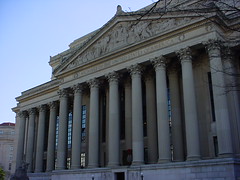
Image of a desk inside the National Archives in the 1950s by C. Getts provided by The U.S. National Archives, and image of the National Archives by marttj, both provided through a Creative Commons license.

Saturday, June 07, 2008

Gatehouse Media in Financial Trouble: Is the A-B TAB At Risk?

Earlier this year the Allston-Brighton TAB had to cut its only full-time reporter position as a result of the budget woes of GateHouse Media, the parent company of the TAB and the owner of more than 100 newspapers (mostly community weeklies).

Now Dan Kennedy reports on the Media Nation blog that Gatehouse Media is descending rapidly into financial turmoil:
GateHouse Media may be in deep trouble. According to the blog 247WallSt.com, the chain — based in suburban Rochester, N.Y. — is doing so badly that you might be able to get some furniture and computers cheap in a few months. After turning itself into a publicly traded company several years ago, the stock price has tanked, falling 80 percent over the past year.

247's Douglas McIntyre writes: "Watch for GHS to be broken up before the end of the year or to enter Chapter 11." (GHS is GateHouse's symbol on the New York Stock Exchange.) Wow.

What's more, the Motley Fool recently listed GateHouse as one of "5 Deathbed Stocks." [some hyperlinks added]
Before you decide not to renew your subscription to the TAB lest the money be lost in a Chapter 11 bankruptcy, Kennedy thinks the community papers won't die even if the parent company goes belly-up:
GateHouse may or may not survive, but its papers should probably be all right in the long run. Community newspapers are in a better market position than major metros these days. Providers of quality local news don't face a lot of competition either from other papers or, with a few exceptions, from the Internet.
While some in the neighborhood periodically complain about poor reporting here or there in the paper, the A-B TAB fulfills a valuable role in the community by keeping the neighborhood informed of news, activities, and interesting people among us. So send in those renewal checks to try to keep the paper afloat.

Friday, April 04, 2008

WGBH Blogger-Critic Turns Blogger

While it was the media-celebrity layoffs in the WBZ newsroom made news this week, over at public broadcaster WGBH they are suffering, too.

First, news that WGBH's short-term borrowing has recently become more expensive due to the credit crisis:
WGBH [uses] "variable" bonds whose rates reset every week based on certain bond indexes, often tied to complex "swap" agreements that also have proven volatile. The station has borrowed $124 million since 2002 for items including its glamorous new [nuclear aircraft carrier] headquarters in Brighton and to buy a radio frequency in the Brewster area...

Lately its borrowing costs have risen as high as 9 percent, from around 3 percent last year, adding an additional $100,000 or so to its borrowing costs - each week...

"Sadly, first and foremost where the impact will come is on our ability to expand," WGBH chief executive Jonathan C. Abbott said. The most likely candidates are special onetime editions of public affairs programs, Abbott said; he doesn't anticipate having to cut any of WGBH's existing shows.
Today we see that WGBH's own media-celebrity, Emily Rooney of Greater Boston, has started blogging. She says she's filling in for Jeff Keating, whose extended leave resulted in no postings since February. "We too suffer from staff shortages and lack of resources," blogger Rooney writes.

Rooney and several of her regular guests on the "Beat the Press" Friday edition of Greater Boston are often quick to criticize blogging and bloggers. (I wish WGBH posted the old videos so that I could dig out the PJs reference.) The burden to set the record straight about blogging often falls upon Dan Kennedy, himself the author of Media Nation blog, or occasionally John Carroll.

Rooney is clearly learning the ropes of this citizen journalism thing. First she puts up a blank post, then two minutes later she submitted another post. Fortunately, the second post had content, although it was littered with grammatical errors, a misspelling, and no paragraph breaks. But -- Hey! -- she was probably posting it from the basement of her parents' house while wearing PJs, and the wireless signal might not be so good down there next to the boiler. I surmise that Rooney's distaste for the medium has something to do with her sloppy initial foray into blogging. Next I expect Kennedy will explain to Rooney how she needs to learn how to shoot, edit, and post video all by herself to stay current in the new journalism world.

I hope Rooney's new experiment with the medium leads her to a greater appreciation of it. Welcome to the blogging world, Ms. Rooney! Remember: double carriage return for a paragraph break! (Kennedy had to teach his Northeastern students this lesson, too.) And don't forget to edit your writing before posting, because this blogging thing ain't all that much different from your regular gig.

Friday, February 15, 2008

GateHouse Media Staff Cuts to Impact Allston-Brighton TAB

The Boston Globe reported in Thursday's edition that GateHouse Media, the owner of more than 100 daily and weekly newspapers in the greater Boston area, will be cutting around 60 staff positions. Thirty-five of the positions are anticipated to be layoffs, while another 25 will consist of currently-vacant positions that will not be re-filled. The cuts correspond to nearly 5% of the entire staffing of GateHouse New England's papers.

GateHouse Media is the owner of the Allston-Brighton TAB, a weekly community newspaper, which will be impacted by the staff reductions. The larger newspapers owned by GateHouse Media in the Boston area are the Patriot Ledger and The Enterprise of Brockton.

The A-B TAB's position of staff reporter is currently vacant after the departure of Rich Cherecwich last month to California. His duties are currently taken up by a number of free-lance reporters.

A source at GateHouse Media confirms that the reporter position at the A-B TAB is one of the 25 vacant positions that will not be filled as part of the staffing cuts. The A-B TAB has typically had 1.5 FTEs on its staff -- one full-time reporter plus an editor, Valentina Zic, who is in charge of two newspapers -- which will be reduced by two-thirds. Free-lance reporters will be replacing the full-time staff reporter position.

The staff reduction at the A-B TAB comes at a critical time for the community because of the challenge in covering the massive institutional expansion proposals of Harvard University in North Allston and Boston College in Brighton. Free-lance reporters will have a steep learning curve in getting "up-to-speed" with the complicated projects proposed by the institutions, and the year(s)-long process of regulatory approval an discussion between the community and the institution.

One way the A-B TAB appears to be dealing with this challenge is to have the same free-lancer cover a given issue regularly. In the last month, Susan Haverson, for example, has had several bylines covering the BC expansion issue. The Boston Globe has also been using the same approach in its City Weekly coverage, where free-lancer Andreae Downs is covering the Harvard and BC beats in A-B for the Sunday section.

GateHouse Media will also be laying off their only staff reporter covering the Massachusetts State House -- reporter Tom Benner of the Patriot Ledger -- as part of the staff reduction, according to Adam Reilly of the Boston Phoenix on his Don't Quote Me blog. Dan Kennedy writes in the Media Nation blog that this one particular position will be sorely missed:
This is a tough cut indeed — one of the benefits of a local paper's having a Statehouse reporter is that he or she can cover hometown legislators, assess the local impact of various initiatives and the like.
The A-B TAB regularly includes "roll call" summaries of how local elected officials voted on various bills in front of the State Legislature. Such coverage will be more difficult -- possibly even stop altogether -- without a State House Bureau staffer in the GateHouse Media consortium.


EDIT (2/17/08): Dan Kennedy reports at Media Nation that, while State House Bureau reporter Tom Benner is being laid off, he will be replaced. The Patriot Ledger of Quincy is therefore not closing their State House Bureau, after all. Adam Reilly recounts how he tried to fact-check his original report, which now appears to have been wrong.

Monday, November 05, 2007

Damn! I Forgot to Get the Money First!

Dan Kennedy of Media Nation finds a profitable business model for community newspapers, including online versions:  "charge city-council candidates for covering them."

The Cambridge Chronicle reports:
Neil McCabe, who edits and writes for the monthly North Cambridge newsletter The Alewife, refused to print a candidate profile on Jonathan Janik written by McCabe’s staff after Janik decided not to buy advertising in McCabe’s newsletter...
[Wrote McCabe in an email:]  "The truth is that I am not in the news business, I am in the real estate business. I have 24 pages of real estate that I have to collect rent on every month."
I've just managed to put up an awful amount of campaign-related stories and information right here at Brighton Centered.  Every time I did so, the candidates told me the check was in the mail...  but I have yet to see one measly buck.  I should've insisted on the cash up front.  Damn.

Monday, October 22, 2007

Journalism, Journalists, and Bloggers

The cacophony continues about whether or not bloggers are journalists, and whether or not they practice journalism. This particular case not only offers a good opportunity to ask generally what is the relationship between blogging and journalism, but to explain how Brighton Centered itself fits into the picture. So we'll start at NECN and BMG, depart to a length trio about Brighton Centered, and then join back in the recapitulation and development of the principal themes.


Beat the Press and NECN Beating Up Bloggers

The latest incident throwing a wrench into the debate occurred a week-and-a-half ago when several writers for the BlueMassGroup blog, who were about to watch a debate among the candidates for the 5th Congressional District, were asked to leave the audience at the NECN studios. Their exclusion was at the request of the handlers for Republican candidate Jim Ogonowski. The reason given was that the BMGers are partisans in the election, having endorsed Ogonowski's opponent, Democrat Niki Tsongas, and actively participated in raising contributions for Tsongas's candidacy through links on their website.

The BMGers left the studios without incident (everyone involved appears to have behaved well publicly), but raised the issue later -- online, of course, but also through the MainStream Media. (See BMG discussions here, here, and here.) The topic was taken up by the pundits on WGBH's "Beat the Press" edition of Greater Boston on Friday, October 12th (video available), who came down on both sides of the issue. Dan Kennedy, of Northeastern University, said that the bloggers should have been able to stay since the BMG bloggers "practice journalism" -- even if they are not professional journalists in a traditional definition -- while John Carroll of Boston University said that those particular bloggers may have been rightfully excluded, because they stepped over the journalistic line by participating in fundraising activities.

Phil Balboni, president of NECN, drew a stark line separating bloggers from journalists when he stated, in a taped interview, that:
Bloggers are not journalists. Not in my definition. You know, the objectivity, the accuracy, the completeness, the balance, and so on and so forth. A story has to have integrity. Bloggers have -- they may or may not wish to subscribe to those standards.
I find that Balboni's statement is self-contradictory: "bloggers may or may not wish to subscribe to those standards" means that those who do are therefore journalists. But that contradicts his point that "bloggers are not journalists," unless he can demonstrate that there exists no blogger on Earth who follows those journalistic standards. Methinks Balboni failed to source his own material; furthermore, I predict that he is probably ignorant about the the blogging corps because he has read little of their writing. To their credit, Beat the Press then countered Balboni's assertion by providing contradictory opinions, i.e., more than one example of a blogger who qualifies as a journalist in their mind. Practicing journalism score card: Beat the Press 1, NECN President Balboni 0.


Does Brighton Centered Practice Journalism?

Let's not just be general about bloggers, let's look at one blog in particular: Brighton Centered. In my view, blogs that deal with local issues, politics, and so on, most closely parallel local newspapers. There are a series of functions that any MSM newspaper will typically contain, and news-related blogs are no different:
  1. Community event listings
  2. News reporting
  3. Opinion (aka "Op/Ed" or columns)
  4. Editorials
  5. Advertising

What You Will and Will Not Find at Brighton Centered.
Here at Brighton Centered, I have made a clear and conscious decision to do #1-3, not to do #4, and not to bother with #5 (because I can't imagine I would make enough money to justify the time spent trying to do so).

This is a very important set of distinctions to make: I endorse no position or candidate for elected office (an "editorial" or "endorsement") like BMG did, while I consider it a key element of this blog to provide thoughtful opinion and analysis of the news and community issues. If I see a stupid proposal I am free to call it that -- while providing details supporting the point -- but I do not need to endorse a position or a person who proposed (or opposed) that stupid idea.

The problem with the blogging corps is that we are all too often a single person who tries to do all of #1-3 and maybe also #4. Newspapers, on the other hand, simply have more than one person working for them and can therefore cleanly separate the news desk from the columnists and the editorial board. It is often quite difficult to separate the news from the opinion... but more on that in a moment.


Does Brighton Centered Practice Journalism?
I believe the answer is yes. There is probably little question in readers' minds that I have strived to perform a public service here by providing such a wide-range of information on candidates for elected office; a reader can find plenty examples of such journalism currently by looking at the top-right column of this blog. Postings here regularly fit neatly into categories #1, 2, and 3 above.

Some blogs are simply opportunities for the writer to collect, rewrite, or comment on news reported elsewhere. Does Brighton Centered do its own reporting [#2 above]? Once again, the answer is a clear yes. Reporting has included: campaign finance reports (and thereby correcting inaccurate reporting found in the Boston Globe), neighborhood meetings (e.g., BC Task Force), election-day problems and get-out-the-vote-efforts, IP addresses, candidate interviews, dying trees, unblocked-and-then-reblocked Wiltshire Road, local angle on EPA lead-paint allegations, phone surveys, a Ward 21 endorsement, correcting misinformation about bicycle paths in the Boston Globe, community policing in Brighton, a rabid raccoon, past contributions to political campaigns, structurally deficient bridges in Allston-Brighton, candidate opposition to BC's proposal to build Brighton Dorms, withdrawal of two and then another candidate from the race, flooding and a fire along the Charles, etc., ... I'm tiring out from all this linking, so I'll just let you read the last six months of posts.

More to the point: do news-related posts such as these follow standard practices of journalism? Mostly yes, but I am always open to criticism and education on this point. The specific item on which I might be considered to most often depart from "standard journalistic practice" is getting on getting comments from subjects of news stories. The code of ethics states that a journalist should always "diligently seek out subjects of news stories to give them the opportunity to respond to allegations of wrongdoing." I rarely carry outright accusations of wrongdoing -- and, when I do, I am very conscious about offering the opportunity to respond -- but there are many more cases in the gray area where I don't always seek out a response. While it may not always appear to be the case (!), I do significant fact-checking behind the scenes, much as is expected by a MSM journalist, and follow the standards on when information can be reported as fact or as assertion. If I were a full-time journalist, I would have far more time to track down more sources... but I've got a real job that pays the bills. Such are the trade-offs of the citizen journalist beat.


Separating News From Opinion on a Blog.
One way of separating news (#2) from opinion (#3) would be to label the top of every post as either one or the other. Unfortunately, that is often a harsh remedy which divides up a story in an unnatural way -- fully separating the information itself from the analysis of it. Nonetheless, I have used this approach frequently, for example when covering the City Council candidate forums with news quotations and transcript as opposed to analysis, or when providing precinct-level election results and then analyzing them.

Another way to separate news from opinion is by using section headers that offer a fairly clear distinction. Examples of this are in my reporting on campaign finance (for District 9 Councilor and Councilor-At-Large), casino gambling, BC's possibly new -- possibly old -- student behavior policy, and CRI beginning construction of a new boathouse.

A more subtle method to separate news from opinion comes from simple language usage: moving from the active or passive voice to the first person. See the section in this post (above) labelled, "Beat the Press and NECN Beating Up Bloggers," where the last paragraph provides my analysis of NECN President Balboni's remarks and the preceding paragraphs report on other people's positions. Since most of the readers here are well-read and understand the subtleties of language, I believe they can appreciate and follow the simple change of voice, which is a clear way of separating factual news from opinion. This use of language is commonly found in my technical scientific writing, where the factually-supported, strong voice "experiment X causes result Y" can be immediately followed by the (first-person plural) assertion that "we consider the experimental approach to be systematically biased."


Reader Comments.
Opinion and commentary also enter into Brighton Centered through another route: comments by readers to the post. Here, I have made some clear decisions that define the nature of the comments allowed. Brighton Centered's reader comments are moderated and require the user to have a Google/Blogger account -- no anonymous reader comments are allowed.

Why? News posts touching Boston College sports in any way -- even when purely factual and containing no opinion or commentary -- routinely result in a torrent of offensive, poorly-written, and totally off-topic responses from readers who are devoted fans of BC sports. (A tiny minority of such fans, I'm sure.) Such reader comments accuse me of bias, hatred of BC sports, etc., even when the posts themselves (and Brighton Centered altogether) contain no such statement; such accusations are not just ignorant, since they have no factual basis, but they would massively clutter up this blog were it to be un-moderated and/or allow anonymous comments.

I have also regularly rejected partisan reader comments on elections-related posts that are of a non-partisan nature. I consider it inappropriate to have reader comments like, "What a stupid answer by Candidate X," attached to a post which is the candidates response to a questionnaire he returned to me. There are places on a blog for reader comments -- but a post containing non-partisan, raw information about a candidate is not such a place.


Does BlueMassGroup Practice Journalism? Is It Even a Blog?

BlueMassGroup is an interesting, albeit odd, online community. It does not squarely follow the format of a blog or a newsgroup; instead, it is a merger of the two, with all of the warts that brings. Blog posts by core members of BMG are typically followed by a wide-ranging discussion of the topic by lots of readers. While it has many lengthy posts, the BMG nonetheless often becomes comment-heavy, not poster-content heavy, which often gives it more of the feel of an active newsgroup than a tightly-controlled blog.


BMG Ejection. The criticism levelled at BMG by John Carroll on Beat the Press was direct and relevant. Newspapers may endorse a candidate but do not participate in fund-raising activities for him/her, so BMG has stepped over a reasonable line drawn by newspapers over the years. As a result, BMGs activity can be argued, with merit, as partisan on the issue of the 5th Congressional District race.

Assuming that NECN had a written document describing how the debate would be run (including who would be in the audience), and had sent this document to the candidates well in advance of the event, then I think that the BMGers probably would not have qualified for press credentials to the event. But NECN appears to have granted press credentials in advance to the BMGers, so we can only conclude that there was no written policy banning journalists who participate in fund-raising activities for one or more candidates. (Or that NECN didn't follow their own rules.)

That said, I don't know why the *&#$ NECN would ban the BMGers from the audience at the studio debate. I have moderated two candidate forums in the last month, and will moderate another debate this week, that have had audiences full of partisans supporting one candidate or another. A professionally-run event simply has to set ground rules for audience behavior (such as no signs, applause, or talking); trust me, the audience will follow the rules and behave with decorum if you ask them. By all accounts, the BMGers were well-behaved and courteous. When NECN President Balboni ejected the BMGers from the audience, he was providing zero confidence in the ability of his own moderator, Jim Braude, to run the event professionally and keep a lid on the audience. I think Balboni's behavior is sad and warrants an apology directly to Braude. If BMGers received press credentials to the event according to NECN's written policy on the debate format, then they should have been allowed in. If Ogonowski's people objected, then he should have walked out the door. His decision, his loss.


BMG, Op/Eds, and Editorials. Some at BMG are correct to state the parallel between their writing and the Op/Ed opinion columns typically found in newspapers. My understanding, however, is that newspapers typically forbid Op/Ed columns from endorsing a specific candidate: "[New York] Times columnists are not allowed to endorse candidates," wrote Thomas Friedman recently. News journalists usually steer clear of endorsements as well as fund-raising activity. Dan Rather of CBS, for example, was criticized in 2001 for participating in a private campaign fund-raiser, although he later stated that he was given inaccurate advance information about the event.

BMG has enough contributing members that they could easily form a small "editorial board" to decide upon endorsements, while leaving the other writers to express Op/Ed opinions and report on the political news. It would be a worthy exercise to examine the BMG archives to see if they follow any such procedure, and also if such a process is fully transparent to the reader. I am an occasional reader of their site, so I lack a full understanding of their process, but I would hazard a guess that their endorsement process is not fully transparent to the casual reader of their site (like me). Now is their opportunity to define a process for making endorsements which is structured, transparent, and clearly defines the roles of various, specific individuals in contributing to that process. If they do so, then they will be able to justify why certain individual BMGers contributing to their site are free from allegations of editorial bias. The MSM has already invented that wheel by separating editorials from news; BMG would be well-advised not to ignore that invention.

Saturday, September 29, 2007

Beat The Press Beating Up Boston College Athletics

I watch very little television, but rarely miss catching "Beat the Press" -- the Friday edition of WGBH's "Greater Boston" -- at some point over the weekend via Comcast On Demand. During one of the segments of the September 28, 2007 broadcast, the panel slid back-and-forth between Oklahoma State football... and Boston College football. Host: Emily Rooney. Guests: Dan Kennedy (Northeastern University), Eileen McNamara (Brandeis University, formerly of Boston Globe), John Carroll (Boston University and Greater Boston), Joe Sciacca (Boston Herald). The video of the segment can be viewed online here.

The show was doing a segment on the press conference by Mike Gundy, coach of the Oklahmoma State University football team, who was complaining about a column by sportswriter Jenni Carlson. Her column was critical of OSU quarterback Bobby Reid, whom Gundy sidelined recently.

The gist of the discussion was that the column was journalistically not well-written -- if not even "toxic" in Carroll's mind -- but also that Gundy's outburst went off the deep end. There was some degree of disagreement amongst the host and guests about whether or not sportswriters should treat college athletes at big-time football programs differently from professional athletes: the segment had an on-air interview by Boston Globe sports columnist Dan Shaunessy who said that they should be treated differently, while acknowedging, however, that it was a bit of a gray area; Joe Sciacca made the point, and Dan Kennedy agreed, that these college athletes are part of a big-time money-making machine, receive big scholarships and premium housing, and are one-step away from professional sports, and hence should be treated with a scrutiny similar to professional athletes. Apparently, Reid's mother is considering a lawsuit against Carlson.

The discussion continued [unofficial transcript produced by myself]:
MCNAMARA: A kid who is playing hockey for Williams College is not the same as somebody who is playing Big 10 or Big 12 football. I know absolutely nothing about sports, but I am married to a sportswriter, and he says this is big-time athletics... We don't comprehend it, really, here in New England, what real big-time college sports is.

KENNEDY [overlapping with Carroll]: It's as big as professional sports in much of the country.

CARROLL [overlapping with Kennedy]: We're going to get a lot of email from BC fans out there... sorry, Dan.

ROONEY: That's a good example: there's a tremendous amount of attention paid to BC and all of its games. Do they get that kind of scrutiny from the local press? I'm asking that rhetorically because I don't read enough...

CARROLL [overlapping with Kennedy and Rooney]: Well, if you read the police blotter, they do. And that's happened quite often...

KENNEDY [inaudible]

ROONEY: I'm talking about the game itself.

KENNEDY: You don't get it here, because we have major professional sports in every sport you can think of. But if you go out into fly-over country like Oklahoma, this is it, this is what life revolves around, their big-time college sports program. And these guys, it's one degree of separation between that and the NFL.
I have a prediction: they are about to receive a lot of letters and/or email from BC fans.

Comments? Direct them to greaterboston@wgbh.org . Once again, comments or complaints about the WGBH broadcast should be directed to greaterboston@wgbh.org, not here.


Legal and/or Behavioral Troubles for BC Athletes

I suspect that Carroll was making a reference to Boston College athletes who have had some legal (and behavioral) problems both recently and in the more distant past. He gave no specifics, particularly since his comments were in passing, but a little bit of research provides some details.

BC's student newspaper, The Heights, published an editorial back in January motivated by two basketball players being kicked off of the team. A previous basketball player had problems: "Ryan Sidney, who was a promising raw talent, peaked as a freshman because he couldn't keep his personal issues under control and was constantly in the news for drug problems and behavioral indiscretions." The problems date back to 2000-1 "when Kenny Harley was busted for getting in a bar fight at Mary Ann's." The Heights continues:
"Teammate Andrew Bryant was subsequently dismissed from the university after news broke of his involvement in a robbery during which he pistol-whipped somebody. The next year, a bizarre story broke concerning Jermaine Watson jumping out a window, rumored to be armed and escaping cops. He jeopardized his playing ability to escape legal authorities."
Hockey isn't immune: "Captain and assistant captain Joe Rooney and Brian Boyle were stripped of their respective C and A jersey patches." [See note below for clarification: punishment stopped there.] Woman's hockey coach Tom Mutch "stepped down [in April] in the wake of allegations of improper behavior with one of his players" (Boston Globe) -- sexually explicit text messages to Mutch were found on one of his player's cell phone, according to The Heights. Mutch is married, by the way, to a woman who isn't on the team.

This summer, two BC football players, Gosder Cherilus and DeJuan Tribble, were involved in a bar scuffle that has led to charges filed against both. I believe that both are currently playing for BC football this fall. And former linebacker Raymond Henderson was recently, allegedly caught with three different drugs and trafficking paraphernalia in his Cleveland Circle apartment, and has been indicted.

Boston College is a Jesuit-led university that focuses on "student formation," i.e., in teaching their students how to be moral and upstanding in every aspect of their life. It is a fair question to ask: why does this focus on "student formation" appear to be finding difficulty gaining traction amongst a few of their student athletes -- and even one of their coaches?


Note: comments to the Brighton Centered Blog are encouraged, but moderated. Vitriolic comments will not be published.


EDIT (10/2/07):  The case of BC football players Tribble and Cherilus just got more complicated:  the man injured in the bar fight, Sean Maney of Watertown, has now also been charged with assault and battery.  This means that pretty much everyone involved in the scuffle (except Maney's brother's girlfriend) has been criminally charged -- Tribble, Cherilus, off-duty state police officer Joseph Boike, and now Maney.

Wednesday, September 12, 2007

After Action Review of Crowdsourced Questionnaire

WARNING!!! Shameless Self-Promotion! WARNING!!!

David S. Bernstein of The Boston Phoenix's "Talking Politics" has very nice words about the crowdsourced questionnaire for candidates to the A-B City Council seat that was put together here over the last month. Bernstein then lost all credibility by referring to Brighton Centered as "one of the best blogs in town."

For those who weren't following the process early-on, I picked up the idea for submitting questions and running a poll from Adam Gaffin of UniversalHub -- who pulled it off successfully with a questionnaire that Suffolk County District Attorney Daniel Conley then answered. The term "crowdsourcing" was suggested by Dan Kennedy to describe Gaffin's process, based on a term that seems to have first appeared only in 2006. The concept of crowdsourcing has been applied retroactively to describe processes that have occurred centuries ago, such as the Longitude Prize.

I believe the crowdsourcing process worked well here in Allston-Brighton for a series of reasons. First, while daily readership of the Brighton Centered Blog may not be astronomical -- it is, after all, a blog mostly about local politics and neighborhood issues -- there are several active Google Groups full of members with similar interests that supplemented the daily readers. They sprouted up in response to Harvard's Allston expansion ("AllstonBrighton2006" and "Harvard Neighbors Forum") and Boston College's expansion into the former St. John's Seminary ("BC_Neighbors_Forum"). Yes, we can thank Harvard and BC for something. Second, another blogger in Allston who predates me, Harry Mattison, prepared the activist neighborhood at large on the concept of reading blogs and groups. Third, I got an advance agreement from most of the candidates that they would participate. Fourth, I reminded most of them about the questionnaire when the date approached. Fifth, as the deadline loomed I chased down the last candidate's questionnaire by contacting every phone, answering machine, pager, and email address I had for him/her. Sixth, the candidates seemed to realize that the questions were directly from the voters. It is far more difficult for a candidate to blow off the voters themselves than a two-bit blogger. And finally, I was asked to moderate the City Council candidates forum next week -- the last one before the preliminary election -- so the candidates probably all felt they had to be nice to me in the hopes of getting a softball question in return.

In response to Bernstein's concerns about not fact-checking the candidates' responses (which I originally noted on the final blog posting): I think the process followed here is parallel to the idea of having a voter information guide that many states publish in hardcopy and mail to all registered voters (Massachusetts does not), although the hardcopy aspect of the guide is probably becoming rare these days. Some states (or municipalities) have the candidates each give a brief biography and/or answer one general, but topical, question. I don't think the Secretaries of State fact-check those candidate answers or biographies; instead, they let the candidates deceive, mislead, or lie at their own risk. That's the same idea I adopted here by publishing their responses unedited.

Anyway, I hope it was an educational experience for everyone who watched and/or participated in the process!

Sunday, July 08, 2007

Councilor McDermott Receives Annual "Muzzle Award"

MediaNation commentator Dan Kennedy has published his annual "Muzzle Awards" highlighting "outrages against free speech and civil liberties in New England." It appears in the current issue of the Boston Phoenix.

While Mitt Romney lead the list again this year (for the second year in a row) -- this time for refusing to provide state security for the former Iranian President who was giving a speech at Harvard University -- a local pol made the list, too.

After Venezuelan President Hugo Chavez made negative remarks about U.S. President George Walker Bush at the United Nations in September, Allston-Brighton District City Councilor Jerry McDermott called for the Citgo sign near Fenway Park to be taken down.  Writes Kennedy:
Jerry McDermott
Boston city councilor aims at Chávez, hits Citgo sign


If there’s an iconic piece of pop kitsch that defines the Boston skyline, it’s surely the giant Citgo sign in Kenmore Square. Lovingly restored in 2005, its burned-out neon tubes replaced with bright LEDs, the 60-by-60-foot sign can been seen from several miles away and is as much a part of the Fenway Park experience as David Ortiz walk-offs and steamed hot dogs in damp, squishy buns.

But the sign came under fire in September after Venezuelan president Hugo Chávez took the podium at the United Nations and issued an offensive — and, let’s be honest, hilarious — attack on President Bush. “The devil came here yesterday,” Chávez said. “And it smells of sulfur still today.”

It turned out that Citgo, based in Houston, is a wholly owned subsidiary of the Venezuelan state oil company. Enter Boston city councilor Jerry McDermott, who introduced a resolution demanding that the Citgo sign be taken down in retaliation for Chávez’s words. “Given the hatred of the United States displayed by dictator Hugo Chávez,” said McDermott, “it would be more fitting to see an American flag when you drive through Kenmore Square.”

Fortunately, cooler heads prevailed, including that of Mayor Tom Menino, who rightly called the sign a “landmark.” But given McDermott’s predilection for heavy-handed governmental authority (he also spoke out against supposedly objectionable material on Boston’s local-access cable channel, and called for voters to produce photo IDs at the polls), the best news to come out of his office all year was his announcement that he will not seek re-election to his Allston-Brighton seat this fall.
Ouch.

While the Citgo sign might be iconic, it ain't no landmark, at least in my mind. I would be surprised if removal of the sign, for example, would require approval of the Boston Landmarks Commission, for example.  But removal of the sign is definitely an unnecessary step in protesting Chavez's remarks.  How about writing an Op-Ed about why you think he's a bad guy?

Wednesday, June 27, 2007

Q/A With Dan Conley, Suffolk County District Attorney

A local blogger, Adam Gaffin (adamg) of "Universal Hub", has arranged for a written question-and-answer with Suffolk County District Attorney Dan Conley.

People have submitted questions already, and he has whittled it down to ten. Vote for your top five; the top five questions go to the DA. Conley will have a week to answer those five questions.

No, I did not submit any questions to Gaffin's project. But I did vote.

Update (6/30/07): Journalist and commentator on the media, Dan Kennedy of Northeastern University (and blog MediaNation), refers to this process of voting on the questions as "crowdsourcing." I've never heard the term before, and the poor wikipedia entry doesn't seem entirely applicable. A neat word to watch, though.