Friday, July 18, 2008

Air Force Band of Liberty Concert at Chandler Pond Thursday 7/24

Last summer the Air Force Band of Liberty's wind ensemble played an outdoor concert at Chandler Pond to an enthusiastic crowd:
Following the opening number, the Air Force Band had a well-timed fly-over. Not by a Stealth Fighter or the Blue Angles, but a flock of Canada Geese headed towards Chandler's shores to make their 1-pound daily deposit.
It was a great family event, and they even provided the DEET.

This year will have an encore event: on Thursday, July 24th, the Air Force's jazz band will be playing an outdoor concert at the same venue at 7:00 pm. The site is on the western edge of the pond in the open, grassy field -- Gallagher Park.

BYO lawn chairs, blankets, and picnics.

Party at D-14 Station

Party. D-14 police station.

No, I don't mean where you end up if you have a loud party.

The police officers at Allston-Brighton station D-14 are hosting a community party at their renovated station as part of the National Night Out celebrations:
Boston Police National Night Out Celebrations
Police Districts to Host “Open House”

As part of the Neighborhood Crime Watch Unit’s National Night Out celebration, each of the 11 Boston Police Districts will be hosting neighborhood celebrations. These events provide an opportunity for community members and police personnel to mingle, exchange ideas and form new relationships. Attendees will enjoy complimentary food, family friendly entertainment and activities.

Saturday, July 26th
Boston Police District D-14 (Allston-Brighton) 10:00 am - 2:00 pm at 301 Washington Street.
Come and see the station's new handicapped-access ramp out front. Chew the fat about who had the worst office in the trailers during the renovations. Enjoy the landscaping out front. Watch the emergency room construction across the street at St. Elizabeth's Medical Center.

And please: no more theater jokes.

Headed in Reverse on Construction Management Plans

In what is hopefully not a bad omen for Boston College's proposed ten-year, $1 billion capital construction project, questions surfaced in the last week over the city approval process for renovations underway at the library on BC's new Brighton Campus.

How did neighborhood residents sense something was going awry? A week or two ago a construction truck drove down one-way Lake Street, the driver probably realized his mistake, and then he backed up several hundred feet in order to get to an entrance into the Brighton Campus -- the former St. John's Seminary land purchased by BC in 2004-7.

At the October 16, 2007 meeting of the BC Task Force at which the library renovations were discussed, I had mentioned that construction vehicles ought to enter the Brighton Campus only through the Commonwealth Avenue entrance. A logical extension is that no construction trucks should travel down Lake Street or Foster Street -- particularly since the latter has a posted 2.5 ton weight limit banning heavy trucks. BC officials seemed to nod in agreement.

After seeing the truck go in reverse up Lake Street, several residents thought that there ought to be a construction management plan (CMP) for the renovation work -- and that it ought to say that there would be no truck traffic on Lake Street. Queries to BC and the BRA caused city workers to scramble for a few days to figure out what was going on -- and if the city's processes regarding the construction work were being followed.

The BRA requires large development projects to negotiate a signed CMP with the Boston Transportation Department after BRA Board approval but before construction begins. The problem: there wasn't a CMP on file for the library renovations.

In the end, everything appeared to be OK: BC told the BRA that renovation work on the library only started after the city issued a building permit on June 18th; and the BRA determined that a CMP was not required for the renovation work because the BRA had issued a "notice of exemption" for the work on May 14th.

And BC officials apparently told their contractors in no uncertain terms what entrance they should be using.


Update on BC's IMP Amendment

The renovation work on the library provided an opportunity to get an update on BC's institutional master plan amendment first filed in October 2007.

The revised IMPA of April 2008 requested approval of temporary occupancy of Bishop Peterson Hall as the offices and classrooms for the new School of Theology and Ministry, along with renovations of the library and St. William's Hall. After the renovations of St. William's Hall are complete, the STM would move there permanently. (St. William's Hall was already approved as the site for the STM in the 2006 IMPA, so BC returned to this previous plan.) The Bishop Peterson Hall kitchens will be permanently used jointly by STM seminarians and the diocesan seminarians at St. John's Seminary. (The former rector of St. John's Seminary won't be happy!)

The "notice of exemption" of May 14, 2008 was issued by the BRA because the library renovations, with the exception of a handicapped access ramp, were entirely interior to the building. While the library renovations are still formally part of the IMPA, the notice meant that BC could proceed with them without waiting for approval of the IMPA itself.

The public comment period for the IMPA closed on June 6, 2008 without any letters received, according to BRA project manager John Fitzgerald.

Since that date, BC and the BRA appear to have been too busy with other issues to follow-up on the IMPA. Even though Article 80 review dictates that a BRA Board vote should follow soon after the close of the public comment period, it has not yet taken place. Nor has the Zoning Commission taken it up.

Fitzgerald offered his assurances that, when the St. William's renovations are approved, the BRA will make sure that a construction management plan is signed with BTD prior to the start of any construction work.

And that no more trucks would be backing up on Lake Street.


Image of a dump truck by cindy47452 provided through a Creative Commons license.

Thursday, July 17, 2008

A-B TAB Op-Ed: Time to Step Back and Slow Down Master Plan Review

The Allston-Brighton TAB last week published an op-ed I wrote arguing that BC and the city of Boston should slow down their master plan review process, particularly in the light of recent comments by Mayor Thomas Menino:
With the tensions having risen between BC on the one hand and the residents and mayor on the other, now would be a good time for BC to: postpone its planning process for a few extra months; go back to the drawing table to improve its plan; engage with the city and community in an iterative process to modify it; and, in the end, produce a consensus plan that accommodates the needs of everyone, not just BC.
One particular way in which the city ought to consider requiring further review is that the purchase of the apartment building at 2000 Commonwealth Avenue -- and subsequent proposal to convert to an undergraduate dormitory -- were not part of the original institutional master plan notification form of December 2007.

In reading the 409 pages of public comments I was unable to find a single case where a letter writer requested BC to purchase off-campus buildings, nor did I find a case where a letter writer used terminology such as "university-controlled housing" or "university-owned housing" when calling for BC to house all their undergraduate students (the term "on-campus" was the typical language used in the letters).

The issue of an off-campus undergraduate dormitory was not raised in the IMPNF and, as a result, the public comments did not consider that possibility.

The Boston Redevelopment Authority has therefore not issued any kind of scoping determination on BC's proposal for an undergraduate dormitory at 2000 Comm Ave. Now would be the time to do so.

Landmarks Commission to Hold Hearing on Demolition by BC of Foster Street Houses

The Boston Landmarks Commission will be holding a hearing on Tuesday, July 22nd regarding a request by Boston College to demolish three houses at 188, 192, and 196 Foster Street.

Thomas Keady, Jr., BC's Vice President for Governmental and Community Affairs, told the now-defunct BostonNOW newspaper last year, "Those three houses will be coming down."

The three houses are located on the corner of the five-acre lot bought by BC from the Archdiocese of Boston. (One house and its comparatively small lot was purchased from a private seller in 2006.) BC has proposed to demolish all three to make way for a 75-bed Jesuit seminarian and theology graduate student housing complex as part of the re-affiliation of the Weston Jesuit School of Theology with BC. The three buildings date to the time period 1870 - 1885.

BC submitted their demolition request to the city, and the BLC will hold this hearing in order to determine whether or not to invoke a 90-day demolition delay under the Article 85 process.


Alternatives to Demolition

Despite arguments presented at this blog as to how BC could incorporate these three houses into their new construction, rather than demolish them, BC has shown no inclination to consider the alternatives. No assessment of the feasibility of renovation or preservation of the buildings was presented in their revised IMP. (By comparison, last year the university extensively renovated three houses bought recently on Wade Street.)

Harvard University, on the other hand, followed such an alternative path 25 years ago with their University Place development -- preserving two houses by incorporating them into their new development to positive reviews from the community.

The Massachusetts Historical Commission in January called for BC to explore alternatives to demolition:
Rehabilitation alternatives should include additions to the existing houses and/or compatible, adjacent new construction. Feasible alternatives that would preserve and protect the historic properties should be adopted and implemented.
The houses "display elements of Victorian eclectic style and are fine examples of this period and type of construction," according to the MHC letter. All three houses are identified in the appendix of BC's IMPNF as listed on the National Register of Historic Places.

In their revised institutional master plan, BC has disputed the architectural significance of the three houses (DPIR 11-5 to 11-6), disagreeing with the MHC's letter:
This opinion is not substantiated with an explanation as to how these buildings are representative of any style or construction, not does it address subsequent changes to 192 and 196 Foster Street which seriously detract from their integrity.
The MHC and BC dispute whether or not the three houses lie within the "Upper Foster Street Area," which is part of the MHC's Inventory of Historic and Archeological Assets and is an area that the MHC said "meets the criteria for listing in the National Register of Historic Places," or the "Foster Street Area," an area that the MHC has not commented on regarding its eligibility for the register.

The Foster Street houses were built by Horace W. Baxter on the southern end of his Baxter Estate, according to an email provided by Brighton historian Bill Marchione. The property traces its prior lineage back to Reverend John Foster, "Brighton’s first resident minister (and namesake of the street), and his wife Hannah Webster Foster, the first native born American female novelist," according to Marchione. Mrs. Charles Eldredge (aka "Fanny Fern") -- "the most popular female writer/ journalist of her day" and author of the novel Ruth Hall -- also lived on the estate.

The Foster Rock is located on the opposite end of the five-acre site from the houses. BC's proposed development would not modify the granite outcropping.


How Can the Public Comment?

The BLC hearing will be at City Hall on Tuesday, July 22nd at 6:25 pm in Room 900.

Verbal public comments will be allowed at the meeting, and written public comments are accepted in advance of the meeting. Written public comments are only accepted by mail. In order for the public comments to be considered at Tuesday's meetings, they must be received before 3:00 pm on 7/22:
Gary L. Russell, Staff Architect
Boston Landmarks Commission
City Hall, Room 805
Boston, MA 02201
617-635-3850
In documents provided by Russell, he notes that consideration of demolition delay by the BLC involves assessing whether or not the building is "preferably preserved" based on:
  • the building's historic, architectural, and urban design significance;
  • whether the building is one of the last remaining examples of its kind in the neighborhood, the City, or the region; and
  • the building's condition.
If the BLC votes for a 90-day demolition delay, then they subsequently discuss if there are feasible alternatives to demolition based on:
  • the outcome of the community meeting held prior to the hearing.
  • the cost of stabilizing, repairing, rehabilitating, or re-using the building;
  • any definite plans for the re-use of the property if the proposed demolition is carried out, and the effects such plans would have on the architectural, social, aesthetic, historic, and urban design character of the surrounding area, as well as on the economy of the area of the City as a whole;
  • any conditions the Applicant proposes to accept for the redevelopment of the site that would mitigate the loss of the building;
  • the availability of other sites for the Applicant's intended purpose or use.
In evaluating alternatives to demolition, the BLC may consider such possibilities as the incorporation of the building into the future development of the site.


BLC Hearing on Proposed Development at 332 Chestnut Hill Avenue

Also on the agenda for the July 22nd meeting is a design review meeting regarding the proposed demolition of the gas station at 332 Chestnut Hill Avenue and construction of a five-story residential building with retail on the first floor. The design review application will be considered at 3:30-4:00 pm, and then discussed by the BLC and voted on at 5:30 pm.


Note that the July 22nd meeting of the BC Task Force was postponed to July 29th in order to allow people to attend the BLC hearing.

Wednesday, July 16, 2008

Playing the Prison Card at BC

Residents, local elected officials, and Mayor Thomas Menino have all argued for increased undergraduate housing on BC's main campus, while BC has argued for locating new dormitories on the former St. John's Seminary land -- and converting their recently-purchased apartment building at 2000 Commonwealth Avenue into a dorm -- based on the argument that any increased housing would make the main campus too dense.

Now BC's director of public affairs, Jack Dunn, increased his rhetoric again by saying Tuesday night that the housing on part of their Chestnut Hill campus is so dense that to find denser housing "you would have to go to a prison."

Dunn's prison remark was met by a series of moans -- "aaaawwwwwwww" -- from the crowd. They weren't buying it at all.

Dunn's prison argument against housing density, as it turns out, rests on analysis of a gerrymandered map of BC's Chestnut Hill campus. A fairer comparison without using a gerrymandered map shows that BU has a substantially higher housing density on their campus than BC has on their Chestnut Hill campus.


Gerrymandering at BC

Dunn's argument relies on a peculiarly-drawn map of BC's Chestnut Hill campus -- a feat of gerrymandering that would make former Massachusetts House Speaker Thomas Finneran proud. [See red dotted lines in figure at right from BC's presentation to the June 14, 2008 meeting of the BC Task Force.]

By drawing the lines in such a way, Dunn makes the argument that BC's proposed housing plan places 4700 students in 40 acres comprising part of their "lower" Chestnut Hill campus.

In fact, by drawing the lines this way, Dunn and other BC officials have actually mixed up the boundary between lower and middle campus in their diagram -- including some parts of the middle campus (those that have dorms) while excluding some parts of the lower campus (those that don't have dorms).

The 6/14/08 presentation commits the misrepresentation to writing by referring to the map above as part of "lower campus area studies," when in reality the area enclosed by red -- and the statistics drawn from it -- includes buildings from the middle campus. In particular, the dorms Gabelli, Ignacio, Rubenstein, and Voute Halls, and 66 Comm Ave, are all identified as middle campus dorms in their DPIR (Table 6-1), yet are strangely included in the "lower campus area studies" diagram.

Draw the lines differently, say, to reflect better the underlying geography and you would get a different answer in terms of student beds per acre.

One thing is for sure: gerrymander the area studied and you'll always get the answer you want.


Comparing Housing Density at BC to BU

In making his case for a campus prison, Dunn was, in effect, implying that Boston University ought to be renamed Boston Prison University, because its undergraduate housing density is substantially higher than BC.

Just compare the housing density in BC's entire main campus at Chestnut Hill to BU's entire campus in the Kenmore neighborhood. No gerrymandering required.

BC currently houses 6455 students (DPIR Table 6-1) in their 118-acre Chestnut Hill campus (DPIR page 1-5), corresponding to 54.7 beds of housing per acre. BU currently houses 10,617 students on their 133-acre campus, corresponding to 79.8 beds of housing per acre -- 46% more dense than BC's campus.

These numbers will not surprise anyone who has seen the tall dormitories that BU has built in order to house their students: BU has a higher housing density than BC. Just stating the obvious.

And I don't think anybody would call BU a prison.


Spokesman Bats 0-For-2

Spokesman Dunn continued to try to make his density argument against new, main campus dormitories by pointing out the usage of all the other facilities there. "It's other functions in that part of campus" that contribute to the density issues, such as the Rec Plex (or its proposed successor, the Recreation Center). He estimates around 8000 students use the student center daily, and around 4000 students per day use the Rec Plex.

The problem is: by adding more students into the calculation, the addition of 500 beds of undergraduate housing to the lower campus becomes even more diluted, weakening his argument.

Adding 500 beds of housing to 4700 is around a 10% increase in the number. But adding 500 beds to 4700 beds plus 8000 students using the student center plus 4000 students using the Rec Center, and the increase is number of people is only 3%. (Yes, his argument does suffer from substantial double- or triple-counting, since many of the same students live on-site, use the student center, and then use the Rec Plex all in the same day.)

By adding all the extra users of the student center and Rec Plex, those 500 more student beds appear to have a more minimal impact. Probably not the conclusion he was shooting for.

A little piece of advice: stick to the housing argument sans Rec Center.


UPDATE: The Allston-Brighton TAB reports that Dunn is backpedaling on his prison comment:
Following the meeting, a college spokesman had to repeatedly defend words he thought may have offended the community...

“You’d have to go to a prison to find that kind of density,” said Dunn. Dunn later told the TAB that he was worried the statement came out wrong and might be misconstrued. “The point I was making, 4,700 students within the 40 acres is equivalent to the density of a prison. It was meant to be a comparative point, and not meant to offend anyone.”

Wednesday, July 09, 2008

BC Task Force Meeting Schedule for July

The BC Task Force will be meeting during July to consider various parts of the revised institutional master plan (the draft project impact report) that BC submitted to the city on June 20th.

All meetings are 6:30-8:30 pm, Brighton Marine Health Center, 77 Warren Street, Brighton.
July 10 [Thursday]: Athletic facilities [Chapters 5 and 7]
July 15 [Tuesday]: Housing [Chapters 5 and 6]
July 22 29 [Tuesday]: Transportation, etc. [Chapters 5 and 9]
Note that none of these meetings is the one that the BRA is required to hold under the Article 80 review process, so there will be at least one more meeting in addition to those listed above.

For more information, contact: John Fitzgerald, Project Manager, BRA, 617-918-4267, John.Fitzgerald.bra@cityofboston.gov


To Attend, Or Not To Attend: That Is The Question for BC Officials

These meetings will differ from previous ones in that there will be no presentation by BC officials -- since most attendees are quite familiar with their institutional master plan. Task force members will be facilitating the meetings as an opportunity to hear community feedback, so there will be no time set aside in the agenda for BC officials to present the plan or answer questions.

City officials (e.g., BRA and other departments) are likely to attend; the task force is, after all, an official advisory body of the BRA. The attendance of BC officials is unclear: this is a public meeting, so they may attend if they wish, but the task force appears neither to have invited nor discouraged them from attending.

At previous meetings during the comment period of the IMPNF, at least one BC official stated publicly that they would be happy either to attend or not -- whatever the community and task force would prefer. (Harvard's counterpart has made the same offer to the Harvard Allston Task Force.) A peculiar situation unfolded in the four January meetings, in that the BC officials were asked to sit in attendance -- yet say nothing as the neighborhood residents made various comments and posed questions. In general, those questions weren't answered because the format didn't allow it. It was an odd format, and several of the BC officials appeared visibly uncomfortable.

This week I have heard from quite a number of Brighton residents, all of whom have told me that they would prefer that BC officials not attend -- since the format appears to avoid allow back-and-forth discussion between residents/task force members and BC officials. Last week's public meeting of the BC Neighbors Forum had only residents in attendance (plus a few reporters and a couple of elected officials' staff members), which allowed the discussion to be thorough and very lively. There is little question in my mind, based on experience, that the discussion is far more frank when only neighborhood residents attend.

We'll see how the task force addresses the situation Thursday night.

Tuesday, July 08, 2008

Oh, And One More Thing... Send a Check for $424k -- Er, Make That $660k

While Mayor Thomas Menino spent a couple of days last week in various interviews with reporters stating his opposition to key elements of Boston College's undergraduate housing proposals in their revised institutional master plan, he forgot to mention one thing: BC's proposed conversion of the apartment building at 2000 Commonwealth Avenue into an undergraduate dormitory would remove more than $400,000 from the city's tax rolls, because BC is a tax-exempt institution.

Today Mayor Menino continued his feud with the BC administration by insisting that BC should increase their Payment In Lieu Of Taxes (PILOT) by the $424,000 that will be removed from the tax rolls, according to the Boston Globe:
Today, Menino, through his spokeswoman, took aim at the college. "He believes BC should make that up somehow," said Menino press secretary Dorothy Joyce. "They don't do as much as their counterparts, and he'd like to see them do more."
Missing from the story is that the building is currently heavily under-assessed relative to similar, nearby comparable apartments; the city should be pushing for $660,000 in increased PILOT, not $424,000.

Mayor Menino's comments Tuesday echo earlier comments by District 9 Councilor Mark Ciommo, who called into question the wisdom of BC removing the property from the tax rolls.


Under-Assessed Property: Taxes Ought To Be $660,000 Not $424,00

Missing from the story is that the apartment building appears to be significantly under-assessed relative to a comparable apartment building in the immediate neighborhood.

The apartments at 2000 Comm Ave are typically split between 1-bedroom/3-room units with 700 square feet assessed around $165,000 (e.g., #806), and 2-BR/4-room units with 1000 sf assessed at around $240,000 (e.g., #805).

Comparable apartments at 1933 Comm Ave across the street are 1-BR/4-room units with 660 sf assessed at nearly $280,000 (e.g., #408), and 2-BR/5-room units with 1150 sf assessed at $350,000 (e.g., #403).

At $36 million, the total assessed value for the 188-unit apartment building at 2000 Comm Ave is therefore under-assessed; a more accurate assessment would be around 56% higher, or $56 million. The current property taxes for the entire building ought not to be $424,000 per year, but instead 56% higher, or $660,000 per year.

Note that 2000 Comm Ave is also a more modern building than 1933 Comm Ave and offers a range of additional, luxury amenities -- including the swimming pool in the photograph, spectacular views of the Chestnut Hill Reservoir, and others features you can see at Archstone's website. So, if anything, 2000 Comm Ave should be assessed even higher than the comparables.

When Mayor Menino is pushing for BC to increase their PILOT to account for the property tax payments on 2000 Comm Ave, the city should use $660,000/year as the baseline for negotiations -- not $424,000/year.

Why would the apartments at 2000 Comm Ave be so heavily under-assessed? I can only speculate that the developers of the building managed to get a "sweetheart" deal with the city to assess the property so low -- but, admittedly, I have no evidence whatsoever of any such agreement. It's a good question to ask the city's Assessing Department.


Is Raising PILOTs an Implicit Acceptance of the Conversion to a Dormitory?

One other problem with Mayor Menino's statement on Tuesday is that, as long as BC continues to operate the building as open market rentals, they already have to continue to pay property taxes since the property is not an "institutional use." Only if and when it switches to institutional use -- such as if it is converted into a dorm -- does the loss of property tax revenue come into play and the modified PILOT is a way to address it.

By raising the PILOT issue now, it sounds like Mayor Menino is implicitly accepting that BC will convert the building into a dorm. Doesn't the city have a say about the conversion? Doesn't BC need approval of that conversion both through the Article 80 review process (requiring approval of both the BRA Board and the Zoning Board) and through a city-issued dormitory license? If so, then the city could easily erect hurdles for BC by blocking their move through either the Article 80 review or the required dorm license.

University PILOT vary widely in their amount. Harvard University pays Cambridge, Watertown, and Boston a combined $5.1 million, while BC pays Newton and Boston a combined $315,000. Better uniformity in the PILOT would make sense, particularly since BC has demonstrated that they are not in dire straits -- having paid $173.4 million for the St. John's Seminary land in 2004-7 and $67 million for 2000 Comm Ave last month.

Friday, July 04, 2008

A Local Produce Trend That's NIMBY

The Boston Globe reports on a green movement they dug up: growing your own produce in your backyard -- or maybe even the White House's gardens. With the price of fuel sky-high and the average produce traveling 1500 miles to reach your local grocery store, locally-grown produce is a way to cut down on U. S. consumption of fossil fuels.

Probably a more concrete trend is the interest in Community Supported Agriculture, where members collectively purchase shares of a local farm's products by providing up-front cash in the winter or spring -- when the farmers need the money to plant crops. Since the farm is located not far from the consumer's house, minimal fuel is needed to transport the produce to the customer for a weekly delivery.

Purchasers of a CSA share typically receive a weekly distribution of produce from late spring to mid autumn. The variety of vegetables, fruit, and herbs are seasonal. The system is a shared-risk and shared-reward for consumer and producer. It's local produce, but Not In My Back Yard.

CSA's such as these date back to the 1960s in Germany or 1980s in the U. S. Current estimates are that there are current between 1300 and 3000 such CSA's in the U. S., although one report puts it at 1080.

I have been receiving weekly deliveries of produce from the Red Fire Farm in Granby, a central Massachusetts town located around 90 miles west of Boston. The farm is a great place to observe the landing route for roaring, low-flying Air Force jumbo jet cargo planes at the Westover Joint Air Reseve Base in neighboring Chickopee, if that's your thing.

It's still early in the season, so quantities and variety are a bit limited, but one week's haul in the early season might be: a couple zucchini or summer squash; a head or two of lettuce; bunches of turnips, radishes, or large pearl onions, all always with the greens still attached; a bunch of garlic scapes [picture at top right], which are the cut tops of garlic (something I've never seen anywhere else!); a head of kale or collard greens; rosemary, dill, cilantro, or chives (with chive flowers); cabbage; and strawberries.

While the advantage of this approach over backyard vegetable gardening is that you don't have to break your back in the process, additional strawberries as well as various kinds of peas are labor-intensive to pick, so many farms allow share-holders to visit and pick-your-own.


Image of garlic scapes by urtica provided through a Creative Commons license.

Appeals Court Upholds Gun Possession Conviction of Brighton High School Student

The Massachusetts Appeals Court ruled Thursday that the physical search in 2004 of student Amenhotep Smith at Brighton High School, which led to discovery of a loaded handgun with four rounds of hollow-point ammunition, was reasonable and that the evidence was correctly allowed in his 2006 trial. Smith was convicted at trial of unlawful possession of a firearm and ammunition.

Defense counsel had argued at appeal that the search violated the Massachusetts Declaration of Rights which, the appeals court noted, "in some circumstances... affords greater protection against arbitrary government action" than the Fourth Amendment." An assistant headmaster at the school searched Smith's jacket and found the handgun and ammunition.

The appeals court nonetheless upheld the trial judge's finding that the results of the search were admissible at trial:
In his findings, the motion judge determined that the search was justified based on three factors: the defendant's violation of a school rule by his presence in the hallway during class; his violation of a school rule by his failure to enter the building through the authorized entrance, namely, the front doors, which are secured with metal detectors, during specific arrival hours; and his failure to follow an arranged plan of dropping his belongings in Prieto's office at the start of the school day.
As such, the appeals court appears to have adjudicated the case based on the facts and case law, rather than calling into question more fundamental issues related to unreasonable search and seizure or the relation of Massachusetts to federal law.

Suffolk County District Attorney Daniel Conley, whose office prosecuted the case and argued the appeals case, released a statement Thursday:
"Our job doesn’t start with a trial or end with a conviction,” Conley said. “We prepare our cases carefully and ethically to withstand the scrutiny of the jury, and we build them on solid legal foundations so they stand up on appeal. Public safety demands that we take action when someone brings a loaded gun to school, and public confidence demands that our action be lasting and meaningful.”
The appeals court ruling upholds Smith's conviction on the gun and ammunition charges for which he was sentencde in 2006 to one year in prison.

See also: Allston-Brighton TAB and UniversalHub.


Image of handgun by robertnelson provided through a Creative Commons license.

Wednesday, July 02, 2008

BAIA To Meet Thursday July 3rd

The Brighton-Allston Improvement Association meets on the first Thursday of every month from 7:00 - 9:00 pm at the Elks Lodge, 426 Washington St., Brighton Center. All BAIA meetings are wheelchair accessible and open to the public. For more information, call 617-787-1299.
  • 45 Harriet St. – Convert a two-family dwelling into two condos; add a full dormer to third floor with three bedrooms and bath
  • 14 Ridgemont St. – Create off-street parking for two vehicles
  • 89-91 Dustin St. – Raise roof line of a two-family house to create additional attic space [proponent asked to postpone]
May be a short meeting...

Third Time's A Charm: Mayor Menino Blasts BC's Undergraduate Housing Plan For Third Straight Day

Three days, three stories. A three-day news cycle. Mayor Thomas Menino is extremely unhappy with Boston College, their institutional master plan, and the "arrogance" of the university's leaders.

Monday, Banker & Tradesman reported that Mayor Menino called BC's plan to house all their undergraduates "double speak" -- because they would do so partly with off-campus, not on-campus, housing. Tuesday, the Boston Herald refers to his dislike for BC's tactics in trying to win approval for their IMP, particularly the email and/or letter that they sent to alumni asking those in Boston to contact city and elected officials to express their opinions on the IMP.

And now, in Wednesday's edition of the Boston Globe (advance version on boston.com), Mayor Menino blasts the overall process that BC has followed in dealing with the neighborhood and city officials:
More broadly, Menino deplored BC's tactics in advancing their proposals, saying the college has not heeded doubts expressed by the neighborhood and the city.

"Confrontation doesn't work," he said. "I'm saying to them, 'Let's work together and stop pitting people against each other.' There has to be a balance between the interests of the city and the college."

While Mayor Menino expressed similar dislike for BC's tactics in Tuesday's Herald article, he went a step further in Wednesday's Globe article by expressing outright opposition to two of BC's proposals: conversion of the recently-purchased apartment building at 2000 Commonwealth Avenue into an off-campus undergraduate dormitory and construction of undergraduate "Brighton Dorms" on the former St. John's Seminary land purchased by BC from the Archdiocese of Boston in 2004-7:
In a wide-ranging and sharply worded criticism of the plan, Menino said that he squarely opposes the college's recent proposal to convert a high-rise apartment building about one-third of a mile from the Jesuit university's main Chestnut Hill campus into a dormitory.

Menino also faulted BC's plans to build new dorms on property it purchased from the Roman Catholic Archdiocese of Boston, and disputed the college's contention that it cannot fit more students on its traditional campus.

"I want them to build on the campus they have right now, not buy up property and turn it into a dormitory," he said in an interview.
At Monday night's public meeting of the BC Neighbors Forum, there was some discussion about the extent of the Mayor's opposition to either or both of BC's housing proposals. His direct quotation as it appeared in the Banker & Tradesman story did not express outright opposition to either proposal, but instead he said that he would "rather see them live up to their commitment to house all of the students on campus.” Maybe only a preference -- possibly even a strong preference -- but not clear opposition.

The Globe story put such word parsing to bed. Mayor Menino opposes both, unequivocally. And, on top of that, he wants BC to find space on their main campus in order to locate the new dorms adjacent to their current dorms.


A Tale of Two Letters

Tuesday I wrote of a June 24, 2008 letter written by Fr. William Leahy, S. J., President of Boston College, to BC alumni. The letter appears to have been sent to an Atlanta alumnus, who wrote about it on his "Eagle in Atlanta" blog on June 26th. The letter reads, in part:
In particular, I ask that those of you who are residents of Boston express your support to elected officials, especially district city councilors and the BRA.
That language makes it clear that the letter is addressed to some alumni who live outside of Boston, but that the request for an expression of support was only made to those recipients who are also residents of Boston.

Wednesday's Globe story refers to a June 27, 2008 letter:
Menino took particular exception to a recent effort by BC administrators to lobby city officials in support of the plan. In a June 27 letter, president William P. Leahy wrote that it would be "most beneficial to have expressions of support from Boston College alumni and employees who live in the city of Boston."
Those words quoted by the Globe in the June 27th letter do not appear in the June 24th letter, hence they appear to be two different letters -- not a separate mailing of the same letter nor a mixed-up date in the Globe story. (UPDATE: a reader provided a copy of the June 27th letter, which indicates it is wholly distinct from the June 24th one. The text is not only different, but the June 27th letter also includes a long list of contact names, addresses, phone numbers, and email addresses for municipal officials as well as city and state elected officials.)

When Jack Dunn, Director of Public Affairs at BC, told the Globe that "Leahy's letter was sent only to BC employees and graduates who live in Allston-Brighton, as well as a small number of graduates who live in other parts of the city," it is more likely that he was referring only to the June 27th letter -- while presumably selectively avoiding discussing the June 24th letter (which appears to have been distributed more widely).


Boston Herald Weighs In, But Misses the Story

The Boston Herald came in with another article Wednesday, "Mayor: BC off track with dorm plan," in which they report that Mayor Menino "stopped short of saying BC needs to back out of the apartment-building deal" which closed last Monday. "They've purchased it... I'll always work with BC," said Mayor Menino.

The Herald's reporting did not note, however, whether or not the Mayor supports BC's proposal to convert their newly-purchased apartment building into an undergraduate dormitory -- a glaring omission.

Wednesday's Globe story filled in the gaps by noting his opposition to the dormitory conversion plan, not the purchase itself. "I want them to build on the campus they have right now, not buy up property and turn it into a dormitory," he said.


Image of Boston Globe by ckirkman provided through a Creative Commons license.

Tuesday, July 01, 2008

Mayor Menino Opposes BC's Tactics, Including Alumni Letter

The Boston Herald quotes Dot Joyce, spokeswoman for Mayor Thomas Menino, as saying that “The mayor is opposed to [Boston College's] tactics" in pushing for their revised institutional master plan.

In particular, Joyce expressed Mayor Menino's dislike for a letter that William Leahy, S. J., President of Boston College, sent to alumni last week asking them to contact city and elected officials in Boston to express support for the revised IMP:
This Institutional Master Plan is critical to our future, and I hope that all members of the Boston College community will take the time to review it and then assist in the approval process. In particular, I ask that those of you who are residents of Boston express your support to elected officials, especially district city councilors and the BRA.
The Herald article follows up on yesterday's story in the Banker & Tradesman in which Mayor Menino said that BC is engaged in "double speak" when describing how they propose to provide university-controlled housing for 100% of their undergraduate students. Mayor Menino objected -- pointing out that "2000 Comm Avenue is not on their campus. I’d rather see them live up to their commitment to house all of the students on campus.”

The Herald article contains a point that is confusing -- if not outright mixed up:
Joyce said the mayor’s “double-speaking” remark was only a reference to BC’s alumni letter, which didn’t mention that 2000 Commonwealth Ave. is off-campus.
The Herald correctly reports that the alumni letter did not specifically mention 2000 Comm Ave, but the Banker & Tradesman direct quotation from Mayor Menino clearly puts it in the context of 2000 Comm Ave, since he mentions it by name. I'm not sure if the Herald got it wrong, or if Joyce did.

The Herald reporter also appears to have asked some tough questions, pushing Joyce to try to get the Mayor's firm position, for or against, both BC's purchase and conversion of 2000 Comm Ave and their IMP in general. Joyce didn't bite:
Joyce stopped short of saying Menino outright opposes BC’s master plan, especially its purchase of 2000 Commonwealth Ave. - about one-third of a mile from BC’s main campus and where the college hopes one day to house hundreds of students.

BC Closes on 2000 Comm Ave for $67 Million

The Suffolk County Registry of Deeds Monday recorded the purchase by Boston College of the apartment building at 2000 Commonwealth Avenue for $67 million.


BC has previously announced that they want to turn it into an off-campus, university-controlled undergraduate dormitory housing 560 students. Mayor Thomas Menino made a statement on Monday saying that he considered the building to be off-campus, and that he would "rather see them live up to their commitment to house all of the students on campus.”

Monday, June 30, 2008

Mayor Menino Calls BC's Purchase of 2000 Comm Ave "Double Speak"

Mayor Thomas Menino has called BC's purchase of the 17-story apartment building at 2000 Commonwealth Avenue "double speak" because their plan to house 100% of their undergraduates does so by purchasing an off-campus building rather than building an on-campus dormitory.

Mayor Menino's statement today implies that he rejects BC's careful word parsing which sought to equate "100% university-controlled housing" with "100% on-campus housing."


Focus on Terminology

Today's statement was the first time Mayor Menino has spoken on the topic since the story was broken six weeks ago by GlobeSt.com that BC was pursuing purchasing the apartment building for $67 million. He told Banker & Tradesman:
“BC is double speaking here,” Menino said. “They’ve said they’re going to have beds for all of their undergraduates on campus, but 2000 Comm. Ave. is not on their campus. I’d rather see them live up to their commitment to house all of the students on campus.”
Mayor Menino has aggressively pushed for a number of years for the city's colleges and universities to house increasing numbers of their undergraduates. Prior to BC's announcement that they wanted to purchase 2000 Comm Ave, it was unclear whether he meant "on-campus housing" or "off-campus, university-controlled housing."

The statement quoted by Banker & Tradesman makes it clear that Mayor Menino wants universities to build new housing rather than purchasing and converting existing housing stock in order to address his city-wide plan for additional student housing.

BC officials have been quite careful in their use of the term "university-controlled" or "university housing," rather than "on-campus" housing. Jack Dunn, Director of Public Affairs at BC, used the term "university housing" with the Boston Globe. Thomas Keady, Jr., Vice President of Governmental and Community Affairs at BC, was quoted in the Allston-Brighton TAB as calling it "Boston College housing"; elsewhere in the TAB's article they correctly called it "university-controlled dorms." The Boston Herald heard the talking points clearly in story two on the topic, while in their first story they mistakenly thought BC was actually proposing to build 1280 new beds. (The correct answer is 720 new beds and 560 converted beds added by buying 2000 Comm Ave. The Boston Globe made the same mistake.) WBZ's two reporters were both mixed up by incorrectly using the term "on-campus" for the dormitories, as did the Boston Bulletin.

Mayor Menino has seen through the carefully-parsed wording coming out of BC. Today's statement reflects that he thinks the appropriate term is "on-campus housing" -- and that BC's plan doesn't achieve it.


Implications of Today's Statement

The Boston Globe's editorial board wrote recently that BC should actively pursue options more agreeable with the neighborhood in order to "smooth the permitting process with the city." That Mayor Menino has problems with BC's plan for using 2000 Comm Ave as an undergraduate dormitory indicates that the potential threat of denying various occupancy and/or construction permits has just increased in its probability. It was Mayor Menino's indication to the BRA on the permitting issue that killed Suffolk University's proposed dormitory on Beacon Hill in December 2006:
Suffolk needed city permits for the 22-story building, but at Menino's request, Maloney yesterday told Suffolk University vice president John A. Nucci the city's support would not be forthcoming -- which means it is all but dead.
Mayor Menino previously announced his opposition to BC's proposal to build several dormitories totalling 500 beds of housing on the former St. John's Seminary land purchased from the Archdiocese of Boston in 2004-7. BC refers to that housing as the "Brighton Dorms." He is now on record opposing two key elements of BC's proposed undergraduate housing plan.

The Brighton neighborhood and BC are currently locked in an argument over the location of undergraduate housing as part of BC's proposed 10-year institutional master plan. The most recent public meeting on the topic, held by the Boston Redevelopment Authority's BC Task Force, was a raucous affair in which the proceedings were interrupted often by protesters both over BC's planned purchase of 2000 Comm Ave and BC's desire to build the Brighton Dorms.

BC's Dunn appears not to like having a public discussion of BC's proposal to buy 2000 Comm Ave and convert it into a dormitory. Dunn told the Banker & Tradesman that he welcomes having the discussion "in private with the Mayor." The Boston Bulletin reported that the audience laughed at Dunn's comments at the June 14th public meeting.

Another public meeting on the topic is scheduled for tonight, which is an opportunity for neighborhood residents to discuss the issues of the university's expansion amongst themselves.


Residents and Non-Residents Write About About BC's Plan

The Boston Globe last week published several letters-to-the-editor on the topic. Neighborhood resident Lisa Lieberman in which she spoke of BC's plan to purchase 2000 Comm Ave:
It is disingenuous of Boston College to suggest that it is getting students out of our neighborhood when in fact it is just shuffling students from one place to another within our community.
Joseph Zadella of Cambridge sees it differently, suggesting that the 33-student building at the corner of Greycliff Road and Commonwealth Avenue has already eliminated any buffer between campus and student dormitories.

Framingham resident Craig Carlson thinks that all the disagreement is caused by "paid community activists and residents," though he didn't seem to have figured out who had all this money to pay them. While I haven't requested pay stubs from BC, my understanding is that BC officials like Keady and Dunn are the ones getting paid in this process -- not the neighborhood residents. I wonder if Carlson would mind if his letter were rewritten to state that all the disagreement is caused by "paid BC officials and employees"?

Brighton residents: is your check in the mail? Quick, look!


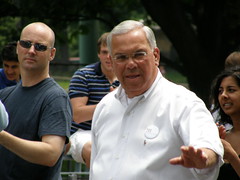
Image of Mayor Menino by Dan4th provided through a Creative Commons license.

BC Neighbors Forum: Public Meeting Monday Night at 7:00 pm

Boston College Neighbors Forum:
Public Meeting to Discuss BC's Master Plan

Monday, June 30th, 7:00 pm
Brighton Elks Lodge, 326 Washington Street

Brighton residents are invited to attend a community meeting to analyze and discuss the details of the Boston College institutional master plan. The meeting will take place on Monday, June 30th, 7:00 pm, at the Brighton Elks Lodge, 326 Washington Street, Brighton Center.

The Boston College Neighbors Forum is an unaffiliated, independent grassroots discussion group. The goal of the meeting is to build a consensus in the community on issues of common concern, and to prepare formal community feedback to BC and the City of Boston.

Public participation is strongly encouraged and all residents will be afforded an opportunity to speak as time permits. Possible topics for future meetings will be discussed.

For more information, contact Michael Pahre at 617-216-1447 or pahre@comcast.net; or visit the BC_Neighbors_Forum Google Group (membership required).

Parking is available at the rear of the building, accessed from Winship Street.


Background

BC's housing presentation to the 6/16 task force meeting can be found here (PDF), while their presentation to the 6/4 meeting (athletics) can be found here. Their full master can be found here.

Thursday, June 19, 2008

Editorials on BC's Revised Housing Proposal

The Boston Globe's editorial page is pushing for Boston College to build denser housing on the Mods site as part of their revised institutional master plan -- and as a potential compromise with the neighborhood:
There should be room to resolve such issues within the 10-year construction schedule of dorms, new academic buildings, and recreation facilities — as long as BC remains flexible. One such opportunity is on the northeast section of the lower campus, where BC wants to replace 22 dreary modular housing units with a 175-student dorm and a swath of greenspace. Enlarging the dorm and moving up the schedule for its construction could postpone the need to build dorms on the contested former archdiocese site. Such compromises would also smooth the permitting process with the city.
The Boston Herald's editorial board, however, thinks BC's plan is fine just the way it is, quoting Eva Webster from the Boston Globe's news story to support their argument.

The Allston-Brighton TAB editorial sides with the Globe, arguing that BC should consider taller dorms on its main campus to minimize housing near residential areas, but is more positive about BC's purchase of 2000 Commonwealth Avenue.

Earlier: Boston Globe editorial in December 2007 that BC has not made a "convincing case" for the Brighton Dorms on the former St. John's Seminary land; adding a few stories to proposed dormitories on their main campus and "maximizing the use of land now occupied by outmoded modular housing units" were suggested.

Also:
Mayor Thomas Menino told the Globe's editorial board in January that he wants to see the dorms built south of Commonwealth Avenue. (The Brighton Dorms would be north of Comm Ave.)

Walk for Open Space Saturday

The Allston Brighton Green Space Advocates and the Allston Brighton Community Development Corporation are hosting a "Walk for Open Space" this Saturday, June 21st at 10 am next to the Veronica Smith Senior Center.

While the walk is a fund-raising event for the ABGSA, there is no requirement to collect donations in order to participate.

There are many little "pocket" parks and urban wilds scattered across Allston-Brighton. Visiting all of them in a single walk would amount to a death march, so it is fortunate that the ABGSA has trimmed the route down to a manageable four miles. Charlie might, however, still choose to do the scenic route.

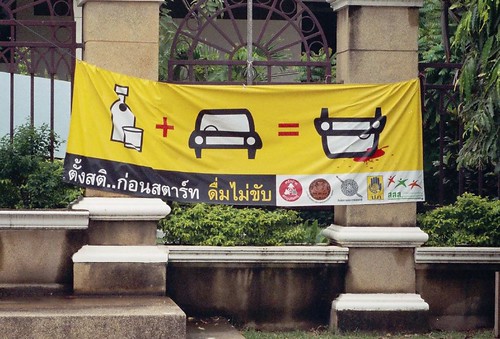
Watch Out Driving on Nonantum Road or Soldiers Field Road

The Allston-Brighton TAB reports that thirteen allegedly drunk drivers were caught last Friday night during a roadblock sting operation between 11 pm and 3 am on Nonantum Road. One driver was not just drunk but also drinking.

The roadblock was presumably on the Watertown/Newton end of the road because the arrests were made by Watertown Police, Newton Police, Middlesex County Sheriff's Department, and State Police.

A previous sting on Nonantum Road took place in July 2007, and police say that they will continue periodically to setup similar roadblocks.

Discussions are underway for a rebuild of Nonantum Road that would narrow it to two lanes and thereby institute some "traffic calming". The State Legislature last year allocated $250,000 towards initial design studies. That stretch of road will have an additional new wrinkle: the intersection for the new entrance and exit for the Community Rowing Inc.'s boathouse, currently under construction east of Daly Field.

Further east on Soldiers Field Road, at least four motorists caught speeding -- one at over 70 mph -- appeared this morning in Brighton Municipal Court, according to a Brighton resident who sat through the morning's proceedings. Not the smartest thing to do: speed on a stretch of road close to the State Police barracks in North Brighton.


UPDATE: Boston Globe article about the redesign, including an image of the fatal 2004 car crash.


Image of Thai drunk driving sign by nathansnostalgia provided through a Creative Commons license.

Tuesday, June 17, 2008

Animated and Angry Crowd Confronts Boston College's Revised Master Plan

"No dorms on Brighton Campus! Change this plan, please!" [Referring to proposed dormitories on the former St. John's Seminary land purchased by Boston College in 2004-7.]

"You're taking your problem and making it our problem!" "It's not on-campus!" [Referring to BC's purchase of the apartment building at 2000 Commonwealth Avenue, which they intend to turn into an off-campus undergraduate dormitory.]

"That's blackmail!" [Referring to attempts by Jack Dunn, BC's Director of Public Affairs, to withhold more popular elements of their master plan unless the entire plan would be approved by the city and neighborhood.]

"Build them higher!" [Referring to five-story dormitories proposed to replace the two-story Mods dormitories on BC's main campus in Chestnut Hill.]

These were repeated shouts from the audience that time and again interrupted Boston College's presentation of their revised institutional master plan Monday night at the Yawkey Center on BC's campus.

Neighborhood meetings can often be total yawners, where residents argue for hours over the smallest details of setbacks, zoning variances, brick color, and window design.

Not so on Monday night. The meeting was nothing short of a raucous affair. The air was theatrically punctuated by rapid-fire flashbulbs from two news photographers.

Thirteen months ago, Thomas Keady, Jr., Vice President for Governmental and Community Affairs at BC, said at one such meeting that he didn't enjoy getting his "head kicked in." There was little question: Monday night was more than just another head-bashing.

BC officials, Boston Redevelopment Authority project managers, and BC Task Force members struggled to keep order in a room crowded with 200-250 people who kept shouting out their anger, frustration, exasperation, and profound disagreement with the undergraduate housing proposals that BC presented as their response to the Scoping Determination on their 10-year IMP issued in February by the BRA.

The university passed a significant milestone Monday by embracing the concept of providing university-owned housing for 100% of their undergraduate students.

University officials insisted that the neighborhood's price for this achievement would be accepting conversion of an off-campus apartment building into a dormitory and construction of new dormitories for the former St. John's Seminary land. Many neighborhood residents disagreed strongly with both premises, insisting that the solution lies in constructing more and/or taller dormitories on BC's main campus in Chestnut Hill.


BC Proposes 100% Undergraduate Housing -- But Some Will Be Off-Campus in the Neighborhood

Keady explained to the audience that there were two major changes to their undergraduate housing proposal.

First, he confirmed that approximately three weeks ago BC entered into a purchase and sale agreement to buy the 17-story apartment building at 2000 Commonwealth Avenue. While Keady claimed the purchase was "one of the worst-kept secrets in Allston-Brighton," many residents of nearby buildings spoke -- or shouted -- that they knew nothing about it until the last few days. "I haven't heard anything about it," said a resident of nearby 1988 Comm Ave.

The obvious reason why they hadn't heard about the purchase? The story broke a month ago online, but was not picked up by the mainstream media -- in part because BC officials refused to speak about the topic at two neighborhood meetings earlier this month.

Second, BC was now presenting a plan that would house 100% of their undergraduates in university-controlled housing -- some of which would be that new building at 2000 Comm Ave. "It's not on-campus!" came the audience replies.

It was this second point that was met with repeated, yet measured, praise from many in the task force and audience.

"The fact that this is now BC's goal is a huge achievement, because it has been the neighborhood's goal for about 15 years," said task force member Paul Berkeley.

"I applaud the 100%" target for undergraduate housing, said task force member Kevin Carragee. He gave his biggest praise to the residents, however, who kept pushing for the goal. "I want to thank the people who have been at these meetings for 15 years," he said.

Radnor Road resident Bruce Kline summarized the meeting at the end, saying that, aside from the addition of 2000 Commonwealth to their plan as a new undergraduate dormitory, the plan "is basically the same" as before.

Kline appeared accurate in his observations. In this revised plan, BC only added 110 additional beds to their main campus -- while many in the neighborhood wanted them to add between 500 (to move all the beds in the Brighton Dorms to the main campus) to 1450 (to house all their undergraduates in on-campus, rather than in off-campus, university-controlled housing).

The BRA required BC to explore two alternate studies for housing 500 additional undergraduates on their main campus, which would eliminate the need for dormitories on the former seminary land. BC's presentation offered no fundamental impediments uncovered by either study, yet rejected both in favor of a plan that was only slightly changed from the IMPNF -- and kept the Brighton Dorms in nearly the same configuration and size as before.

"I'm a little perplexed about the consideration of options," said task force member Tim Schofield. "It did sound like [the other two options] were feasible."


2000 Comm Ave: BC Official Tries Unsuccessfully to Play One Neighborhood Against Another

A significant number of residents in buildings near to 2000 Comm Ave attended Monday's meeting and expressed their displeasure with BC's pending purchase of the property.

"It's going to lower the quality of life in the neighborhood," said Lamya Shahabuddin, a board member of the building at 1933 Comm Ave. "When we bought those condos, we didn't sign up to live on campus."

Even BC Professor of Mathematics Mark Reeder, also a board member at 1933 Comm Ave, expressed his opposition to the purchase. "BC is trying to transfer their problem [to be] Brighton's problem," he said, in apparent reference to the difficulties in controlling student behavior.

One of BC's explanations for the basis of their housing plan was to create more open space on their main campus by moving some uses, such as student dormitories, further away onto the Brighton Campus -- or now at 2000 Comm Ave. "Not enough wild grass [for students] to play in?" said Reeder. "That's BC's problem, not Brighton's problem."

Keady had suggested earlier in the evening that converting the building to undergraduate dormitories was something that the neighbors of the Radnor Road, Lane Park, and Kirkwood Road area were supporting.

Lane Park resident Sandy Furman only partially backed him up. Furman said that, if faced with competing options of students in houses versus students in 2000 Comm Ave, he would choose the latter. "But it doesn't have to be that way," he said, indicating that BC had other options available, such as taller buildings on their main campus.

Shelby Marshall, Furman's Lane Park neighbor, indicated that the apartment building is already 40% occupied by BC students, which Nick Fondas, another Lane Park resident, speculated might otherwise tip over to 75-80% student-occupied within a few years. "I would rather it be a supervised than unsupervised dorm," said Marshall.

Other residents wanted nothing of Keady's attempts to pit the Radnor Road/Lane Park neighbors against those on Commonwealth Avenue. "I resent that BC would play the Radnor Road neighbors against 2000 Comm Ave," said Kirkwood Road resident Lisa Lieberman to audience applause.


"We Are Now in a Question Of How"

Task force member Kevin Carragee said these words to describe how the debate between the neighborhood, BRA, and BC was no longer focused on whether or not BC should house 100% of their undergraduate students. The discussion has now switched to where those dormitories should be located -- i.e., "how" to achieve the agreed-upon goal of full housing.

In short: location, location, location.


Repeated Neighborhood Proposals for a Tall Dormitory on Mods Site

Carragee continued with his proposed solution: "Why not go high on the Mods site?" He referred to the location of the two-story Mods dormitories, constructed as temporary housing in the 1970s -- yet eleven of those buildings would still be standing in 2019 in BC's proposed plan.

In the strangest recurring theme of the evening, Keady didn't answer Carragee's question. When asked if he was going to answer it, Keady simply replied, "No."

Shouts from the crowd requested him to answer, but more silence followed. Later questions by the audience repeatedly brought up the same question, demanding an answer -- any answer at all -- but still drew no response from Keady.

Jack Dunn, BC's Director of Public Affairs, eventually stood up out of his front-row seat, grabbed a microphone, and answered the question. "The issue for us is an issue of density," he said. "Our conclusion was that 4700 students in 40 acres [on the main campus] was the limit."

Dunn remained standing next to the podium. Every time the same question resurfaced, he repeated the same answer, and Keady stood by watching. Dunn's stock answer began to be met by laughter from the crowd.

Falkland Street resident Donal Carroll offered a comeback, noting that BC has paid its consultants probably hundreds of thousands -- if not millions -- of dollars to draw up the designs for the master plan. "If you're unable to house 12 extra individuals per acre on a 40-acre site," he said, then BC probably needs to find some different consultants, you know, to get their money's worth. Laughter ensued, drowning out Carroll's words.

One resident went to the projected map on the screen and demonstrated how small a footprint the 17-story building at 2000 Comm Ave would form if an exact, duplicate copy were constructed on the Mods site.

A version of his visual is displayed here to the right. The 2000 Comm Ave apartment building footprint is the small, gray, L-shaped building above and to the right of the proposed, new recreation center (building #19).

The implication is clear: very little green space on their main campus would be sacrificed to put 560 beds of undergraduate housing in such a building. BC could still have their wide-open main campus.


Are BC Officials Themselves Exhibiting NIMBY-ism?

In watching the meeting unfold, I couldn't help but think: if BC would agree to build such a dormitory at the Mods site on their main campus instead of the Brighton Dorms, they might very well be able to convert heavy neighborhood opposition against their housing proposals into broader support.

But, for some reason, at least one BC official on Monday night was persistently refusing to consider the option of constructing such a building on their own campus.

Several months ago, BC's Dunn resorted to name-calling by labelling neighborhood opponents of the Brighton Dorms as holding a position that amounts to "NIMBY-ism" (Not In My Back Yard).

Have the tables now turned?

When BC decided to pursue purchasing 2000 Comm Ave, they probably viewed it as a tactical victory that would curry favor from the city and quiet down neighborhood opposition to their plans in the near term.

Once BC showed their hand by expressing interest in purchasing 2000 Comm Ave -- with the intention to convert it into an undergraduate dormitory -- they stumbled into what I can only see to be a vast, strategic blunder on their part.

If such a tall building is a perfectly acceptable dormitory for their students off-campus, then they have implicitly accepted the proposition that it is an equally acceptable model for a dormitory on-campus. But BC officials are racked by inconsistency. They want the tall dormitory in the neighborhood, but they don't want an equally tall dormitory on their own campus.

Is the rejection of a tall dormitory on the main campus an act of NIMBY-ism on the part of BC officials?


The Silent Type

While Keady's silence on the issue of a tall dormitory was noticeable, somebody else's silence probably escaped the notice of most Brighton residents.

Patrick Keating, BC's Executive Vice President, who is in charge of long-range planning for the university, attended Monday's meeting of the BC Task Force. It is the first time I have ever seen him in attendance at a meeting of the task force.

I have long wondered how the neighborhood opposition to key elements in BC's undergraduate housing plan filters through the usual attendees from Governmental and Community Affairs (and Public Affairs) to the top university officials in charge of making decisions on the long-range plan, i.e., Executive VP Keating and Fr. William Leahy, S. J., President of BC. Do the intermediaries down-play residents' opposition? Do the absent executives not believe in the neighborhood opposition because they don't hear it first-hand?

Even though Keating was completely silent throughout the meeting, there was no filtering of the neighborhood's positions on the issues. Keating heard every shouted word himself.

Leahy, however, did not. He issued a press release instead, saying that the plan is:
“a manifestation of BC’s desire to be a good neighbor by taking students out of the neighborhood and providing increased stability for local residence [sic], while also addressing Boston College’s most pressing needs.”

Mainstream Media Pick Up the Story

The Boston Globe has a brief story up about BC's revised plan; a longer story is here. Monday's meeting occurred after their deadline, so it is not mentioned. WBZ radio has an audio story on the revised proposal which quotes Dunn but fails to pursue any alternative viewpoints. Boston Herald reporters have now been seen in Brighton for the first time covering the BC student housing story; they appear to have later deadlines than the Globe.


UPDATE: Allston-Brighton TAB makes reference to the mayhem. The Herald had a second story the following day which focused on the meeting. (The first article focused on BC's press release.) Expect a story from the Boston Bulletin later this week.

UPDATE: Here's the Bulletin story.


Image of shouting woman from ronsho provided through a Creative Commons license.